Israeli Farmer Revives the Biblical Balm Of Gilead And Third Temple Incense
 By Adam Eliyahu Berkowitz/Israel 365 News August 31, 2023
Share this article:
One very special farmer in the Holy Land is raising rare and endangered plants in an effort to bring back the Biblical Balm of Gilead and the Temple incense.
In 2008, Guy Ehrlich was driven to recreate the Biblical Balm of Gilead, renowned for its healing properties. Incredibly rare even in Biblical times, growing only in the extreme heat and saline soil of the Dead Sea area, it disappeared from the region in the sixth century. A German scientist smuggled a single shoot out of Saudi Arabia, and some plants were at the Botanical Garden in Jerusalem.
Unfortunately, the climate of Jerusalem was too cold for the desert-loving plants. Fortunately, before they all died, the garden sent some to Dr. Elaine Solowey, director of the Center for Sustainable Agriculture at Kibbutz Ketura. She provided Ehrlich with a beginning for his six-acre Biblical farm. The plants thrived in the Dead Sea climate, and his farm now has about five thousand balsam plants.
His passion for this semi-mythical balm led him to name his farm after it: the Balm of Gilead Farm. Today, his Balm of Gilead Farm has the world's largest private collection of Biblical plants.
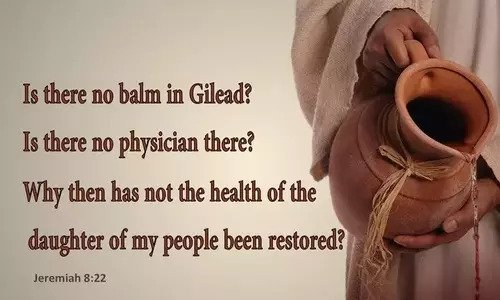
Its healing properties were first hinted at by the Prophet Jeremiah:
Is there no balm in Gilead? Can no physician be found? Why has healing not yet Come to my poor people? Jeremiah 8:22
But Guy insists that he is not religious.
"I am a Jew, and we know that when the Jews are in Israel, the desert blooms," Ehrlich told Israel365 News. "The Temple just happened to be part of that. The incense was part of that."
It is believed that the Balm of Gilead was so important that the Bible referred to it simply as generic by the generic names 'balm,' or, in Hebrew ẓori צֳרִי or 'perfume' (bosem בֹּשֶׂם).
As such, it is believed by some Biblical commentators to have been carried by the caravan that received Joseph from the pit (Gen. 37:25). When Jacob dispatched his embassy into Egypt, his present to the unknown ruler included "a little balm" (Gen. 43:11). Balm was one of the commodities which Hebrew merchants carried to the market of Tyre ( Ezekiel 27:17) and, according to 1 Kings 10:10, balsam was among the many precious gifts of the Queen of Sheba to King Solomon.
The balm was made from the tree known scientifically as Commiphora gileadensis. The sap of the balsam tree is released by cutting the bark.
"I focus on plants that few other people in the world cultivate. That's how I have a chance to succeed in the years to come," he said. "These are also very important plants, and if they're not cultivated, they'll disappear."
In the later days of Jewish history, the neighborhood of Jericho was believed to be the only spot where the true balsam grew, and the Talmud notes that its main use was medicinal rather than cosmetic. After King Josiah hid away the holy anointing oil, balsam oil was used in its stead. The Talmud (Avodah Zarah 3:1) states that in the messianic era, the righteous will "bathe in 13 rivers of balsam."
In Roman times, it was grown only in Jericho and Ein-Gedi, and it generated much revenue both for the Hasmoneans and King Herod. The Muslim conquest brought an end to its production.
The New Testament describes Mary, the mother of Jesus, receiving gifts of frankincense, myrrh, and gold from the Three Magi. Some others argue that the gold presented is really the Balm of Gilead as it was more valuable than gold. It was significant as it was used as anointing oil by Israel's Kings during the period of the Second Temple.
Ehrlich now cultivates around 60 biblical plants on his farm near Almog in the Jordan Valley, near the northwestern shores of the Dead Sea. He creates creams, perfumes, soap, and honey.
Ehrlich's is the only farm in existence that cultivates Boswellia trees, an endangered species that is the source of the frankincense that constituted one of the eleven ingredients of the Temple incense. The Boswellia tree is in danger of extinction and has no agricultural cultivation anywhere else in the world except on Ehrlich's farm. Top-grade frankincense can sell for hundreds of dollars per pound.
Ehrlich also cultivates myrrh.
His trees have been certified by the Temple Institute for use in the Third Temple, which want to make sure the raw materials of the incense will be available when the Temple is rebuilt.
His online store offers Myrrh and Frankincense oil, Balm of Gilead essential oil, Balm of Gilead perfume, incense to be used for the Havdalah ritual, First Temple anointing oil, Second Temple anointing oil, and even Third Temple anointing oil. It is also possible to sponsor Biblical trees. He produces premium honey from the trees that sells for $1,000 per kilogram. He also produces a perfume he touts as "the scent used by Cleopatra".
But his efforts to revive Biblical agriculture have been hampered by modern politics. One company that partnered with him at first pulled out after pressure from the Boycott Divestment Sanctions (BDS) movement.
Originally published at Israel 365 News - reposted with permission.