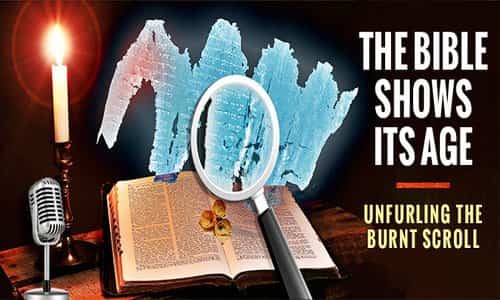
The Bible Shows Its Age: Unfurling the Burnt Scroll
 By Eric Metaxas/Breakpoint.org September 29, 2016
Share this article:
How do you read a scroll you can't open? Modern technology provides the answer, and shows that Scripture is more durable than the material it's written on.
Is the Bible we read today the same Bible that was written millennia ago by prophets and apostles? That was a question that consumed scholars for generations. You see, prior to 1947, the earliest manuscript copies of the Old Testament were from the Middle Ages. Critics seized on this as a major hole in the Bible's reliability.
How, they asked, could we trust a text that had been copied hundreds of times in the thousands of years since its authors wrote it? Surely it had suffered corruption through all those duplications.
But seventy years ago, a Bedouin shepherd boy shattered those doubts when he threw a rock into a cave, breaking some clay pots containing the Dead Sea Scrolls.
These ancient manuscripts of the Old Testament were near matches to the medieval text, confirming our modern Bible's antiquity and pushing the earliest known evidence for the Hebrew Scriptures back a millennium.
Now, thanks to another discovery on the shores of the Dead Sea, and an exciting technological breakthrough, that date has moved back even further.
This story begins in 1970, when archaeologists at En-Gedi found a burnt scroll that was little more than a lump of charcoal. A fire in 600 AD had destroyed the synagogue there, leaving its ancient documents so brittle that a touch would cause them to disintegrate.
Unable to read the scroll, curators merely preserved it, hoping that someday, the technology necessary to peek at its contents would be developed.
Well, that day has arrived. The New York Times reports that computer scientists at the University of Kentucky partnered with biblical scholars in Jerusalem to pioneer a technique for "unfurling" this badly-damaged scroll.
Thanks to traces of metal in the ancient ink and a new method for reconstructing 3-D surfaces, known as "volume cartography," these scientists were able to read the charred parchment, without ever opening it.
The results were stunning. Dr. Michael Segal of the Hebrew University in Jerusalem marveled: "Much of the text is as readable, or close to as readable as actual unharmed Dead Sea Scrolls."
That text is the first two chapters of Leviticus--ironically, a set of instructions for burnt offerings to the Lord. But what's really amazing is that the fragment is identical--letter for letter--to the Masoretic text that forms the basis of modern Old Testament translations.
And how old is this incredibly accurate copy? Experts in Hebrew paleography say the script style strongly suggests an origin in the first century A.D., around the time of Christ. And that, reports the Times, would make it the oldest fragment of the Hebrew Pentateuch--aka, the first five books of the Bible--ever discovered.
"Never in our wildest dreams did we think anything would come of it," said Pnina Shor, head of the Dead Sea Scrolls Project at the Israeli Antiquities Authority.
Yet despite being burnt itself, this chapter about burnt offerings is now as visible to us as it was to the scribe who copied it two-thousand years ago.
Folks, the Bible we have in the twenty-first century has been providentially--one might even say miraculously--preserved against the ravages of time.
And with each discovery of an older manuscript, it becomes clearer that what we hold today is the same word that God inspired thousands of years ago--no matter what it's written on. If I may paraphrase Isaiah, parchment smolders and papyrus flames, but the word of our God endures forever.
Originally published at Breakpoint.org - reposted with permission.