The Right/Left Divide Between Israeli And American Jews
 By PNW Staff October 05, 2016
Share this article:

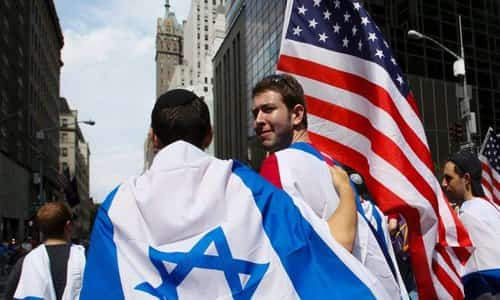
There is no doubt that Jewish communities in the United States and Israel hold an affinity for each other. This unique form of national bond crosses political and geographical boundaries and links the two populations.
In a striking demographic parity, survey data show that 43% of American Jews have visited Israel and approximately the same portion of Israeli Jews has visited the United States.
Yet despite the friendliness of the two communities, Israeli Jews tend to be more conservative while their American counterparts favor the liberal side of the spectrum. A recent survey conducted by the Pew Research Center and headed by Neha Sahgal examines these divided beliefs.
This division can be seen clearly in their support of Democratic candidates over Republicans in American politics, despite the Republican party's history as the party with stronger religious ties and its steadfast pro-Israel stance.
The division between the Israel and American Jewish communities can also been seen in their core political beliefs which not only put them on both sides of the political spectrum but also demonstrate other influential factors in the creation of two distinct value systems.
Among American Jews, the belief that a Palestinian state can co-exist in peace with Israel sits at a hefty 61% whereas only 43% of Israeli Jews hold this belief. Likewise, Sahgal found that Israeli Jews believe at a rate of 52% that America is not supporting enough of Israel while only 31% of American Jews believe this.
Perhaps it is only natural that those providing the support believe that they are doing enough while those in Israel who can see the needs in Israel first-hand believe that the support is insufficient, but a similar divide can be seen on some issues of security and economics as well.
Among the sharpest political divides is the belief held by 43% of Israeli Jews that Judea and Samaria are important components of Israel's strategic protection, a belief that compares to only 17% of American Jews who agree.
According to the Pew Survey, social and religious issues were identified as the central issue facing Israel by 14% of Israeli Jews and 18% of American Jews. Meanwhile, 38% of Israeli Jews pointed to security threats as the most significant problem and 39% to economic issues.
It is little wonder that a conservative viewpoint that emphasizes individual hard work, traditional beliefs, security and an emphasis on religious values would hold the majority in Israel whereas the liberal party in the United States can find more common ground with the message of inclusion and pluralism, which can be appealing to a philanthropic Jewish community in America.
Stephen Cohen of Hebrew Union College describes has described the division as a "red" state of Israel and a "blue" nation of the United States, borrowing the nomenclature in use in America. The exception to this red/blue dynamic has been the Orthodox Jewish community in the United States, which comprises about 10% of the US Jewish population.
The Orthodox community had been staunchly conservative until cracks began to appear in this election cycle with the candidacy of Donald Trump.
Some surveys indicate that the shift away from the right for the Orthodox could be the result of a rejection of what is perceived as the common Trump supporter while other theories point to a repudiation of the moral character of Trump himself, despite his familial ties to the Jewish community through his daughter.
Campaign contributions in the 2016 election cycle provide an incredible amount of insight into the Jewish view of and influence on politics in the United States. As reported by Gil Troy of McGill University in Canada, nearly 50% of Clinton's donations have come from Jewish contributors, though other later reports show that this percentage has now fallen slightly as other deep pocketed donors have thrown their hats into the ring.
Regardless, the outsized influence of such a politically influential group should not be underestimated, even if the Jewish population is only 2% of the total US population. Troy's data indicate that as much 25% of the money raised from Republican campaigns has also come from Jewish donors.
Another key factor in providing the Jewish community with a strong political voice is the concentration in key swing states such as Florida, Michigan, Ohio and Pennsylvania.
There is no doubt that a group that votes at a higher rate, that donates at a higher rate and that resides in strategic election swing states is going to have the power to sway elections and, now, this influence is leaning ever stronger towards liberal candidates in the United States elections.
Obama won between 70% and 73% of the Jewish vote in the last election and polling by McGill shows Clinton on track to repeat or even beat those numbers, despite the continued support for Trump by 56% of the Orthodox Community.
Some speculate that the depiction of Trump's base as overtly nationalist may have pushed the American Jewish community further into a liberal identity and widened the political division between Israel and the United States.
Though the two countries' Jewish communities may be divided on several key issues, there is still significant common ground. With such significant contact at all levels, only time will tell which view, red or blue, wins out in the end between Israel and the United States.