Algorithm Of Truth - Lie Detection Robot Coming Soon
 By PNW Staff January 05, 2017
Share this article:

Traditional lie detector machines function based on the premise that the natural anxiety of lying will cause variations in blood pressure, pulse, respiration and skin conductivity. People trained to detect lies, on the other hand, look for micro-expressions that indicate anxiety.
A movement of the eyes, lifting one corner of the mouth, and even a barely perceptible movement of fingers and toes. Now a machine called AVATAR is capable of detecting lies by analyzing a person's facial expressions, voice changes and body language reactions, all with a video camera.
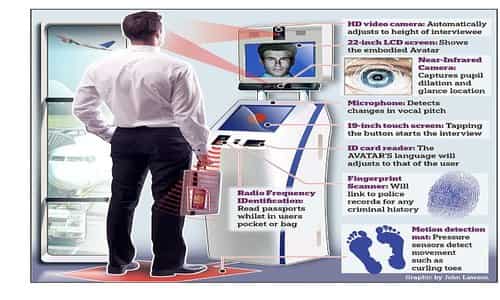
The machine, Automated Virtual Agent for Truth Assessments in Realtime (AVATAR), is designed as a kiosk. Developed in 2012 by the University of Arizona, it has seen significant advances since that time and is now being considered for implementation by the Canadian Border Services Agency.
If AVATAR is successful, it is almost certain to be adopted by both employers and law enforcement agencies around the world.
Similar to the kiosks that some international airports use to scan passports and screen travelers about the details of their trip before seeing a Customs official, the AVATAR kiosk is configured to ask several simple, baseline questions before testing for truthfulness.
Interacting with a video image of a head on the screen, the subject stands on a pressure pad that is precise enough to detect when a person's toes curl inside their shoes.
Voice, gestures and facial expression are analyzed in real time as the system asks about the subject's intentions and their possession of contraband.
Developed by Dr. Aaron Elkins, the system automates, with superhuman accuracy, the age-old human way of detecting lies that doesn't require any physical contact apart from standing on a pressure pad, unlike a traditional lie detecting machines.
Polite and bilingual, the machine doesn't need more than a few seconds to feed a set of reactions through its algorithms and flag a lie.
The questions, "Are you traveling to New York?" or "Are you older than 18?" are easily verifiable truths, but the questions "Are you carrying any agricultural products? Are you bringing any weapons?" are questions that look for reaction anomalies. For airports, this could add a quick level of extra security to the security screening process, but what of its applications elsewhere?
What human resource department wouldn't like a machine capable of determining if applicants were lying about their work experience, education or criminal backgrounds? What police department wouldn't like the ability to detect lies in an interview without the use of a traditional polygraph?
It was its creator, Dr. Elkins who said, "We've come to realize that this can be used not just for border security, but also for law enforcement, job interviews, and other human resource applications as well."
Since the system uses little more than a precise video camera and complex artificial intelligence, there is little reason to suspect that the law would require consent to be given beyond that already needed for a police interrogation.
We all lie, whether they are white lies with good social intentions or more serious lies that attempt to hide guilt. But that may soon be a thing of the past.
Dr. Elkins went on to say, "We continue to make improvements, such as analyzing the collected data using Big Data analysis techniques that make AVATAR a potentially valuable tool across many industries." He claims the system is fully ready to enter service.
Systems like AVATAR are set to weed out a few of those lies at the airport, but also present those in power with another tool of surveillance and control.
The right against self-incrimination, a bedrock of the American justice system, may not last long against the relentless advancement of robotic systems like AVATAR when your every gesture, facial expression and change in the pitch of your voice betrays your guilt.
Even AVATAR, however, cannot compare with that Great Day when the Ancient of Days shall sit, and the books will be opened, "For God shall bring every work into judgment, with every secret thing, whether it be good or whether it be evil." (Ecclesiastes 12.14)