
The Robot Soldier Is No Longer Science Fiction
 By PNW Staff June 02, 2026
Share this article:
For decades, the idea of humanoid robots fighting wars belonged to the realm of science fiction. Hollywood filled our screens with mechanical armies, autonomous killing machines, and futuristic battlefields where humans struggled to maintain control over the technologies they had created. Movies such as The Terminator, Robocop, and The Matrix were entertaining precisely because they seemed so distant from reality.
That distance is shrinking faster than most people realize.
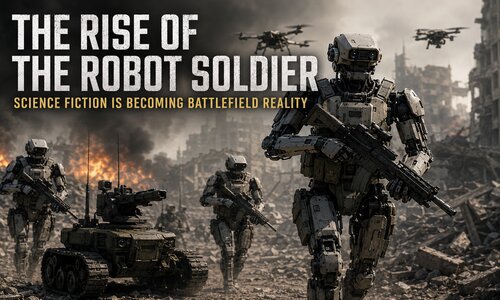
According to a report from Popular Mechanics, humanoid robots are now moving from research laboratories and industrial warehouses onto actual battlefields. What once seemed like fantasy is rapidly becoming military doctrine.
The implications are enormous.
Ukraine's 2024 all-robot assault may one day be remembered as a historic turning point. The operation involved wheeled and tracked robotic systems equipped with machine guns and explosives conducting combat missions without direct human participation on the battlefield. While the technology had limitations, it demonstrated something revolutionary: warfare was beginning to separate the soldier from the fight itself.
Now attention is shifting toward humanoid robots capable of moving through environments traditionally reserved for human infantry.
The Phantom MK1, developed by Foundation, stands nearly six feet tall and weighs 176 pounds. Unlike traditional ground robots that struggle with stairs, doorways, debris, and urban obstacles, humanoid designs can navigate environments built for human beings. They can enter buildings, climb stairwells, move through rubble, and potentially perform many of the same tasks currently assigned to soldiers.
Military planners are paying close attention.
The U.S. Army is reportedly evaluating these systems for breaching operations--among the most dangerous assignments in warfare. Minefields, fortified positions, tunnels, and kill zones often produce horrific casualties. A robot that can carry explosives, clear obstacles, absorb enemy fire, and open pathways for advancing troops offers an obvious military advantage.
From a purely tactical standpoint, the logic is difficult to ignore.
Why send a soldier when a machine can do the job?
That question is likely to drive military spending for decades to come.
But today's battlefield robots are only the beginning.
Around the world, nations are already investing heavily in artificial intelligence, autonomous drones, robotic vehicles, machine learning, computer vision systems, and battlefield networking technologies. The United States, China, Russia, Israel, and several European powers are racing to gain an advantage in what many experts view as the next great military revolution.
The battlefield of the future may look radically different from today's wars.
Imagine swarms of thousands of drones coordinating attacks simultaneously. Picture robotic infantry advancing without fear, fatigue, hunger, or morale problems. Consider autonomous logistics systems delivering ammunition and supplies without drivers. Envision robotic medics evacuating wounded soldiers while AI systems identify targets faster than any human commander could.
Much of this technology already exists in primitive form.
The question is no longer whether it can be developed.
The question is how quickly it will mature.
What makes humanoid robots particularly significant is that they represent a bridge between machines and traditional soldiers. Drones dominate the skies, but humanoid robots could eventually dominate the ground. They are designed to operate in human environments because our cities, buildings, tunnels, roads, and infrastructure were built for human bodies.
A robot that can run, climb, jump, open doors, carry equipment, and use tools has enormous military potential.
Future versions may be stronger than humans.
They may be faster.
They may possess perfect night vision.
They may communicate instantly with every other robotic unit on the battlefield.
They may never experience fear.
They may never need sleep.
And unlike human soldiers, they can be mass-produced.
This is where the conversation becomes more unsettling.
Military experts today emphasize that these robots remain under human control. Human operators make the decisions. Human commanders authorize the missions. Human beings remain responsible for lethal force.
For now.
History suggests that military technologies rarely remain static.
The same arguments once used for remotely piloted drones are now being used for autonomous systems. Advocates point to efficiency, reduced casualties, faster decision-making, and operational advantages.
But as artificial intelligence continues to advance, pressure will inevitably grow to give robots increasing levels of autonomy.
After all, if an AI system can identify threats faster than a human operator, military planners will ask why they should slow the process down.
If autonomous systems outperform human-controlled systems in combat, competitors will feel compelled to follow.
This creates a dangerous technological arms race.
What begins as human-controlled robots could gradually evolve into increasingly independent battlefield systems making life-and-death decisions at machine speed.
That possibility has prompted warnings from scientists, ethicists, military leaders, and technology experts alike.
The images from science fiction may not be as unrealistic as they once seemed.
No, tomorrow's battlefields are unlikely to feature time-traveling cyborg assassins. But armies of AI-enabled robotic soldiers working alongside human forces are becoming increasingly plausible with each passing year.
The technological pieces are falling into place.
Artificial intelligence continues advancing at breathtaking speed. Robotics improves every year. Sensors become smaller and more capable. Batteries last longer. Computer processing grows more powerful. Military budgets continue pouring billions into these technologies.
The trajectory is unmistakable.
The broader lesson extends beyond warfare.
Humanity is entering an age in which machines increasingly perform tasks once considered uniquely human. The battlefield may simply be one of the first places where that transformation becomes visible.
The challenge facing future generations may not be whether humanity can build robotic soldiers.
It may be whether humanity possesses the wisdom to control them.
As artificial intelligence and robotics continue their rapid advance, one thing is becoming clear: the line between science fiction and reality is disappearing. What seemed impossible twenty years ago is being tested today. What seems futuristic now may become commonplace tomorrow.
And the robot soldiers once confined to movie screens may soon be marching onto battlefields around the world.