
AOC's Awkward Reality Check: The Truth About Islam And Women's Rights
 By PNW Staff May 30, 2026
Share this article:
The viral videos were difficult to miss.
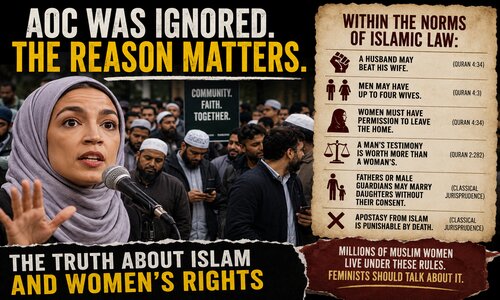
Rep. Alexandria Ocasio-Cortez, one of America's most prominent progressive politicians and outspoken defenders of Muslim communities, appeared at a Muslim cultural gathering wearing a hijab and addressing the crowd. Yet what captured attention online was not what she said. It was how many in the audience appeared to respond. In several widely circulated clips, groups of men seemed largely uninterested, continuing conversations among themselves or appearing to ignore the congresswoman altogether.
The optics were striking. Here was one of the leading voices of modern feminism standing before a crowd where many men appeared to treat her as background noise.
For many observers, the moment exposed a contradiction that Western progressives have spent years trying to avoid.
Progressive activists frequently portray criticism of Islamic teachings regarding women as intolerant or bigoted. Yet they routinely condemn similar views when expressed by conservative Christians, traditionalists, or political opponents. The result is a glaring double standard that becomes harder to ignore with each passing year.
The reality is that many of the world's most restrictive laws regarding women exist not in Western democracies but in nations governed by traditional interpretations of Islamic law.
Afghanistan provides perhaps the clearest example.
When the Taliban returned to power in 2021, its leaders assured the world they would respect women's rights "within Islamic law." Many Western media outlets cautiously welcomed the statement. Five years later, the reality has become painfully clear. Women have been largely removed from public life, educational opportunities have been drastically restricted, and human rights organizations continue to raise alarms about forced marriages and the treatment of women under Taliban rule.
The issue extends beyond Afghanistan. Reports from various parts of the Islamic world continue to reveal debates surrounding child marriage, women's legal status, guardianship laws, and unequal treatment under traditional interpretations of Sharia. Critics point to examples from Afghanistan, Pakistan, Nigeria, Saudi Arabia, and elsewhere where influential clerics have defended positions that would be considered unacceptable throughout most of the Western world.
The problem for modern progressives is that many of these issues are not merely cultural practices found in distant countries. They arise from longstanding interpretations of Islamic law itself.
While Muslims disagree over how such texts should be understood and applied today, traditional Islamic jurisprudence contains teachings that would trigger outrage if they appeared anywhere else. Under classical interpretations of Sharia, a husband may discipline his wife physically, women face restrictions that men do not regarding marriage, and a man's testimony can carry greater legal weight than that of a woman. Traditional rulings have also permitted polygamy for men while prohibiting it for women.
Some classical legal manuals further state that a woman requires the permission of her husband in various aspects of public life, while fathers and male guardians possess authority over family matters that mothers do not. Inheritance laws often provide daughters with smaller shares than sons, and in some traditional interpretations, a woman who leaves Islam can face severe legal penalties under an Islamic state.
Critics further point to teachings found in traditional Islamic jurisprudence that allow men greater authority within marriage, restrict Muslim women from marrying outside the faith while allowing Muslim men to marry Christians and Jews, and place women under systems of male guardianship.
Human rights organizations have also raised concerns regarding the treatment of women in countries where strict forms of Sharia are enforced, including issues surrounding custody rights, forced marriages, female genital mutilation, and honor-based violence.
These are not fringe accusations invented by critics. They are found in centuries of Islamic legal literature and remain defended by influential clerics and scholars across parts of the Muslim world today.
Perhaps nowhere is the contradiction more obvious than on the issue of child marriage.
Prominent Islamic scholars in multiple countries have historically argued that Islamic law does not establish a fixed minimum age for marriage. Human rights organizations have documented how such interpretations continue to influence legal systems in parts of the Muslim world.
The debate exists because these issues are not inventions of Islam's critics. They are subjects of active discussion within the Islamic world itself.
Yet Western progressives often seem reluctant to acknowledge the debate at all.
Instead, criticism is frequently dismissed as prejudice.
This unwillingness to engage honestly with difficult questions ultimately harms the very women progressives claim to champion.
Women living under oppressive interpretations of Islamic law do not need Western activists pretending the problem doesn't exist. They need allies willing to speak openly about the challenges they face.
That includes women in Iran who have risked imprisonment by removing mandatory head coverings.
It includes Afghan women barred from educational opportunities.
It includes reformers across the Muslim world who are pushing for greater freedom despite enormous pressure from religious authorities.
Ironically, many of these women display more courage than the politicians and activists who claim to represent them.
The scene involving AOC may ultimately be remembered for more than a few awkward viral videos. It served as a reminder that alliances built on political expediency often collide with reality.
Progressives have spent years insisting that every culture shares the same assumptions about gender equality. The evidence increasingly suggests otherwise.
The question now is whether they are willing to acknowledge it.
Because genuine concern for women's rights requires consistency. If inequality is wrong, it is wrong regardless of who promotes it, what language it is spoken in, or what religion claims to justify it.
The question is whether feminists will apply the same standards to every belief system. If equality truly matters, then silence regarding teachings that place women in a subordinate position is not courage. It is selective activism.
Anything less is not feminism.
It is politics.