Literally Eating Scripture - Prophetic Ministry Overreach?
 By PNW Staff May 29, 2026
Share this article:
There is no shortage of strange stories emerging from modern charismatic circles, but every so often one comes along that forces Christians to ask a difficult question: At what point does a prophetic act stop being biblical symbolism and become theological confusion?
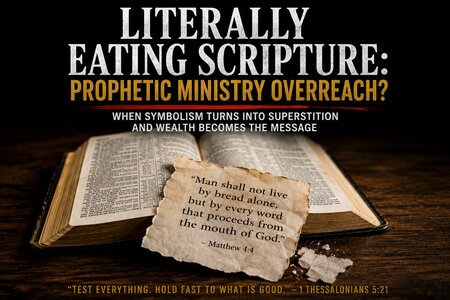
That question is now being asked after a prophetic conference in West Virginia where longtime minister Kevin Leal instructed an 18-year-old young man to literally tear a page from the Book of Proverbs, chew it, and swallow it. The act followed a series of prophecies declaring that the teenager, Ethan Soucy, would become a wealthy "kingdom businessman" and future millionaire who would fund ministries around the world.
According to reports, Leal told the young man that after eating the page, "the power of God is going to go inside of you."
The scene immediately generated criticism from Christians across multiple denominations, and for good reason.
While defenders of the event point to biblical examples where prophets were instructed to eat scrolls, a closer examination reveals that what happened on that stage bears little resemblance to what Scripture actually teaches.
The Scrolls Of Ezekiel And John
Supporters often cite the experiences of the prophet Ezekiel and the Apostle John.
In Ezekiel 3, God commanded Ezekiel to eat a scroll before delivering His message to Israel. Likewise, in Revelation 10, John was instructed to eat a scroll that was sweet in his mouth but bitter in his stomach.
These passages were never intended to establish a ritual for receiving divine power.
The symbolism was clear. God's Word was being internalized. The prophet was receiving and absorbing God's message before proclaiming it to others.
Neither Ezekiel nor John was told that supernatural power would enter their bodies through the physical consumption of paper.
Neither passage involved promises of financial prosperity.
Neither passage suggested that wisdom could be obtained by literally swallowing parchment.
The Bible consistently teaches that wisdom comes through fearing God, studying His Word, obeying His commands, and being led by the Holy Spirit--not through symbolic rituals performed as if they possess power in themselves.
"The Power Of God Will Go Inside You"
Perhaps the most troubling statement from the event was not the eating itself but the explanation given for it.
"When you eat this, the power of God is going to go inside of you."
That statement introduces a concept foreign to biblical Christianity.
The New Testament teaches that believers receive the Holy Spirit through faith in Jesus Christ. God's power is not transmitted through objects, paper, rituals, or ceremonial acts.
This begins to resemble a form of spiritual superstition--treating a physical object as though it possesses inherent spiritual power.
Throughout church history, Christians have repeatedly battled similar errors.
Whether relics, charms, blessed objects, magical formulas, or mystical rituals, the temptation has always been the same: replacing faith in Christ with confidence in a physical act.
The Apostle Paul warned against such thinking repeatedly. God's power is not manipulated through ceremonies. It is received through God's grace and operates according to His will.
The Prosperity Problem
The second major concern is the context surrounding the event.
This was not merely a discussion about wisdom.
The entire prophetic exercise was centered around predictions of future wealth.
Repeated declarations of becoming a millionaire were made over the young man. Businessmen proclaimed not just millions, but "millions and millions." The young man himself was encouraged to pray for God to make him wealthy so he could support the Kingdom.
While Christians should celebrate generosity and faithful stewardship, Scripture repeatedly warns against making wealth a central focus of spiritual life.
Jesus spoke more warnings about riches than many modern prosperity preachers seem willing to acknowledge.
The Apostle Paul warned that those who desire to be rich fall into temptation and many harmful desires. He did not say wealth itself was evil, but he certainly did not present becoming a millionaire as a primary spiritual goal.
One cannot help but wonder how many young Christians leave such meetings believing God's favor is measured by future bank account balances.
That is a dangerous message.
Testing The Spirits
The Bible does not tell believers to reject every prophetic claim automatically.
At the same time, it does not tell believers to accept every prophetic claim automatically either.
Instead, Scripture commands Christians to test everything.
The Bereans were praised because they examined teachings carefully against God's Word. Paul instructed believers to test prophecies. John warned Christians to test the spirits because many false teachers had gone out into the world.
That remains sound advice today.
The issue is not whether God can use symbolism.
The issue is whether the symbolism aligns with Scripture.
The issue is not whether God blesses people financially.
The issue is whether wealth has become the centerpiece of the message.
The issue is not whether someone claims a prophetic gift.
The issue is whether that gift is operating within biblical boundaries.
Discernment Is Needed More Than Ever
Modern Christianity desperately needs discernment.
Not cynicism. Not mockery. Not hostility toward the supernatural.
Discernment.
The Bible is filled with miracles, visions, prophetic actions, and extraordinary encounters with God. Christians should never apologize for believing that God still works powerfully today.
But biblical Christianity is also rooted in truth.
When symbolic acts begin to resemble superstition, when prophecy becomes focused on wealth, and when physical rituals are presented as conduits of divine power, alarm bells should begin ringing.
God's Word is meant to be consumed spiritually through study, meditation, and obedience--not swallowed physically in hopes that wisdom or power will somehow transfer into the body.
The teenager involved may have had sincere motives. Many in attendance may have sincerely desired to honor God.
But sincerity alone is not enough.
Every movement, every prophecy, and every spiritual claim must ultimately be measured against the one standard that never changes: the Word of God itself.