
The Silent Hunters: Why Militaries Are Terrified Of Fiber-Optic Drones
 By PNW Staff June 03, 2026
Share this article:
For years, modern militaries believed they had finally found an answer to the drone threat. Electronic warfare systems could jam radio frequencies, disrupt communications, and turn enemy drones into expensive pieces of falling debris. Nations poured billions into anti-drone technology based on one simple assumption: if you sever the connection between the operator and the drone, the threat disappears.
That assumption is now being shattered on battlefields from Ukraine to Lebanon.
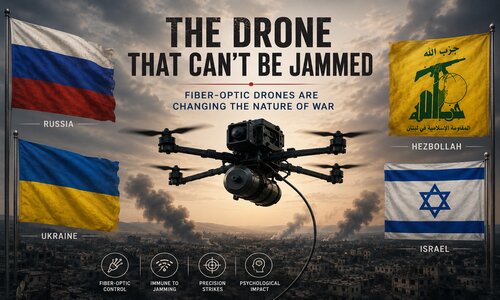
A new generation of fiber-optic drones is rapidly changing the nature of warfare, creating a technological challenge that many militaries--including some of the world's most advanced--are struggling to counter. These drones do not rely on radio signals. Instead, they drag a thin fiber-optic cable behind them, sometimes stretching for miles. Commands travel through the cable itself, making them virtually immune to traditional electronic jamming.
The result is a battlefield revolution that could alter military strategy for decades to come.
The technology first gained widespread attention during the war between Russia and Ukraine. Both sides had become masters of electronic warfare, constantly jamming each other's drones and communications. Conventional drones increasingly struggled to survive in heavily contested airspace.
Then came fiber-optic drones.
Because they communicate through physical cables rather than radio frequencies, they can fly directly into areas saturated with jamming equipment. Operators maintain crystal-clear control and video feeds even in environments where ordinary drones would instantly lose connection.
Military observers quickly recognized what this meant. A weapon once considered vulnerable had suddenly become much harder to stop.
Now that same lesson is confronting Israel.
For decades, Israel has been regarded as one of the most technologically sophisticated militaries on Earth. Time and again, Israeli intelligence and defense agencies have stunned the world with operations that seemed more like scenes from a spy thriller than real-life warfare.
The most famous recent example was the extraordinary operation involving exploding pagers and communication devices used by Hezbollah operatives. The attack demonstrated an unprecedented level of intelligence penetration and technological ingenuity. Israel reportedly managed to compromise devices deep inside Hezbollah's network, turning routine communications equipment into weapons against the very people carrying them.
Israel also spent years methodically penetrating Hezbollah's command structure, gathering intelligence that enabled precision strikes against senior commanders and key leadership figures. The organization's chain of command was repeatedly disrupted, creating the impression that Hezbollah had become increasingly vulnerable and incapable of mounting a sophisticated response.
The message seemed clear: Israel owned the technological high ground.
Yet warfare has a habit of humbling even the most advanced militaries.
Hezbollah's growing use of fiber-optic first-person-view (FPV) drones has created a challenge that Israeli planners apparently did not fully anticipate. Unlike traditional drones that can often be jammed or disrupted electronically, these systems continue operating even in environments packed with advanced countermeasures.
The results have been unsettling.
Hezbollah has released numerous videos showing drones hunting Israeli positions, tracking vehicles, and striking troops. While these attacks have not inflicted casualties on the scale of Israel's operations against Hezbollah, they have exposed an uncomfortable reality: highly trained soldiers can appear surprisingly vulnerable when targeted by inexpensive drones that are difficult to detect and nearly impossible to jam.
But the physical damage is only part of the story.
These drones have introduced a powerful new element to modern warfare: instant psychological warfare. Unlike previous generations of weapons, many FPV drone strikes are recorded in real time from the drone's onboard camera and uploaded to social media within hours. Viewers witness the entire sequence unfold through the eyes of the weapon itself--spotting a target, closing in, and ultimately striking. The footage can be graphic, unsettling, and highly effective as a propaganda tool.
For organizations like Hezbollah, the videos serve multiple purposes. They demonstrate capability to supporters, intimidate opponents, boost recruitment, and create the perception that nowhere is truly safe. A single successful strike can be viewed millions of times online, amplifying its psychological impact far beyond the actual battlefield damage. Soldiers know that they are not only being hunted from above but that any mistake or vulnerability could be recorded and broadcast across the world.
The Ukraine-Russia war pioneered much of this new reality. Social media feeds have become flooded with first-person footage of drones chasing tanks, armored vehicles, and individual soldiers. The battlefield is no longer merely a contest of firepower--it is also a contest of narratives. Every drone strike now carries the potential to become a viral propaganda victory, influencing public opinion, morale, and even political decision-making thousands of miles from the front lines.
Former Israeli security officials have acknowledged that the threat caught many by surprise. The assumption that electronic warfare could provide a reliable defense suddenly looks outdated.
This creates a larger strategic problem.
Israel's military doctrine has long emphasized maneuver warfare, intelligence superiority, and technological dominance. But fiber-optic drones are helping level the playing field. A relatively inexpensive drone can now threaten tanks, command posts, logistics hubs, and infantry positions that once enjoyed significant protection.
The challenge becomes even greater when forces occupy fixed positions. Military analysts have noted that stationary troops become ideal targets for persistent drone surveillance and attack. Once a position is identified, repeated strikes can follow with remarkable precision.
The implications extend far beyond Lebanon.
Military planners around the world are paying close attention to lessons emerging from both Ukraine and the Middle East. If fiber-optic drones continue proving effective, every major army will need to rethink battlefield tactics.
Traditional electronic warfare systems may no longer be enough.
Future defenses could require new layers of protection including laser weapons, kinetic interceptors, artificial intelligence detection systems, physical barriers, and autonomous counter-drone platforms. Armies may need entirely new doctrines for movement, concealment, and force protection.
Perhaps most concerning is the economics involved.
A modern tank can cost millions of dollars. A sophisticated command vehicle may cost even more. Yet many FPV drones cost only a tiny fraction of those amounts. When a low-cost drone can destroy or disable equipment worth hundreds of times its price, the economics of warfare begin to change dramatically.
This is why many defense experts increasingly compare drones to the machine gun's arrival in World War I or the introduction of precision-guided munitions decades later. A technology once viewed as supplementary is becoming central to combat operations.
The broader lesson is one that history repeatedly teaches. Military superiority is never permanent.
Yesterday's breakthrough eventually becomes tomorrow's vulnerability.
Israel remains one of the world's most capable military powers, but even it is discovering that innovation is a race with no finish line. The same nation that stunned the world with exploding pagers, covert intelligence operations, and technological wizardry now finds itself searching for answers to a relatively inexpensive weapon that bypasses some of its most trusted defenses.
From the trenches of Ukraine to the hills of southern Lebanon, a new chapter of warfare is being written.
The battlefield of the future may not be dominated by fighter jets, tanks, or even missiles. It may be ruled by swarms of inexpensive drones connected by strands of glass no thicker than a human hair--silent hunters that cannot be jammed, cannot be easily stopped, and broadcast their victories to the entire world in real time.
And if that future has already arrived, the rest of the world may be far less prepared than it realizes.