America's New Sacred Symbol Being Raised Across The Land: The Pride Flag
 By PNW Staff June 10, 2026
Share this article:
There was a time when flags represented nations, causes, or communities. Today, however, some flags appear to have taken on a far deeper role. They are no longer merely symbols to be displayed. They are objects to be celebrated, honored, blessed, and in some cases treated with a level of reverence once reserved for religious icons.
Two recent events illustrate just how far this transformation has gone.
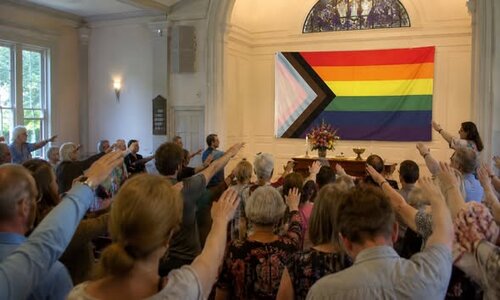
In one gathering at a church, people literally stretched out their hands toward a Pride flag and prayed over it. They declared:
"Let this banner be a symbol of hope, a blanket of protection, and a cape of power."
Pause for a moment and consider those words.
A blanket of protection.
A cape of power.
These are not merely political statements. They are spiritual declarations. They assign supernatural significance to a piece of fabric. They attribute qualities to a symbol that Christians have historically attributed to God alone.
This is what happens when a culture abandons biblical faith but still possesses a deep human desire to worship.
Human beings were created to worship something. If they reject God, they do not stop worshipping. They simply redirect their devotion elsewhere. History is filled with examples. Ancient civilizations worshipped statues. Modern societies worship celebrities, governments, ideologies, money, and movements.
Today, many appear willing to elevate sexual identity and political causes into something resembling a substitute religion.
The Pride movement increasingly contains many of the elements traditionally associated with faith. It has sacred symbols. It has approved doctrines. It has heresies that cannot be questioned. It has public rituals. It has annual festivals. It even has forms of excommunication for those who refuse to affirm its teachings.
Most troubling of all, some churches have eagerly joined the movement.
Rather than calling people to repentance and transformation through Christ, certain congregations now devote themselves to affirming whatever cultural trend happens to dominate the moment. In doing so, they are creating a new theology where acceptance becomes the highest virtue and affirmation becomes the greatest commandment.
The result is a faith that may use Christian language while abandoning Christian authority.
When church leaders stretch out their hands toward a Pride flag and ask for blessings upon it, they are revealing a deeper problem. The issue is not merely sexuality. The issue is authority.
Who defines truth?
Who determines right and wrong?
Who deserves worship?
For Christians, the answer has always been God and His Word. Once that foundation is abandoned, almost anything can become sacred.
The second event is equally disturbing, though for different reasons.
In Somerville, Massachusetts, city officials held a Pride flag-raising ceremony at City Hall. But rather than asking elected officials, veterans, or community leaders to raise the flag, organizers called children to the front.
One by one, the children lined up and helped hoist the Pride banner above the government building.
The symbolism could not have been clearer.
This was not simply a celebration of adults making personal choices. It was a public ceremony involving government institutions and children as the central participants.
Supporters will undoubtedly insist that this was merely about inclusion and kindness. Yet the staging itself raises serious questions.
Why are children so frequently placed at the center of these events?
Why do political and ideological movements consistently seek validation through the participation of minors?
The answer is uncomfortable but important.
Children possess tremendous symbolic power. They create emotional protection around ideas that might otherwise face greater scrutiny. Questioning a political movement becomes far more difficult when smiling children are placed at the center of its public presentation.
Parents increasingly notice a recurring pattern. Schools, libraries, municipal governments, entertainment companies, and activist organizations repeatedly insist that conversations about sexuality and gender must involve children at younger and younger ages.
At the same time, many parents find themselves excluded from those conversations.
A child is considered old enough to participate in public advocacy campaigns. Old enough to stand before cameras and promote ideological causes. Old enough to become the face of a movement.
Yet somehow parents are often treated as obstacles rather than primary decision-makers.
This inversion of authority should concern everyone regardless of political affiliation.
Children deserve protection from becoming instruments in adult political battles.
They deserve time to mature, develop, and understand complex issues without being recruited into causes they may not fully comprehend.
Most importantly, they deserve parents who remain the primary influence in their moral and spiritual formation.
For Christians, these two stories point to a larger cultural reality.
The battle is no longer merely political. It is spiritual.
One story reveals a movement increasingly treated with religious devotion. The other reveals how aggressively children are being drawn into that movement's public rituals and celebrations.
Neither development should be ignored.
Flags cannot save souls.
Banners cannot provide protection.
Political movements cannot offer redemption.
Only Christ can do that.
As Western culture drifts further from its biblical foundations, we should not be surprised to see substitute religions emerge. The real question is whether Christians will have the courage to recognize them for what they are--and remain faithful to the truth even when the culture demands otherwise.