
Turkey's Ottoman Dreams And Ezekiel's Warning
 By PNW Staff June 11, 2026
Share this article:
The war of words between Turkey and Israel is becoming increasingly difficult to ignore. What was once a tense diplomatic relationship has evolved into something far more confrontational, with Turkish leaders openly speaking about Jerusalem, threatening Israel, and positioning themselves as champions of the Islamic world against the Jewish state.
This week, the rhetoric reached another alarming level.
Turkey's Interior Minister Mustafa Çiftçi openly declared his hope that one day Turkey would witness the "liberation of Jerusalem" just as it had supposedly witnessed the "liberation" of Damascus, Aleppo, and Karabakh. He even expressed a desire to become governor of Jerusalem for a day, declaring that lands once controlled by the Ottoman Empire would one day return to Turkish sovereignty.
For Israelis, these comments were not viewed as harmless political theater. They were interpreted as a direct challenge to Israel's sovereignty and a revival of old Ottoman ambitions.
Israel's response was swift and sharp.
Foreign Minister Gideon Sa'ar reminded Turkey that "the corrupt Ottoman Empire is gone. Forever."
Defense Minister Israel Katz went even further, declaring that Jerusalem is not Constantinople and that Israel is not some crumbling medieval kingdom waiting to be conquered. Jerusalem, he emphasized, has been the capital of the Jewish people for 3,000 years and will remain Israel's capital.
Behind the exchange lies a much larger geopolitical story.
For years, Turkish President Recep Tayyip Erdoğan has increasingly embraced a neo-Ottoman vision of Turkey's role in the Middle East. While modern Turkey was founded by Mustafa Kemal Atatürk as a secular republic following the collapse of the Ottoman Empire after World War I, Erdoğan has steadily moved the nation back toward Islamic nationalism.
Many analysts believe Erdoğan sees Turkey not merely as a regional power but as the natural leader of the Sunni Muslim world.
That helps explain Turkey's growing involvement in Syria, Libya, Azerbaijan, Lebanon, and Gaza.
It also helps explain why Jerusalem occupies such an important place in Turkish political rhetoric.
For nearly 400 years, from 1516 until 1917, Jerusalem was under Ottoman control. The city's loss remains a symbolic wound for many Islamists who view the collapse of the Ottoman Empire as one of the great tragedies of Islamic history.
Today, some Turkish politicians openly speak as though history can be reversed.
But rhetoric about Jerusalem is only one part of the story.
This week Erdoğan also warned that Israeli military actions in Syria and Lebanon threaten Turkey itself. He declared that Turkey's security extends beyond its own borders into Aleppo, Damascus, and Beirut. He further warned that Turkey would respond forcefully if Turkish or Turkish-Cypriot interests were threatened.
Such statements reveal a growing willingness by Ankara to project military and political influence far beyond its borders.
At the same time, Israel increasingly views Turkey's support for Hamas and its close relationship with Islamist movements across the region as a direct threat.
The result is a rapidly deteriorating relationship between two of the most powerful militaries in the Middle East.
For students of Bible prophecy, however, these developments carry an additional layer of significance.
The Bible foretells a future coalition of nations that will one day march against Israel.
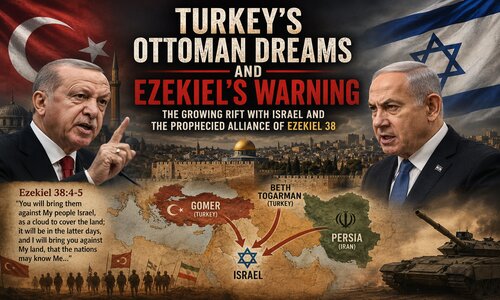
Ezekiel 38 describes an alliance led by "Gog of the land of Magog" that includes Persia, Gomer, and Beth Togarmah.
Most prophecy scholars identify Persia as modern Iran.
The names Gomer and Beth Togarmah have long been associated with regions that correspond largely to modern-day Turkey.
This is one of the reasons many prophecy watchers have paid such close attention to Turkey's transformation over the past two decades.
For much of the twentieth century, Turkey was one of Israel's strongest regional partners. It was secular, Western-oriented, and even maintained military cooperation with the Jewish state.
Yet today's Turkey looks very different.
Under Erdoğan, anti-Israel rhetoric has become commonplace. Turkish leaders regularly accuse Israel of aggression while simultaneously defending Hamas and other Islamist causes. The relationship has shifted from partnership to hostility.
Meanwhile, Iran and Turkey increasingly find themselves aligned on key regional issues despite their historic rivalries.
Neither nation currently appears capable of leading a successful military campaign against Israel by itself. Iran's regional proxy network has suffered significant setbacks and she has been significantly weakened after attacks by the United States and Israel. These attacks may even be part of the reason she would reach out to other nations to help bring down Israel. With Hezbollah weakened and Hamas devastated she has few regional partners left to call upon.
Yet Ezekiel does not describe the condition of these nations today.
It describes a future alignment.
The remarkable thing is not that Turkey and Iran currently have disagreements. The remarkable thing is that Scripture predicted thousands of years ago that these nations would ultimately find themselves on the same side of a future confrontation involving Israel.
Whether that alliance forms in the near future or decades from now remains unknown.
What is becoming increasingly clear, however, is that Turkey's trajectory is moving away from the secular vision of Atatürk and toward a far more assertive Islamic identity.
That shift has profound implications for the Middle East.
It also serves as a reminder that the geopolitical landscape surrounding Israel continues to evolve in ways that many Bible students find strikingly familiar.
The headlines coming out of Ankara and Jerusalem this week may seem like another diplomatic spat. But beneath the rhetoric lies a deeper struggle over history, sovereignty, religion, and regional power.
And for those watching the prophetic stage, Turkey's increasingly hostile posture toward Israel is one development that cannot be easily dismissed.
The Ottoman Empire may never return. But the alliances foretold by Ezekiel appear to be moving closer into focus with each passing year.