
The Child Safety Trojan Horse: Digital IDs Are Coming
 By PNW Staff June 11, 2026
Share this article:
Around the world, governments are increasingly moving to restrict children's access to social media, pornography, and other online content. On the surface, the goal seems noble. Most parents agree that children should not have unrestricted access to explicit material, predatory online communities, or social media platforms that have been linked to anxiety, depression, and other mental health concerns.
The problem is not necessarily the goal.
The problem is the method.
What is unfolding across Britain, Canada, Australia, France, and other nations may ultimately become one of the most significant battles over privacy, free speech, and digital freedom in the coming decade.
Because there is one unavoidable reality: to verify someone's age online, you must first verify who they are.
And that is where the danger begins.
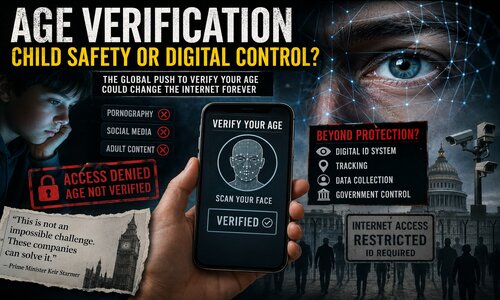
Britain's Labour government recently announced plans to force major technology companies such as Apple and Google to implement age verification systems designed to prevent children from accessing pornography and even from taking or sharing nude photographs. Prime Minister Keir Starmer has argued that technology companies already possess the tools necessary to accomplish this and should be required to deploy them.
At first glance, many parents will applaud the effort.
Who wants children exposed to pornography?
Who wants minors sending explicit images?
Who wants online predators targeting vulnerable teenagers?
These are legitimate concerns.
Yet critics warn that the solution being proposed could require something unprecedented: population-wide identity verification to access large portions of the internet.
Civil liberties groups have sounded the alarm that age verification cannot function without collecting some form of identifying information. Whether it is a government-issued ID, facial recognition scan, biometric age estimation, passport verification, driver's license confirmation, or digital identity credential, the end result is largely the same.
The internet begins to lose its anonymity.
Instead of simply visiting a website, citizens may increasingly be required to prove who they are before being allowed access.
Supporters insist that such systems would only confirm age and would not permanently store identities.
History suggests otherwise.
Governments rarely surrender powers once they obtain them.
Throughout history, emergency powers, surveillance authorities, and security measures introduced for one purpose often expand into entirely different areas over time. What begins as child protection can quickly become misinformation monitoring. What begins as pornography restrictions can evolve into content restrictions. What begins as age verification can become identity verification for nearly everything online.
This phenomenon is often referred to as "mission creep."
And there are already signs of it emerging.
Britain's Online Safety framework not only contemplates age verification but also includes provisions that could require platforms to scan private communications for prohibited material. Critics argue that such measures threaten end-to-end encryption, one of the last remaining tools protecting private communications from government surveillance.
Signal, one of the world's leading encrypted messaging platforms, has repeatedly warned that creating government-approved backdoors into encrypted systems is technically impossible without creating vulnerabilities that can eventually be exploited by hackers, criminals, foreign governments, or malicious actors.
The fundamental problem is simple.
There is no such thing as a surveillance system that only the "good guys" can access.
Every database becomes a target.
Every digital credential becomes valuable.
Every identity system eventually creates opportunities for abuse.
Canada is now moving in a similar direction.
The proposed Safe Social Media Act would prohibit social media accounts for children under 16 while creating a new Digital Safety Commission tasked with overseeing compliance. Age verification would become a central component of enforcement.
Australia has already moved aggressively in this direction, reporting millions of accounts removed following its under-16 social media ban.
France, Spain, Denmark, South Korea, Brazil, Indonesia, Thailand, and other nations are considering similar restrictions.
Viewed individually, each proposal may appear reasonable.
Viewed collectively, however, they reveal something much larger.
A global framework is emerging in which access to information increasingly requires proof of identity.
For decades, the internet functioned much like a public square. Citizens could read, research, discuss, and debate without first presenting identification papers.
That model is gradually disappearing.
The next generation internet increasingly resembles an airport security checkpoint.
Before you enter, you must prove who you are.
Before you speak, you may need credentials.
Before you access information, your identity may be verified.
And once that infrastructure exists, governments gain tremendous leverage.
A future administration could require age verification for political content deemed "harmful."
Another could require identity verification before posting comments.
Another could restrict access to certain viewpoints, news sources, or controversial topics.
The technology itself is neutral.
The question is who controls it.
Christians should pay particular attention to these developments.
The Bible repeatedly warns about the dangers of centralized systems of control. While age verification laws are not the fulfillment of prophecy, they contribute to a broader technological environment where access, participation, commerce, and information become increasingly dependent upon digital credentials and government-approved verification systems.
That trend deserves scrutiny.
Children absolutely need protection online.
Parents need better tools.
Platforms should be held accountable when they knowingly expose minors to harmful content.
But societies must also be careful not to sacrifice liberty in pursuit of safety.
Because history teaches a consistent lesson.
The greatest threats to freedom rarely arrive announcing themselves as threats.
They usually arrive carrying promises of security.