Australian Parents Are Being Told How To Pray For Their Children
 By PNW Staff June 17, 2026
Share this article:
Imagine sitting down with your son or daughter, bowing your head in prayer, and wondering whether the government would approve of the words you are about to speak.
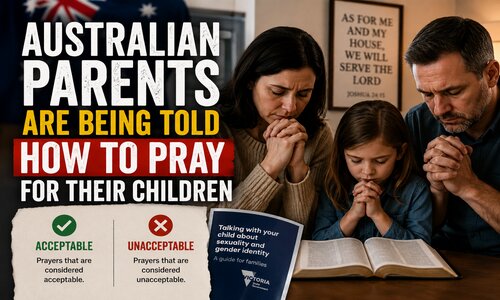
That may sound like something from a dystopian novel. Yet in the Australian state of Victoria, government guidance is now telling parents which prayers for their children are considered acceptable—and which are not.
The guidance, issued as part of the state's approach to sexuality and gender identity, insists that people who identify as LGBTQA are not "sick or broken" and do not need to be "fixed." It then reassures parents that they remain free to share their beliefs and values with their children.
But there is a catch.
According to the guidance, some forms of prayer may be considered harmful. The government has even outlined examples of prayers it considers acceptable and unacceptable.
Prayers for guidance, peace, reassurance, and reminders of God's love are permitted.
Prayers asking God for a change in desires, for strength not to act on attractions, discussions of repentance, or prayers encouraging celibacy are not.
Pause and consider what that means.
This is no longer merely a debate about sexuality or gender identity. It is a debate about authority. Who gets the final say in the spiritual formation of a child—parents, God, or the state?
For Christians, the answer has always been clear.
God never intended parents to be mere providers of food, shelter, and education. He entrusted them with something far greater: the spiritual formation of the next generation.
In Deuteronomy 6, parents are commanded to teach God's truth diligently to their children—to talk about it at home, on the road, in the morning, and at night. The family was designed to be the primary place where faith is taught, nurtured, and passed on.
That biblical responsibility does not disappear when a government agency publishes new guidance.
Yet what is happening in Victoria should concern believers far beyond Australia's borders.
The issue is not simply whether one agrees with the government's position. The larger concern is the growing belief throughout much of the Western world that governments should play an increasing role in determining which religious beliefs may be expressed, taught, or practiced.
The language is almost always the same: safety, inclusion, harm prevention, and protection. These goals may sound noble, but they often come with a hidden assumption—that the state has the authority to decide which moral convictions are acceptable and which are not.
Parents are told they have rights, but only within government-approved boundaries.
Churches are told they have freedom, but only if their teachings align with prevailing cultural values.
Christians are told they can practice their faith, but increasingly they are expected to do so quietly and without challenging the assumptions of the age.
History teaches that whoever shapes the next generation shapes the future. That is why the battle for children has become one of the defining struggles of our time.
The pressure comes through schools, media, technology, entertainment, legislation, and now, in some cases, guidance about family prayer itself.
Australia may simply be showing the rest of the Western world where these debates are heading.
For Christian parents, the challenge is not to respond with fear but with conviction. God has not delegated the responsibility of discipling children to bureaucrats, politicians, or cultural influencers. He has entrusted that responsibility first to mothers and fathers.
And that is why this story matters.
Because the real question is not whether governments can recommend what parents should say to their children.
The real question is whether parents will surrender a role that God Himself gave them.
The battle for the next generation is no longer on the horizon.
It has already arrived at the family dinner table.