
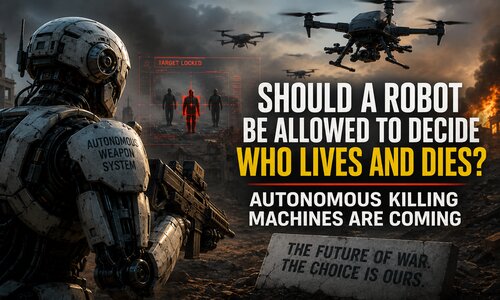
Should A Robot Be Allowed To Decide Who Lives And Dies? The Killer Robot Debate
 By PNW Staff June 15, 2026
Share this article:
For decades, Hollywood warned us about killer robots. The assumption was that truly autonomous machines making life-and-death decisions belonged to some distant future. The war in Ukraine has shattered that illusion.
The battlefields of eastern Europe have become the world's largest laboratory for autonomous warfare. What began as simple reconnaissance drones has evolved into AI-assisted systems capable of identifying targets, navigating electronic warfare environments, coordinating attacks, and in some cases reportedly operating with little or no direct human control. The question is no longer whether autonomous warfare is coming. The question is whether humanity will establish rules before the technology spreads everywhere.
Recent reports suggest that even governments that once insisted humans must remain firmly in control are reconsidering their position. In the United Kingdom, senior defense officials have openly discussed the possibility that future battlefield systems may need the option of taking humans "out of the loop" when making targeting decisions. The debate is no longer theoretical--it is happening now.
Ukraine's war has demonstrated why.
The modern battlefield moves too fast for traditional decision-making. Drones now fill the skies, scanning vast areas and relaying enormous quantities of information. Artificial intelligence can process that data in seconds, identifying threats and proposing responses faster than any human operator could manage. Ukraine's own defense AI leadership recently predicted a future where battlefield systems are linked together into a single operating network, creating what they describe as a "war of operating systems" where victory may depend on which side can make decisions faster.
Military planners see obvious advantages.
Robots do not get tired. They do not panic. They do not require food, sleep, medical treatment, or evacuation. They can enter radioactive zones, chemical environments, minefields, and heavily defended positions without risking human lives. AI-powered drones can remain airborne for hours, tracking targets with a level of patience impossible for human soldiers. Autonomous systems also promise to dramatically reduce military casualties among the nations deploying them.
That reality is already transforming warfare.
Some analysts now estimate that drones account for the overwhelming majority of casualties on parts of the Ukrainian battlefield. Entire regions near the front have become drone-dominated "kill zones" where troop movements are immediately detected and targeted. Military leaders around the world are studying these developments closely because they understand that every future conflict will be shaped by the lessons learned in Ukraine.
The next stage is even more dramatic.
Today many drones still rely on human operators for final authorization. Tomorrow's systems may not.
Reports emerging this month indicate that Ukraine has already experimented with highly autonomous systems capable of identifying and engaging targets without real-time human control. Whether such systems become widespread remains uncertain, but the technological threshold appears to have been crossed.
Supporters argue that autonomous weapons could actually make war more humane.
A machine, they claim, does not act out of hatred, fear, revenge, or prejudice. It can be programmed to follow rules consistently. Former British intelligence officials have even suggested that future AI systems might be capable of making more ethical battlefield decisions than stressed human soldiers operating under extreme pressure.
Perhaps.
But that argument assumes something history repeatedly teaches us not to assume--that technology will always work exactly as intended.
What happens when an autonomous drone identifies the wrong target?
What happens when a facial recognition system misclassifies a civilian?
What happens when adversaries hack an autonomous weapons platform or manipulate the data feeding its decisions?
Most troubling of all, who is responsible when a machine makes a fatal mistake?
For centuries, warfare has maintained a clear chain of accountability. A commander gives an order. A soldier carries it out. Responsibility can be traced back to a human being. Autonomous warfare threatens to blur that line beyond recognition.
If an AI-controlled drone kills a family because it incorrectly identified a vehicle as a military target, is the blame assigned to the programmer? The commander? The manufacturer? The government? Or does accountability simply disappear into a black box algorithm?
That concern is precisely why many experts continue to advocate for a "human-in-the-loop" model where a human operator retains final authority over lethal decisions. Others support a compromise known as "human-on-the-loop," where autonomous systems act independently but remain under human supervision.
Yet battlefield realities may eventually overwhelm those safeguards.
If one nation allows fully autonomous systems while its rival insists on human approval for every strike, the autonomous force may gain a decisive speed advantage. In war, speed often determines survival. The pressure to remove humans from the decision cycle could become irresistible.
That is why the debate cannot wait.
Autonomous warfare is no longer a futuristic possibility. It is emerging before our eyes. The technologies being tested in Ukraine today will eventually spread to major powers, regional powers, and eventually non-state actors. The same AI that can guide a military drone can potentially be copied, modified, and deployed by terrorist organizations or criminal networks tomorrow.
Humanity stands at a crossroads. We must decide whether machines will remain tools used by soldiers or become soldiers themselves.
Because once fully autonomous weapons become commonplace, putting the genie back in the bottle may be impossible.
The age of robot warfare has arrived. The only question remaining is whether humans will still be the ones deciding when another human being dies.