The World Cup Is Revealing Something Bigger Than Soccer
 By PNW Staff June 23, 2026
Share this article:
Every four years the World Cup reminds us that national identity still matters. Fans wave flags. Anthems are sung. Rivalries that stretch back generations are renewed. Nations celebrate victories and mourn defeats together.
Yet amid all the passion and patriotism on display at the 2026 World Cup, something else has quietly emerged—something far more powerful than national pride.
Faith.
While much of the media remains focused on goals, controversies, and tournament storylines, many players from multiple nations are using one of the world's largest sporting stages to publicly declare their trust in Jesus Christ. Even more remarkable, players who wear different uniforms, speak different languages, and represent different countries are finding unity not in nationality, race, or politics, but in their shared faith.
In a world constantly trying to divide people into competing groups, the World Cup is providing a glimpse of a very different reality.
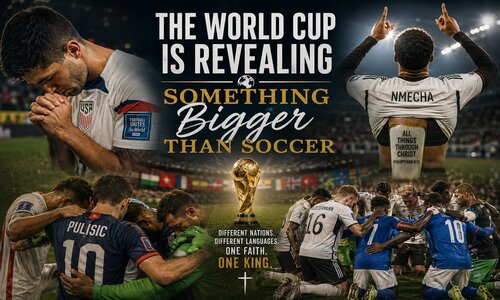
Recent reporting highlighted how openly Christian many members of the United States Men's National Team have become about their faith. Christian Pulisic, Weston McKennie, Chris Richards, Matt Freese, and others have spoken publicly about prayer, Bible studies, and the role Scripture plays in their lives. Pulisic has even become known for organizing what teammates affectionately call "Bible Time," regular Bible studies among players.
For many Christians watching the tournament, this visibility has been refreshing. Faith is no longer being hidden behind carefully crafted public relations statements. Players are openly acknowledging that their ultimate identity is not found in soccer, fame, or national achievement.
The United States is not alone.
German midfielder Felix Nmecha has become one of the most visible examples of faith at the tournament. Cameras captured his shin guard bearing the words, "ALL THINGS THROUGH CHRIST" from Philippians 4:13. After scoring for Germany, Nmecha openly pointed attention toward God rather than himself.
England also has several players known for their Christian faith. Bukayo Saka, Eberechi Eze, Marc Guéhi, and Ivan Toney have reportedly developed a reputation for praying together during international camps. Guéhi has repeatedly spoken publicly about his faith, while Saka has often credited God for helping him navigate both success and disappointment.
Croatia's Luka Modrić continues to be recognized as one of the tournament's most openly Christian veterans, while players across Africa, Latin America, Europe, and North America have been increasingly willing to discuss faith publicly.
But perhaps the most powerful moments have not come during interviews.
They have come after the final whistle.
One of the most striking images from this World Cup occurred after Germany's match with Curaçao. Instead of simply celebrating or walking toward the locker room, players from both teams gathered together on the field in prayer. Countries that had just competed against one another were suddenly united before God.
Similar scenes have emerged involving members of the U.S. team, who have been seen gathering in prayer after matches. Images and videos of players kneeling together, heads bowed, have spread across social media throughout the tournament.
Think about what these moments represent.
The world often teaches that our primary identity is our race, nationality, ethnicity, political affiliation, or social group. Entire industries thrive by convincing people they should view others primarily through those categories.
Yet Christianity has always offered a radically different vision.
The Apostle Paul wrote in Galatians 3:28:
"There is neither Jew nor Greek, slave nor free, male nor female, for you are all one in Christ Jesus."
That does not erase national identity. Germans remain Germans. Americans remain Americans. Brazilians remain Brazilians.
But it establishes something greater.
When believers encounter one another, they see a brother or sister in Christ before they see a passport, skin color, or nationality.
That truth is being demonstrated on soccer fields before millions of viewers.
A German Christian and a Curaçao Christian may be opponents for ninety minutes. An American believer and an English believer may desperately want their own team to win. Yet when the match ends, they recognize a deeper reality. They belong to the same Kingdom.
In a tournament that features nations with political disagreements, historical grievances, and vastly different cultures, these moments of prayer quietly proclaim a message the world desperately needs to hear.
Christ breaks down barriers.
He does not unite people through government mandates, political programs, or global institutions. He changes hearts.
The result is something that politics has never successfully achieved: genuine unity without requiring uniformity.
Perhaps that is why these displays of faith have resonated with so many people.
At a time when society often feels increasingly fractured, the World Cup is revealing that the Gospel still possesses extraordinary power to unite people who otherwise have little in common.
The headlines may focus on trophies and championships. Those stories will eventually fade.
But long after the final match is played, some of the most important images from this World Cup may be the ones showing players from opposing nations standing shoulder to shoulder in prayer.
For a few moments, the world gets to see what Scripture has been teaching for two thousand years:
In Christ, we are family.