
Gaza Or Manhattan? Fifth Graders Pretend To Be Shot Over Politics
 By PNW Staff June 24, 2026
Share this article:
For decades, the world watched with concern as reports emerged from Palestinian schools, children's television programs, and youth organizations that appeared designed not merely to educate children, but to shape them into political activists from an early age.
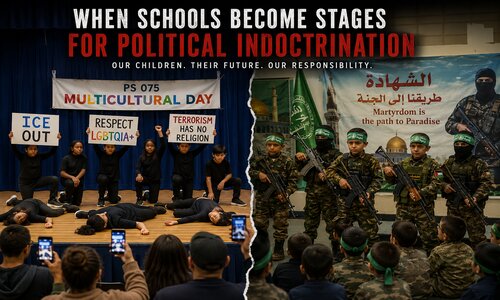
Investigations by watchdog groups documented textbooks that demonized Jews, television programs that glorified "martyrdom," and school performances where children acted out attacks against Israelis. In some cases, students dressed as militants, paraded mock hostages across stages, and reenacted executions before cheering crowds of fellow students, teachers, and parents.
Many Americans looked at those stories and thought such things could never happen here.
After all, this is America.
We teach children how to think, not what to think.
Or at least we used to.
A recent incident at Emily Dickinson School on Manhattan's Upper West Side should serve as a wake-up call for every parent in America.
During what was billed as a "Multicultural Day" celebration, fifth-grade students were placed on a stage in front of their families and directed through a carefully choreographed political performance.
The children danced to "Glory" by John Legend and Common, a song closely associated with the Ferguson protests following the shooting of Michael Brown. As the music played, students acted out being shot by police, collapsing to the floor and lying motionless as though they had been killed.
But the performance did not end there.
After the mock-death sequence, the students rose from the floor and dropped to one knee in the style popularized by former NFL quarterback Colin Kaepernick. They then rushed across the stage carrying handmade political signs that included messages such as "ICE Out," "Respect LGBTQIA+," "Terrorism Has No Religion".
This was not a spontaneous student expression. According to reports, the event was organized by teacher Shahreen Karim, who heads the school's multicultural committee.
Think about what these children were being asked to do.
Ten- and eleven-year-olds were instructed to simulate being shot by police officers. They were then directed to perform one of the most recognizable political protest gestures in modern America before displaying activist slogans selected by adults.
Whether one personally agrees or disagrees with any of those messages is beside the point.
The issue is that elementary school children were being used as vehicles for political advocacy.
An NYPD officer quoted by the New York Post summarized the situation bluntly: "Having fifth graders pretend to be shot by police is not education; it's political indoctrination."
That assessment is difficult to dispute.
Schools are supposed to teach reading, writing, mathematics, science, history, and critical thinking. They are supposed to equip young people with the tools necessary to evaluate competing ideas and reach their own conclusions as they mature.
Instead, these students were effectively cast as actors in a political demonstration they were too young to fully understand.
What makes this particularly troubling is that it reflects the same underlying philosophy that has damaged educational systems around the world: the belief that schools exist not primarily to educate children, but to mold them into advocates for a particular worldview.
The specific ideology may differ from country to country.
In some places it is nationalism.
In others it is socialism.
In others it is religious extremism.
In today's America, it increasingly appears to be progressive political activism.
The mechanism, however, remains remarkably similar.
Children are emotionally engaged through dramatic performances. Complex issues are reduced to simplistic moral narratives. Students are encouraged to identify with a cause before they are mature enough to critically evaluate it. Emotional conditioning takes precedence over intellectual development.
That is not education.
It is programming.
The lesson from Palestinian society is not merely about anti-Semitism. It is about what happens when a generation is systematically taught to view the world through a political lens before they have developed the ability to think independently.
When children repeatedly hear one side of a story, perform one side of a conflict, and emotionally identify with one political narrative, the result is predictable. Those beliefs become deeply rooted long before reason and critical analysis have a chance to develop.
That is why educators carry such enormous responsibility.
Children naturally trust authority figures. They want approval from teachers. They assume adults know what is true.
When that trust is used to advance political agendas, the consequences can last a lifetime.
Perhaps the most disturbing aspect of the Manhattan incident was the response from New York City's educational leadership.
The Department of Education did not condemn the event. It did not apologize to parents. It did not acknowledge that elementary-aged children perhaps should not be reenacting politically charged shootings during a school function.
Instead, officials reportedly stated they were "working with the school to give families advance notice before events."
Read that carefully.
The concern was not the content.
The concern was that parents were not warned beforehand.
In other words, the problem was not the indoctrination itself. The problem was merely that families were surprised by it.
That response reveals how normalized political activism has become within parts of the educational establishment.
As Christians, we should recognize the danger immediately.
Scripture places the primary responsibility for shaping a child's worldview upon parents, not government institutions. Deuteronomy commands parents to diligently teach God's truth to their children. The biblical model places families at the center of moral formation, not bureaucracies.
When schools begin assuming the role of ideological guide, they inevitably compete with the values and beliefs parents are attempting to instill at home.
The issue is larger than politics.
It is about who gets to shape the hearts and minds of the next generation.
The images from Manhattan should concern Americans of every political persuasion. If schools can use children to advance causes we happen to agree with today, they can just as easily use them tomorrow to promote causes we oppose.
History repeatedly teaches the same lesson: whenever children become tools for political movements, education suffers, truth becomes secondary, and society pays the price.
The warning signs are flashing.
The question is whether parents are paying attention.