
How America Raised A Generation Ready For Socialism
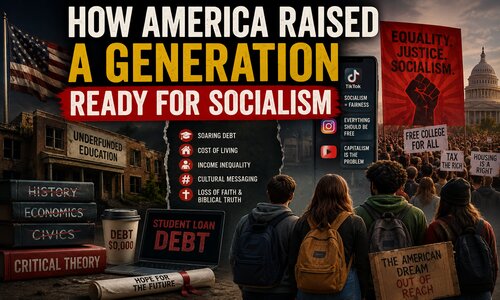 By PNW Staff June 30, 2026
Share this article:
For most of the twentieth century, socialism carried a heavy stigma in America. It conjured images of bread lines, government oppression, collapsing economies and millions who suffered under communist regimes from the Soviet Union to China, Cuba and Venezuela. Politicians from both major parties avoided the label, understanding that Americans overwhelmingly viewed it as incompatible with freedom.
Today, something remarkable has happened.
A growing number of young Americans not only tolerate socialism--they openly embrace it.
Recent Democratic primary victories by candidates aligned with self-described democratic socialist Zohran Mamdani have become the latest evidence of a movement gaining momentum. Celebrating the wins, the Sunrise Movement proclaimed, "Young people have taken over New York City... Young people, who are unapologetically Democratic-Socialist."
Whether that vision spreads nationally remains to be seen. But one fact is increasingly difficult to ignore: socialism has become fashionable among America's youngest voters.
That should cause us to ask a far more important question than which party benefits politically.
How did America raise a generation ready for socialism?
The answer isn't that young people suddenly became lazy or anti-American.
The answer is that America slowly created the perfect conditions for socialism to sound attractive.
A Generation Looking For Hope
Imagine graduating college with tens of thousands of dollars in debt.
You discover that the average home costs six or seven times your annual salary. Rent consumes nearly half your paycheck. Inflation has steadily eroded your buying power. Starting a family seems financially impossible. Healthcare costs continue climbing while retirement feels decades out of reach.
Then someone comes along promising free college, forgiven debt, universal healthcare, subsidized housing and guaranteed income.
That message doesn't sound radical.
It sounds hopeful.
This is why socialism has found fertile ground among younger Americans. It promises relief from problems that many genuinely experience every day.
The tragedy is that while many of those problems are real, the proposed solution often ignores the very policies that helped create them.
Fairness Is A Powerful Word
Senator Rand Paul recently observed that many younger Americans don't think about socialism in terms of failed governments.
"They understand it to be fairness," Paul explained.
That single word--**fairness**--may explain more than any economic textbook ever could.
Most young Americans aren't advocating for state ownership of industry because they've studied Karl Marx.
They're responding emotionally to what they perceive as an increasingly unfair society.
Social media constantly reminds them that someone their own age is driving a Lamborghini, living in a million-dollar home, or making millions posting videos online.
Comparison has become a way of life.
Previous generations compared themselves to neighbors.
Today's generation compares itself to billionaires.
When inequality is placed in front of someone hundreds of times every day, resentment naturally begins to grow.
Socialism enters that emotional vacuum promising to level the playing field.
The Cold War Is Ancient History
Perhaps the biggest reason socialism has returned is astonishingly simple.
The generation embracing it never experienced its failures.
To many young Americans, the Berlin Wall is as distant as the Civil War.
The Soviet Union exists only in documentaries.
They never watched East Germans risk their lives to escape communism.
They never saw the endless bread lines.
They never witnessed the collapse of Venezuela after years of socialist policies.
Many know Cuba more as a vacation destination than a nation where shortages of medicine, food and basic necessities continue to plague daily life.
History loses its power when it becomes someone else's story.
Without those living memories, socialism becomes an abstract theory instead of a documented historical failure.
Every generation eventually relearns the lessons the previous generation forgets.
History suggests those lessons are often painfully expensive.
Schools Teach America's Sins--But Not Its Successes
Education has changed dramatically over the past several decades.
Students today spend considerable time learning about America's failures--slavery, segregation, discrimination and injustice.
Those subjects deserve honest discussion.
But many graduate with surprisingly little understanding of free markets, entrepreneurship, capitalism or why America became the most prosperous nation in history.
Few students ever study why centrally planned economies consistently fail.
Few learn why prices matter.
Few understand incentives.
Few explore why private property, competition and innovation lifted billions of people worldwide out of poverty.
Economic literacy has quietly disappeared.
Into that educational vacuum enters social media, where complex economic questions are answered in sixty-second videos promising simple solutions to complicated problems.
TikTok Is The New Economics Classroom
For previous generations, ideas spread through books, professors and newspapers.
Today's political education increasingly comes through algorithms.
Millions of young Americans consume hours of TikTok, Instagram and YouTube every day.
These platforms reward emotion over nuance.
A thirty-second video explaining why billionaires should simply "pay their fair share" spreads much faster than an hour-long lecture explaining monetary policy, tax incidence or economic incentives.
Complicated debates become catchy slogans.
"Tax the rich."
"Free healthcare."
"Free college."
"Housing is a human right."
The slogans are emotionally compelling because they begin with real problems.
What rarely follows is an honest discussion about unintended consequences, exploding government debt, inflation, reduced innovation or the historical record of countries that embraced similar ideas.
Government Creates Problems...Then Promises To Fix Them
Ironically, many frustrations driving younger voters toward socialism were not created by free markets alone.
Housing shortages have been worsened by restrictive zoning laws and burdensome regulations.
College tuition exploded during decades of expanding federal student loan programs.
Healthcare costs continue rising within one of the most heavily regulated sectors of the economy.
Government intervention often creates distortions.
The proposed solution?
Even more government intervention.
It becomes a cycle where government is repeatedly presented as both the problem and the only possible answer.
The Disappearance Of Responsibility
Perhaps the greatest cultural shift isn't economic.
It's philosophical.
America increasingly teaches young people to view themselves through the lens of identity, oppression and systemic barriers.
Personal responsibility, delayed gratification, sacrifice and perseverance receive far less attention than they once did.
Certainly, genuine injustice exists.
But when an entire generation is taught that success depends primarily upon external systems rather than individual character, socialism naturally becomes attractive.
It promises to fix the system.
It requires much less examination of ourselves.
The Spiritual Vacuum
For Christians, however, the discussion reaches even deeper.
Politics alone cannot explain what is happening.
Scripture repeatedly commands believers to care for the poor, defend the vulnerable and practice extraordinary generosity.
Yet the Bible consistently places those responsibilities upon transformed hearts, generous communities and willing hands--not governments compelling redistribution through political force.
The Eighth Commandment assumes private property.
The Apostle Paul wrote, "If anyone is not willing to work, let him not eat" (2 Thessalonians 3:10), balancing compassion with responsibility.
As biblical literacy has declined across America, many young people no longer possess that framework.
When belief in God fades, people naturally begin searching for another source of security.
If faith in Christ diminishes, faith in government often expands.
Government becomes provider.
Government becomes protector.
Government becomes redeemer.
In many ways, socialism is not merely an economic philosophy.
It becomes a substitute religion--promising salvation through politics instead of transformation through Christ.
The Real Battle
This is why the rise of socialism should concern Christians for reasons far beyond elections.
It reflects a deeper cultural reality.
America did not simply raise a generation that votes differently.
It raised a generation searching desperately for hope, security, fairness and purpose.
Those longings are real.
But history repeatedly demonstrates that socialism cannot satisfy them.
Only a society built upon truth, personal responsibility, freedom, strong families and biblical values can sustain both liberty and genuine compassion.
The battle before us is therefore not simply between capitalism and socialism.
It is between two competing worldviews--one that places ultimate hope in government, and another that understands lasting transformation begins in the human heart.
The political trends we see today are merely the symptom.
The real story is how America raised a generation searching for answers in all the wrong places.