Government Funding Comes With A Price: Surrender Your Christian Beliefs
 By PNW Staff July 08, 2026
Share this article:
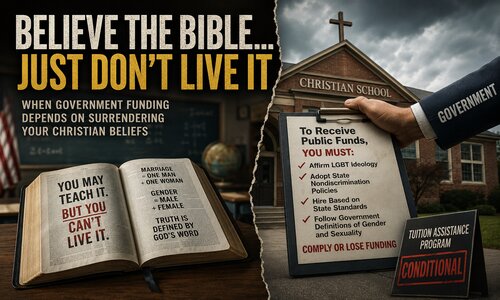
You can believe the Bible... just don't act like you believe it.
That increasingly appears to be the government's definition of religious freedom.
Across America, Christians are repeatedly assured that no one is trying to take away their faith. They are free to attend church, own a Bible, pray before meals, and believe whatever they wish. Religious liberty, we're told, is alive and well.
But there is an increasingly important condition attached to that promise.
Believe what you want—as long as those beliefs don't shape how you live, how you run your business, how you educate your children, or how your institutions operate.
Faith is tolerated... until it becomes visible.
The moment biblical convictions influence hiring decisions, codes of conduct, school policies, or public life, the government increasingly steps in and says, "Not like that."
That troubling reality was reinforced once again by a recent federal appeals court ruling involving Bangor Christian School in Maine.
The court ruled that while the school is free to teach biblical beliefs regarding sexuality and gender, families cannot benefit from Maine's tuition assistance program unless the school complies with the state's LGBT nondiscrimination policies. The judges rejected the school's argument that requiring it to abandon conduct consistent with its beliefs violated its constitutional right to freely exercise its religion.
Think carefully about what that means.
The court essentially acknowledged that Christians may hold biblical beliefs—but ruled those beliefs need not be accommodated when they are actually put into practice.
But what exactly is Christianity if not a faith that is lived?
Jesus never called His followers simply to agree with Him intellectually. He called them to obey Him. Scripture repeatedly teaches that genuine faith transforms both belief and behavior. Christianity has never been confined to Sunday worship services or private opinions. It shapes every aspect of life—including how Christians educate their children and operate their schools.
Separating belief from conduct fundamentally misunderstands the very nature of religious freedom.
Imagine telling an environmental organization it may believe in protecting forests but cannot refuse to participate in logging. Or telling a vegetarian society it may promote vegetarianism but must serve meat at its official events.
The belief becomes meaningless if it cannot influence conduct.
Yet that is precisely the direction many governments now appear to be heading with Christianity.
Supporters of Maine's policy argue that the rules are neutral because every school must follow them equally. But "equal" treatment does not always produce equal outcomes.
A secular private school that already embraces the state's gender ideology sacrifices nothing by complying with these requirements. A Christian school committed to biblical teaching faces a completely different reality. It must either violate deeply held religious convictions or lose access to a public benefit available to others.
That is not neutrality.
It is pressure.
The state is effectively saying, "You may remain Christian—but only if your Christianity never conflicts with our ideology."
Perhaps even more revealing were the comments made by Maine Attorney General Aaron Frey after the U.S. Supreme Court's 2022 decision in *Carson v. Makin*. Although the Supreme Court ruled that parents could not be excluded from Maine's tuition assistance program simply because they chose a religious school, Frey insisted Bangor Christian School should still remain ineligible because its biblical views on sexuality and gender were, in his words, "inimical to a public education."
That statement should concern every American.
Not because everyone agrees with Bangor Christian School's beliefs, but because it reflects a growing assumption that historic Christianity itself is somehow incompatible with participation in public life.
Notice the double standard.
Governments celebrate diversity when it comes to race, ethnicity, language, culture, gender identity, and sexual orientation. Society is constantly reminded that differing viewpoints strengthen democracy.
But increasingly, one viewpoint seems exempt from that celebration.
Traditional biblical Christianity.
Christian schools are expected to accommodate the moral convictions of the surrounding culture, while the surrounding culture is never expected to accommodate theirs.
Universities require faculty to support institutional values.
Advocacy organizations hire people who believe in their mission.
Political groups openly expect ideological agreement from employees.
No one considers that unusual.
But when Christian schools ask teachers and staff to uphold biblical standards that have been part of Christian teaching for two thousand years, those same convictions are increasingly described as discrimination.
That is a remarkable shift.
The debate is no longer simply about preventing discrimination.
It is about determining which belief system will ultimately define society's moral boundaries.
History shows that governments rarely begin by outlawing religion altogether. Instead, they regulate it. They attach conditions to funding, accreditation, licensing, and participation in public programs. One requirement follows another until religious institutions face an increasingly difficult choice: remain faithful to Scripture or receive the benefits available to everyone else.
The pressure is subtle.
But it is real.
And it grows with every court ruling that tells Christians they may believe whatever they want—as long as they don't organize their lives around those beliefs.
For Christians, this should not come as a surprise. Jesus warned His followers that obedience to Him would often place them at odds with the world. The apostles themselves declared, "We ought to obey God rather than men."
That principle has not changed.
Religious liberty was never intended to protect only those beliefs that happen to align with the prevailing political or cultural consensus. It exists precisely to protect the beliefs that challenge it.
The question facing America is becoming increasingly clear.
Will Christian schools remain free to operate as genuinely Christian institutions?
Or will they simply be permitted to keep the name "Christian" while government officials dictate which biblical convictions they are allowed to practice?
Because in the end, a faith that may be believed but not lived is not genuine religious freedom at all.