
The Robot Navy Has Arrived: America's Sea Drone Strike Is Glimpse Of Future War
 By PNW Staff July 16, 2026
Share this article:
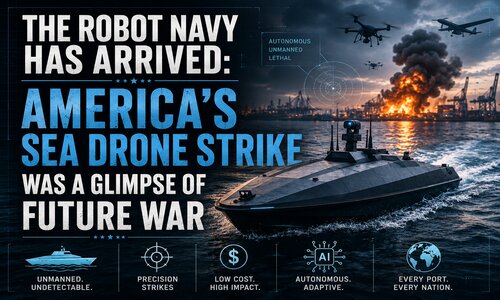
While headlines focused on the target of America's recent strike against an Iranian port, military planners around the world were likely paying closer attention to something else entirely: the weapon that delivered it.
The United States didn't simply attack a strategic facility. It publicly demonstrated that autonomous sea drones are no longer experimental concepts or futuristic prototypes. They have become operational weapons capable of striking valuable targets with precision while keeping human operators safely out of harm's way.
If aerial drones transformed warfare over the past two decades, sea drones may be about to do the same for the world's oceans.
The idea isn't entirely new. Ukraine stunned military analysts by using inexpensive unmanned surface vessels to damage or destroy multiple Russian warships in the Black Sea. A nation with virtually no conventional navy forced one of the world's largest fleets to retreat from its dominant position. The lesson was unmistakable: technological innovation can outweigh traditional military advantages.
Now the United States has signaled that it, too, is embracing this new era of naval warfare.
For generations, sea power has been measured by aircraft carriers, destroyers, submarines, and cruisers. Nations spent decades and trillions of dollars building fleets designed to project strength across the globe. Those ships remain formidable, but they now face a growing challenge from autonomous vessels that cost only a tiny fraction of the price.
The economics alone should command attention.
A billion-dollar warship may be forced to defend itself against a drone costing a few hundred thousand dollars—or less. Worse still, defenders may launch sophisticated interceptor missiles costing millions of dollars to destroy a target that is almost disposable by comparison.
That is not a sustainable equation.
Yet the greatest danger isn't a single drone.
It's a swarm.
Imagine not one autonomous boat approaching a naval base, but one hundred. Some travel on the surface. Others move beneath the water. Overhead, aerial drones provide surveillance while electronic warfare systems jam communications. Artificial intelligence helps coordinate the attack, adjusting routes in real time as defenses respond.
Even the most advanced naval defenses can become overwhelmed when forced to engage dozens or hundreds of simultaneous threats arriving from multiple directions.
This is where the conversation shifts from today's headlines to tomorrow's reality.
Military planners increasingly recognize that future wars will not be fought solely by soldiers, sailors, pilots, and Marines. They will also involve fleets of autonomous machines operating across land, sea, air, and under the ocean. Human operators will increasingly supervise battles rather than personally fight every engagement.
That reality changes political calculations as well. A nation can undertake riskier missions when it knows no crew members will become prisoners of war or casualties if an unmanned vessel is destroyed. The threshold for military action may become lower simply because the human cost appears smaller.
The implications stretch far beyond Iran.
Every major port in the world—from Norfolk and Pearl Harbor to Haifa, Singapore, and Yokosuka—must now consider how to defend against autonomous maritime threats. Commercial shipping lanes, energy terminals, bridges, offshore infrastructure, and naval bases all become potential targets in ways that were difficult to imagine only a decade ago.
History has repeatedly shown that the most devastating attacks often come from threats nations failed to take seriously.
Before December 7, 1941, many believed America's geographic isolation and powerful fleet provided sufficient protection. Pearl Harbor shattered that illusion.
Before September 11, 2001, few imagined commercial airliners becoming strategic weapons capable of changing history.
Today another military revolution is quietly unfolding.
The danger is not simply that sea drones exist. The danger is assuming they will remain a niche capability confined to today's regional conflicts. History suggests otherwise. Once a military innovation proves effective, others quickly copy it, refine it, and deploy it on a larger scale.
A future "Pearl Harbor 2.0" may not begin with bombers appearing over the horizon. It could begin with hundreds of autonomous vessels—some above the water, others below—moving silently toward ports, fuel depots, naval bases, bridges, and critical infrastructure before anyone fully recognizes what is happening.
That is no longer the stuff of science fiction. It is a capability being developed in real time.
The lesson of Pearl Harbor was never simply that America needed a bigger navy. It was that nations must recognize new forms of warfare before an adversary exploits them. Those who prepare only for yesterday's battles often pay a terrible price tomorrow.
For Christians, these developments are another reminder that the world continues to move toward an era of rapidly accelerating technology, where innovation can be used for both tremendous good and profound destruction. Scripture reminds us that wars and rumors of wars will continue, but it also calls believers to be discerning about the times in which they live.
Ignoring revolutionary technologies because they seem novel or unlikely has never been a winning strategy. The nations that adapt will shape the future. Those that fail to recognize the changing character of warfare may discover—too late—that history has a way of repeating itself in forms no one expected.