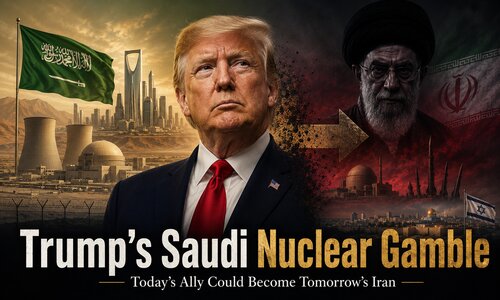
Trumps Saudi Nuclear Gamble: Today's Ally Could Become Tomorrow's Iran
 By PNW Staff July 23, 2026
Share this article:
There is a dangerous contradiction emerging from the war against Iran.
The United States and Israel have spent enormous military resources attempting to prevent Tehran from possessing the infrastructure and enriched uranium needed to build nuclear weapons. Yet even as that war continues, President Donald Trump has signed a sweeping nuclear cooperation agreement that could eventually allow Saudi Arabia to enrich uranium on its own soil.
The program is officially civilian. The reactors would generate electricity, help Saudi Arabia preserve more oil for export and give American nuclear companies a major role in one of the world's wealthiest energy markets.
But uranium enrichment is never merely an ordinary energy project.
The same centrifuges that produce low-enriched uranium for power plants can, if operated longer or reconfigured, produce highly enriched uranium suitable for nuclear weapons. A nation that masters enrichment does not automatically possess a bomb, but it acquires one of the most difficult pieces of the nuclear puzzle.
The 30-year agreement includes a separate bilateral safeguards arrangement, and the Trump administration insists it will uphold strong nonproliferation standards. However, the agreement reportedly does not require Saudi Arabia to adopt the International Atomic Energy Agency's Additional Protocol, which gives inspectors greater authority and access when looking for undeclared nuclear activities. It also abandons the previous effort to make civilian nuclear cooperation part of a larger Saudi normalization agreement with Israel.
Trump's reasoning is not difficult to understand.
Saudi Arabia is determined to develop nuclear energy. If Washington refuses to participate, Riyadh could turn to China, Russia, France or South Korea. American involvement may provide greater visibility and influence than leaving the program to Beijing or Moscow. The kingdom is also a vital counterweight to Iran, and strengthening Saudi Arabia could help rebuild a regional coalition against Tehran.
But the central question is not simply whether America trusts the Saudi government of 2026.
The question is whether America can trust every Saudi government that might control this technology over the next 30, 40 or 50 years.
Nuclear Technology Outlives Political Leaders
Crown Prince Mohammed bin Salman has transformed Saudi Arabia in significant ways. He has reduced the authority of the religious police, opened the country to tourism and entertainment, expanded opportunities for women and confronted some of the extremist religious influences that once dominated Saudi society.
The present Saudi leadership is also quietly aligned with Israel against Iran, despite the absence of formal diplomatic relations.
Yet governments change.
Leaders die. Royal families experience internal struggles. Economic crises produce unrest. Wars weaken political institutions. Religious movements that appear contained can suddenly return with extraordinary force.
A nuclear reactor or enrichment facility built under a comparatively pragmatic ruler could one day be inherited by a leader with a radically different worldview.
That concern is especially significant because Saudi Arabia is not just another Muslim-majority country. It is the birthplace of Islam and home to Mecca and Medina, Islam's two holiest cities. The Saudi king carries the title "Custodian of the Two Holy Mosques," giving the government a religious significance that extends far beyond its borders.
If hardline Islamists ever seized influence over the kingdom, they would not simply inherit Saudi Arabia's oil reserves, advanced American weapons and strategic geography. They could also inherit a sophisticated nuclear infrastructure.
That possibility may appear remote today. But Iran should have taught Washington never to assume that a friendly Middle Eastern government will remain friendly forever.
Before 1979, Iran was one of America's most important regional allies. The Shah cooperated with the West, maintained relations with Israel and purchased large quantities of American military equipment. Then the Islamic Revolution swept away the monarchy and replaced it with a regime devoted to exporting radical Islam, destroying Israel and driving the United States from the region.
American weapons intended to strengthen an ally became the property of an enemy.
The same principle applies to nuclear infrastructure: once transferred, it cannot easily be taken back.
Afghanistan provides another warning. After two decades of Western investment in an internationally supported government and military, the Taliban returned to power in 2021 with astonishing speed. Political arrangements that appeared permanent vanished in a matter of weeks.
Saudi Arabia may remain stable and cooperative for decades. But nuclear policy cannot be based solely on the expectation that the best-case political scenario will continue indefinitely.
What This Means For Israel
For Israel, the Saudi agreement presents several serious risks.
The first is the possibility of a regional nuclear arms race.
Mohammed bin Salman has already stated that Saudi Arabia would pursue a nuclear weapon if Iran obtained one. Those comments confirm that Riyadh's nuclear ambitions cannot be separated from its strategic competition with Tehran.
Even if Iran's nuclear infrastructure is severely damaged, Saudi Arabia may now decide that it needs a permanent nuclear hedge against whatever Tehran rebuilds.
Turkey and Egypt could eventually reach the same conclusion. Each country considers itself a major regional power. Neither will necessarily accept a Middle East in which Israel, Iran and potentially Saudi Arabia possess nuclear or near-nuclear capabilities while it remains dependent on outside powers.
One enrichment program could lead to another.
The second risk is that Israel may eventually face a nuclear-capable Arab state without receiving peace in return.
Civilian nuclear cooperation was once discussed as part of a historic bargain: Saudi Arabia would normalize relations with Israel, while the United States provided Riyadh with security guarantees and nuclear assistance. Under the new agreement, the nuclear component has been separated from normalization.
Saudi Arabia receives the technology, while Israel receives no formal diplomatic recognition, no embassy in Riyadh and no permanent peace agreement.
An Israeli security analysis warned that this could leave Jerusalem facing the most problematic combination: increased proliferation risk without the strategic reward of Saudi-Israeli normalization.
The third danger is what happens if Israeli-Saudi relations deteriorate.
Today, both countries fear Iran. Tomorrow, a different Saudi leader could revive hostility toward Israel, embrace the Muslim Brotherhood, bow to pressure from the Arab street or seek leadership of a more confrontational Islamic bloc.
Israel would then be forced to decide whether it could tolerate Saudi enrichment facilities that might be converted into a weapons program.
Israel has previously demonstrated that it will not quietly accept emerging nuclear threats. It destroyed Iraq's Osirak reactor in 1981 and struck a suspected Syrian nuclear facility in 2007. A future Saudi breakout could therefore create the possibility of an Israeli preventive strike against a country that is currently treated as an unofficial partner.
The fourth risk is that widespread nuclear infrastructure would make every future Middle Eastern war more dangerous.
Reactors, enrichment facilities and fuel-storage sites could become missile targets. Terrorist organizations could attempt sabotage or steal nuclear materials. Governments facing defeat might threaten to accelerate weapons programs. A regional crisis that once involved conventional missiles and aircraft could suddenly carry fears of radioactive contamination or nuclear escalation.
Today's Ally Is Not Necessarily Tomorrow's Ally
Supporters of Trump's agreement will argue that American participation is safer than allowing China or Russia to dominate Saudi Arabia's nuclear program. That argument deserves consideration.
But the United States should not confuse influence with permanent control.
Inspectors can be expelled. Agreements can be abandoned. Governments can withdraw from treaties. Facilities can be nationalized. Civilian programs can be redirected. Knowledge acquired by Saudi scientists cannot be erased if political conditions change.
Most importantly, America is creating a precedent.
After insisting that Iran could not be trusted with domestic enrichment, Washington is now preparing to accept enrichment in another powerful Middle Eastern state. Tehran will exploit that contradiction. Other governments will demand equal treatment.
Trump may believe he is containing Iran by strengthening its greatest Arab rival. But he could also be establishing the logic that drives the next stage of Middle Eastern proliferation: Iran sought enrichment, so Saudi Arabia requires enrichment; Saudi Arabia receives enrichment, so Turkey and Egypt demand enrichment.
That is how nuclear dominoes begin to fall.
The current Saudi leadership may have no intention of building a bomb. But responsible policy must consider not only who controls the kingdom today, but who could control it decades from now.
Iran was once a dependable American ally.
Afghanistan once had a Western-backed government.
Political systems that appear solid can collapse with stunning speed.
The most dangerous weapons are not necessarily those handed directly to an enemy. Sometimes they are the capabilities given to a friend, only to be inherited later by someone who was never supposed to possess them.
Trump may succeed in destroying Iran's immediate nuclear ambitions. But unless powerful safeguards are added to the Saudi agreement, history may record that the effort to stop one nuclear threat helped create an entire region of them.