
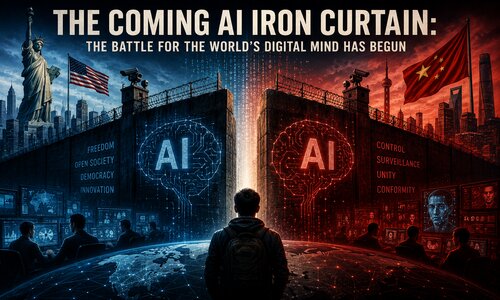
The Coming AI Iron Curtain: The Battle For The World's Digital Mind Has Begun
 By PNW Staff July 21, 2026
Share this article:
For decades, the world's superpowers measured their strength in aircraft carriers, nuclear warheads, and economic output. The Cold War was fought through military alliances, espionage, and competing political systems. Today, another global contest is rapidly taking shape--but this one will not be decided primarily by bombs or bullets.
It will be decided by artificial intelligence.
Recent developments out of China have sent another clear signal that the AI race is entering a far more consequential phase. While much of the media has focused on stock prices, market valuations, or whether one AI model performs slightly better than another, those are merely the surface-level story.
The real battle is over something much larger: who will control the world's digital intelligence.
This is beginning to resemble a new Cold War--except instead of competing over missiles, nations are competing to become the default source of knowledge, reasoning, and decision-making for billions of people.
That is a level of influence history has never witnessed.
The New Cold War
During the twentieth century, countries chose sides between Washington and Moscow. Military alliances largely determined the balance of power. Today, nations may increasingly find themselves choosing between competing AI ecosystems instead.
Will governments rely primarily on American-developed AI?
Chinese-developed AI?
Or attempt the costly challenge of building their own?
This may sound like a technical question, but it is actually one of national sovereignty.
Artificial intelligence is steadily moving beyond chatbots. It is becoming the operating system for modern civilization. Businesses are using it to make financial decisions. Hospitals are beginning to rely on it for diagnostics. Schools are integrating it into classrooms. Governments are exploring its use for public services. Militaries are incorporating it into intelligence analysis, logistics, and battlefield planning.
Whoever supplies that intelligence infrastructure gains tremendous long-term influence.
That is why this race matters far beyond Silicon Valley.
Intelligence Is Becoming Infrastructure
Previous technological revolutions changed how people worked.
Artificial intelligence may change how societies think.
Increasingly, people will ask AI not merely for facts, but for advice, analysis, recommendations, legal guidance, medical explanations, financial planning, and even moral opinions.
That raises an uncomfortable question.
If millions--or eventually billions--of people rely on an AI system every day, whose values are shaping the answers?
Artificial intelligence is often presented as objective. In reality, every system reflects choices made by its creators. Decisions about what information is prioritized, what viewpoints are considered acceptable, how controversial issues are framed, and what content is filtered all reflect human judgment somewhere in the process.
In other words, AI is never completely neutral.
That reality makes this global competition far more significant than simply building the fastest or cheapest model.
It becomes a competition over influence itself.
The Quiet Rise Of Digital Colonization
History is filled with examples of powerful nations extending their influence through military conquest or economic leverage.
Artificial intelligence introduces another possibility.
Digital colonization.
Instead of occupying territory, nations can become indispensable through technology.
Imagine developing countries building their education systems, healthcare networks, government services, banking infrastructure, and business operations around AI provided by a foreign power.
No soldiers arrive.
No borders change.
Yet dependence quietly grows.
Eventually, replacing that technology becomes extraordinarily expensive and disruptive. The provider gains influence not because anyone was forced to accept it, but because it became the easiest, cheapest, and most practical option.
History offers several examples of industries where this strategy proved successful. Artificial intelligence has the potential to magnify that dynamic exponentially because it touches nearly every sector of society.
This is not merely exporting software.
It is exporting the digital brain that increasingly helps societies function.
That is precisely why China's strategy deserves close attention. Offering powerful AI models at little or no cost may appear generous on the surface, but history teaches that nations rarely invest billions in strategic technologies without expecting long-term returns. If countries across Africa, Asia, South America, and the Middle East build their digital infrastructure on Chinese AI, Beijing's influence could extend far beyond trade agreements or diplomatic partnerships.
The first nation to become indispensable often becomes the hardest to replace.
An AI Iron Curtain?
One expert recently suggested that today's open approach to AI could eventually evolve into something much more strategic.
That possibility deserves attention.
What if today's freely available AI becomes tomorrow's indispensable infrastructure?
What if nations, businesses, and institutions gradually build their entire digital ecosystems around one country's technology?
The original Iron Curtain divided East and West through ideology, politics, and military power.
The next Iron Curtain may not be visible at all.
Instead of concrete walls and barbed wire, it could consist of competing AI ecosystems that rarely communicate with one another.
Different answers.
Different rules.
Different values.
Different definitions of acceptable speech.
Different versions of history.
Different political assumptions.
Rather than one open internet, the world could slowly fracture into separate digital spheres of influence, each shaped by the priorities of its dominant AI provider.
That prospect would have enormous consequences for global commerce, diplomacy, cybersecurity, and even freedom of expression.
More Than A Technology Story
Many people still view artificial intelligence primarily as a faster search engine or a helpful workplace assistant.
That dramatically understates what is unfolding.
This is becoming a geopolitical contest over influence, culture, economics, and national security. The countries that establish trusted AI platforms today may shape education, commerce, communication, healthcare, financial systems, and public policy for decades to come.
The stakes are not simply about which company earns the largest profits.
They concern who writes the invisible operating system of the future.
The Next Iron Curtain May Be Invisible
When Winston Churchill warned that an "Iron Curtain" had descended across Europe, he wasn't describing a physical wall stretching across the continent. He was describing an ideological divide that eventually manifested itself in borders, barriers, and, most famously, the Berlin Wall.
That wall did far more than separate East from West. It divided families, restricted information, controlled movement, and symbolized two competing visions of how society should function.
Today's world may be witnessing the early stages of a different kind of divide.
This time, there may be no concrete barriers, guard towers, or barbed wire. Instead, the separation could be built from algorithms, AI platforms, competing digital ecosystems, and entirely different versions of reality.
One group of nations may rely primarily on AI systems developed in the United States. Others may increasingly adopt Chinese platforms because they are cheaper, open-source, or more readily available. Over time, those competing systems may shape how billions of people receive information, conduct business, educate their children, and even understand history and current events.
The Berlin Wall eventually fell because physical walls cannot permanently suppress the human desire for freedom.
Digital walls, however, are far less obvious.
Most people will not notice them being built.
They will simply choose the cheapest software, the most capable assistant, or the easiest platform to use. Years later, they may discover that entire nations have become dependent on technologies developed according to someone else's priorities, values, and strategic interests.
The battle now unfolding is not simply about who builds the smartest artificial intelligence.
It is about who earns the trust of the world--and in doing so, quietly shapes how the world thinks.
The original Iron Curtain divided continents.
The next one may divide minds.