
Parents vs. The State: The Growing Battle Over Who Controls A Child's Health
 By PNW Staff July 20, 2026
Share this article:
There was a time when the answer to a child's scraped knee, broken arm, or frightening diagnosis was simple: call Mom or Dad.
Today, in a growing number of jurisdictions, governments are quietly rewriting that assumption.
The debate is no longer merely about healthcare. It is about authority. It is about whether parents remain the primary decision-makers in their children's lives--or whether the state increasingly views them as optional participants.
The latest flashpoint comes from Newfoundland and Labrador, where the rollout of the province's new digital health system has ignited outrage over parental access to children's medical records.
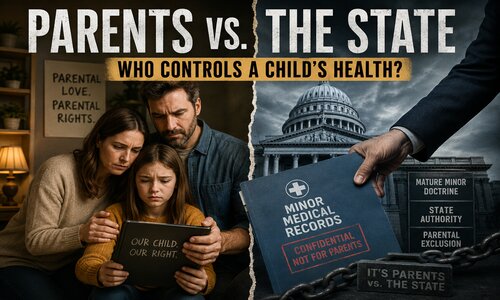
The controversy centers on a policy that cuts off automatic parental access when a child turns 12. Parents seeking access to the medical records of a 12- to 15-year-old must now obtain the child's consent through the MyHealthNL system. At age 16, the child gains full control over who may view those records.
Think about that for a moment.
A twelve-year-old cannot legally get a tattoo without parental permission. They cannot sign contracts. They cannot open most bank accounts on their own. They cannot vote, buy alcohol, or drive independently.
Yet the government has determined that they may prevent their parents from viewing portions of their own medical information.
Public backlash was so swift that Newfoundland Premier Tony Wakeham announced the government would review the legislation, declaring that "parents are the primary protectors of their children" and promising changes to restore parental access. The controversy exposed what many families had never realized--that existing laws had already shifted significant authority away from parents, and the new digital system simply made those policies visible.
California's Different Route--Same Direction
The same philosophical battle is playing out south of the border.
California has spent years positioning itself as a sanctuary state for gender-transition procedures and has increasingly strengthened privacy protections surrounding gender-related issues.
At the same time, California has become the national epicenter of battles over whether schools should notify parents when students socially transition at school. Assembly Bill 1955 restricted school districts from adopting mandatory parental notification policies regarding a student's gender identity. Supporters argue the law protects vulnerable youth who may face abuse at home, while critics believe it deliberately sidelines parents from life-changing decisions involving their own children.
The specifics differ between healthcare records and school policies, but the underlying philosophy increasingly appears consistent: when government officials believe parental involvement could conflict with a child's stated wishes regarding gender identity, the state's role expands while the parent's role contracts.
A Broader Trend
These developments are hardly isolated.
Across Canada, several provinces recognize the legal doctrine of the "mature minor," allowing physicians to determine whether a child is sufficiently mature to consent to certain medical treatments without parental approval. While intended for exceptional circumstances, the doctrine has increasingly been applied to decisions involving gender-related care, leaving some parents shocked to discover they may have little legal authority once a doctor concludes their child is capable of making the decision independently.
British Columbia has become one of the most well-known examples. Courts there have upheld the right of minors deemed mature enough to pursue gender-transition treatments over the objections of parents. In one widely publicized case, a father who attempted to prevent his teenage daughter's medical transition not only lost in court but was later found in contempt after publicly identifying his child. The case became a landmark illustration of how parental rights can collide with the state's interpretation of a child's medical autonomy.
Oregon has likewise expanded minors' ability to consent to various forms of medical care without parental involvement. State law allows minors of certain ages to independently obtain treatment for mental health services, substance abuse treatment, reproductive healthcare, and other sensitive medical issues.
While Oregon does not have one blanket age of medical independence, its laws permit minors in several circumstances to receive significant healthcare services without parental consent. Supporters argue these protections ensure vulnerable youth receive needed care, while critics contend they further normalize the idea that parents should be excluded from some of the most consequential decisions affecting their children's lives.
Taken together with the recent controversy in Newfoundland, these examples point toward a broader cultural and legal shift. While each jurisdiction has its own laws and justifications, the common trend is unmistakable: the balance of authority is gradually moving away from parents and toward governments, healthcare providers, and state institutions.
The Question Few Politicians Want To Answer
This raises an uncomfortable question.
At what age does government believe someone stops being your child?
Is it 18?
16?
12?
Or does it simply depend upon which political issue is being discussed?
When a child gets into legal trouble, parents are still expected to provide supervision.
When a teenager crashes the family car, parents remain financially responsible.
When schools need volunteers, fundraising, transportation, or discipline support, parents are indispensable.
But when questions arise surrounding gender identity or certain medical decisions, some governments increasingly suggest parents become obstacles rather than partners.
That contradiction deserves scrutiny.
The Erosion Of Trust
Perhaps the greatest casualty is trust.
Healthy families are built upon communication.
Government policies that encourage secrecy--even when motivated by concern for vulnerable youth--risk teaching children that difficult conversations should be hidden rather than navigated together.
Certainly, tragic situations exist where abusive homes require intervention. Child protection laws exist precisely because genuine abuse is real.
But exceptional cases should not become the template for every family.
Public policy should begin with the presumption that loving parents act in the best interests of their children--not that they are potential threats requiring exclusion.
More Than A Political Debate
For Christians, this issue reaches beyond partisan politics.
Scripture consistently assigns parents--not governments--the primary responsibility for raising, teaching, correcting, and guiding children. Deuteronomy repeatedly commands parents to teach God's ways diligently to their children. Ephesians instructs fathers to bring children up "in the training and instruction of the Lord." Those responsibilities become nearly impossible if parents are intentionally kept uninformed about major developments affecting their children's physical or emotional health.
Governments undoubtedly have an important role in protecting children from genuine harm.
But they should exercise great caution before assuming responsibilities that belong first to families.
The debate unfolding in Newfoundland, California, British Columbia, Oregon, and elsewhere is not merely about privacy settings or electronic medical records.
It is about a much larger question.
Who raises children?
If the answer increasingly becomes "the state," then society has crossed a line far more significant than many people yet realize.