
The Rise Of Physical AI Changes Everything
 By PNW Staff July 17, 2026
Share this article:
For years, the artificial intelligence revolution lived almost entirely on our screens.
AI wrote emails, answered questions, generated artwork, and powered chatbots. It was impressive, but it still felt like software—a tool we interacted with through keyboards and smartphones.
That era is ending.
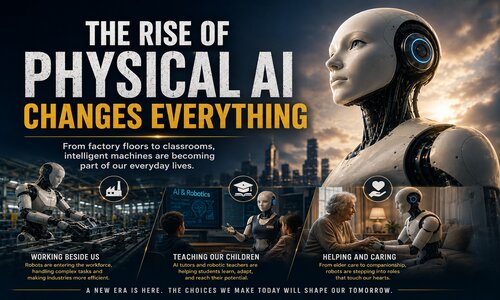
This week alone offered three remarkable glimpses into what comes next. At BMW's South Carolina manufacturing plant, a humanoid robot is now working alongside employees on the production line, handling parts and adapting to changing tasks with remarkable precision.
In Switzerland, researchers unveiled a humanoid robot capable of instantly transforming its face into convincing digital likenesses of Donald Trump, Barack Obama, Mark Zuckerberg, and others while maintaining natural conversation and eye contact.
Meanwhile, a New York school district announced that students returning this fall will find a lifelike humanoid robot named "Sally" helping teach AI and robotics classes while serving as an intelligent tutor long after the school day ends.
Viewed separately, each story is fascinating.
Viewed together, they reveal something much larger.
Artificial intelligence is no longer confined to computers.
It is acquiring a body.
That changes everything.
The Next Technological Revolution
The first wave of AI transformed information.
The second wave is transforming the physical world.
For decades, industrial robots lived behind safety cages performing the same repetitive movement thousands of times a day. They were powerful, but they weren't intelligent.
Today's "physical AI" is fundamentally different.
These machines can see.
Learn.
Adapt.
Navigate unfamiliar environments.
Hold conversations.
Recognize faces.
Remember previous interactions.
Respond naturally.
Soon they won't simply build our cars—they'll work beside us, care for aging parents, stock warehouses, patrol military bases, greet hotel guests, assist doctors, teach students, and eventually become familiar fixtures inside millions of homes.
This isn't science fiction anymore.
It's beginning now.
The Factory Was Just The Beginning
The BMW deployment illustrates the first stage.
Robots are entering workplaces where they perform dangerous, repetitive, or physically demanding jobs alongside human workers.
Most people expected this.
What many didn't expect is how quickly these same technologies are moving into far more personal spaces.
The Swiss demonstration points toward another future entirely.
When a robot can instantly become President Trump, Barack Obama, or virtually anyone else—with convincing facial expressions, eye contact, and natural speech—we enter a world where physical appearance becomes programmable.
For generations we've been warned not to believe everything we see online.
Soon we may have to remember not to believe everything standing in front of us.
The implications extend well beyond entertainment. Identity, trust, authentication, misinformation, and even fraud become far more complicated when artificial intelligence can convincingly inhabit a human face.
Then Come The Children
Perhaps the most overlooked story was also the most significant.
A school district has decided that one of the first regular interactions students will have with a humanoid robot won't be at a science museum.
It will be in a classroom.
The district insists—and rightly so—that the robot is intended to assist rather than replace teachers. It offers individualized tutoring, language translation, homework assistance, and personalized conversations that continue after students leave school.
Those are worthwhile goals.
But history teaches us that technologies introduced as assistants often become fixtures we grow increasingly dependent upon.
Today's tutor.
Tomorrow's counselor.
Eventually... whose voice carries the greatest authority?
Children naturally bond with those who consistently answer their questions, encourage them, remember them, and patiently respond without frustration.
That is precisely what AI is becoming.
More Than An Engineering Challenge
For Christians, this discussion isn't ultimately about whether robots become smarter.
It's about whether people begin forgetting what makes human beings unique.
Scripture teaches that mankind is created in the image of God—not because we are the strongest, fastest, or most intelligent creatures, but because God uniquely fashioned us with spiritual, moral, and eternal significance.
No machine, no matter how convincing, possesses a soul.
It cannot repent.
It cannot worship.
It cannot love in the biblical sense.
It cannot bear moral responsibility before its Creator.
That distinction becomes increasingly important as robots become increasingly persuasive.
The danger is not that machines become human.
The danger is that humans begin treating machines as though they are.
The New Idol?
Throughout Scripture, humanity repeatedly turned the works of its own hands into objects of trust.
Isaiah mocked those who carved idols from wood and then bowed before them.
Our generation is unlikely to worship carved statues.
But what happens when the work of our hands walks, speaks, smiles, remembers our birthdays, comforts our loneliness, answers every question, and patiently validates every opinion we hold?
The temptation will not simply be to use technology.
It will be to trust it.
To consult it before Scripture.
To seek wisdom from algorithms before seeking wisdom from God.
To substitute artificial companionship for genuine human relationships.
That may prove to be the greatest spiritual danger of all.
The Real Question
Hollywood imagined robots overthrowing humanity with lasers and violence.
Reality appears to be unfolding much differently.
The greatest transformation may not come through force.
It may come through convenience.
Little by little, machines will become more capable, more familiar, and more trusted until one day many people cannot imagine life without them.
Christians need not fear innovation. Machines that help the disabled walk, protect soldiers from danger, or perform hazardous work are remarkable examples of human creativity serving the common good.
But these three headlines remind us that we have entered a new chapter in technological history.
Artificial intelligence is no longer something we merely consult.
It is becoming something we encounter.
Something that works beside us.
Teaches our children.
Cares for our loved ones.
Looks us in the eye.
The rise of physical AI changes far more than technology. It forces us to answer one of the oldest questions in Scripture: What does it truly mean to be human?