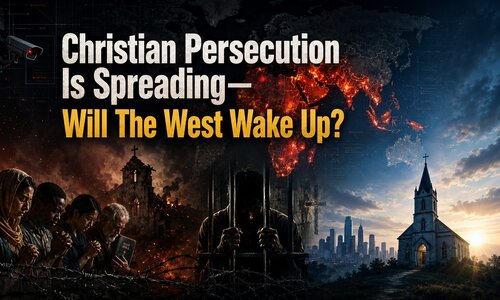
Christian Persecution Is Spreading - Will The West Wake Up?
 By PNW Staff July 24, 2026
Share this article:
Somewhere today, a Christian will be arrested for attending a prayer meeting.
A pastor will preach knowing government agents may be listening. A family will be driven from its village because it refuses to renounce Christ. A young believer will hide a Bible beneath the floorboards. A church congregation will gather without signs, music or public announcements because discovery could mean imprisonment--or death.
For hundreds of millions of Christians, persecution is not an uncomfortable conversation or an occasional insult on social media. It is the daily cost of following Jesus.
International Christian Concern's newly released 2026 Global Persecution Index examines persecution in more than 20 countries and warns that the forces threatening Christians are not retreating. They are spreading, cooperating and becoming increasingly sophisticated. Meanwhile, Open Doors estimates that more than 388 million Christians--approximately one in seven believers worldwide--now face high levels of persecution or discrimination because of their faith.
Behind that number are real people.
They are mothers who have watched militants burn their homes. They are pastors who disappeared into prison systems. They are converts rejected by their families. They are children growing up in refugee camps because terrorists decided Christians no longer belonged in their ancestral communities.
Persecution Is Taking Many Forms
There is no single face of Christian persecution.
In parts of Africa, it arrives with rifles and machetes. Islamist militants raid villages, murder residents, kidnap women and force survivors from their land. Open Doors documented 4,849 faith-related Christian deaths during its latest reporting period. More than 4,400 occurred in sub-Saharan Africa, with Nigeria accounting for over 70 percent of the global total.
These attacks are not merely isolated outbursts of tribal violence. In many regions, they form a pattern: Christian communities are attacked repeatedly, government protection is inadequate or nonexistent, and displaced families discover that returning home may be impossible.
In North Korea, persecution comes through a totalitarian state that regards Christianity as a threat to the regime itself. Possessing a Bible, contacting a missionary or participating in secret worship can place an entire family in danger. North Korea remains the most dangerous country in the world in which to be identified as a Christian.
In China, persecution is increasingly technological and bureaucratic. The government does not need to burn every church when it can regulate sermons, monitor online activity, control religious appointments and steadily narrow the boundaries of permissible belief. Registered churches face pressure to align their teaching with Communist ideology, while house churches remain vulnerable to raids and closure.
In India and Nepal, Hindu nationalism is turning Christianity into a supposed foreign threat. Anti-conversion laws can be used to criminalize evangelism, baptism or even ordinary expressions of faith. A Christian accused of attempting to convert someone may face police action or mob violence before the facts are ever examined.
In Myanmar, Buddhist nationalism has helped create an atmosphere in which Christian villages can be destroyed and minority believers driven from their homes.
In Iran, converts from Islam risk surveillance, interrogation and imprisonment for participating in underground churches. Yet Christianity continues to spread through quiet relationships, house fellowships and digital networks that the government has been unable to eliminate completely.
In Algeria, the pressure has become so severe that Open Doors reports there are now no functioning Protestant churches in the country.
Even Syria, where Christians have endured civil war and the rise of ISIS, has become significantly more dangerous. Syria climbed from 18th to sixth place on the 2026 World Watch List, driven partly by instability and violence, including an attack on a Damascus church that killed 25 people.
The Persecutors Are Learning From One Another
Perhaps the most disturbing warning in the ICC report is that persecution is becoming more coordinated.
Authoritarian governments are sharing surveillance methods. Intelligence services are tracking religious dissidents beyond national borders. Exiled believers may escape their country without escaping the reach of the regime.
This "transnational repression" allows governments to threaten relatives, monitor diaspora communities, pressure foreign authorities and attempt to force asylum seekers back into danger.
Western technology can also become an instrument of oppression. Facial-recognition systems, artificial intelligence, phone monitoring, digital identity platforms and enormous databases give governments powers earlier dictators could only have imagined.
The persecutor of the future may not need to station a police officer outside every church. An algorithm could identify who attends, who donates, who downloads a Bible and who communicates with foreign Christians.
Persecution is therefore no longer limited to mobs, prisons and firing squads. It can be built into banking systems, travel permissions, employment records and access to public services.
Western Christians Must Stop Looking Away
Christians in the West should be careful not to compare every cultural disagreement or legal setback with the suffering of believers facing torture or execution. Losing an argument is not the same as losing a family member. Being criticized online is not the same as being imprisoned in Iran.
But recognizing that difference must not become an excuse for complacency.
Religious liberty is also eroding in parts of the West. Christian teachings on marriage, sexuality, the sanctity of life and the exclusivity of Christ are increasingly treated not merely as mistaken, but as dangerous. The tools used elsewhere to silence Christians rarely appear overnight. They advance gradually through speech restrictions, professional penalties, compelled conformity and public intimidation.
Western believers cannot afford to bury their heads in the sand simply because the worst persecution is happening somewhere else.
The first responsibility is to pray specifically. Churches should regularly name persecuted countries, imprisoned pastors and displaced communities rather than offering only vague prayers for "those who are suffering."
Second, Christians should financially support trustworthy organizations providing Bibles, legal assistance, emergency shelter, trauma care and practical help to persecuted families.
Third, believers should speak. Pastors, Christian media outlets and individual congregations can keep persecution before the public. Silence benefits the persecutor because forgotten prisoners are easier to abuse.
Fourth, Christians should contact elected officials and demand that religious liberty remain part of foreign policy, trade negotiations, refugee decisions and diplomatic relationships. Governments receiving Western aid or technology should not be given a free pass while they imprison Christians.
Finally, the Western church must recover the conviction that Christianity is worth suffering for.
Our persecuted brothers and sisters are not simply victims. They are witnesses. Their courage confronts a comfortable church with an uncomfortable question: Would we remain faithful if following Christ cost us our reputation, career, freedom or safety?
Scripture tells believers to remember those in prison as though imprisoned with them. That command does not permit indifference.
The global church is being watched, regulated, displaced and attacked--but it is not being defeated. In many of the places where governments have worked hardest to extinguish Christianity, the Gospel continues to spread.
The question is not whether persecuted Christians will remain faithful.
The question is whether Christians who are still free will remember them before that freedom begins to disappear.