
Michigan's Election May Be A Preview Of America's Future
 By PNW Staff August 04, 2026
Share this article:
By the time you read this, Michigan voters may already have decided the Democratic nominee for the U.S. Senate.
But the outcome, important as it is, may not be the biggest story.
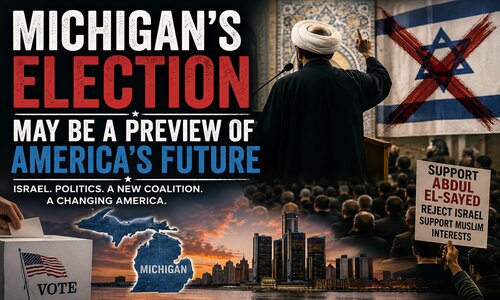
During the campaign's closing days, a Michigan cleric declared from the pulpit that Muslims had a religious duty to support Abdul El-Sayed because his opponent supported Israel. It was a remarkable moment--not simply because a religious leader endorsed a candidate, but because support for Israel was presented as a disqualifying issue.
Whether El-Sayed ultimately wins or loses, the campaign has revealed something Christians should not ignore. Across parts of America, a new political coalition is emerging where Israel increasingly serves as the defining issue around which activists, religious leaders, and organized voting blocs are mobilizing.
Michigan may simply be the first state where that reality became impossible to ignore.
For decades, support for Israel was one of the few issues that enjoyed broad bipartisan consensus in Washington. Republicans and Democrats often disagreed over the details of Middle East policy, but America's strategic partnership with Israel remained remarkably durable. That consensus is no longer guaranteed.
Today, Israel has become one of the most polarizing issues in American politics. Increasingly, candidates are being judged less by their positions on taxes, healthcare, or the economy than by where they stand on the Jewish state. The aftermath of October 7 accelerated this trend, exposing deep divisions inside political parties, universities, activist organizations, and even religious communities.
The Michigan Senate race illustrates how dramatically the conversation has shifted.
According to translated remarks reported by MEMRI, the cleric did not simply encourage civic participation. He framed voting for El-Sayed as a religious obligation because he was a fellow Muslim who would support Muslim interests, while portraying support for Israel as grounds for rejecting the opposing candidate. Regardless of how one views the election itself, the message reflected an unmistakable reality: Israel is increasingly becoming a political litmus test.
That raises questions extending far beyond a single campaign.
A New Political Coalition
One of the most significant developments in recent years has been the emergence of an increasingly organized coalition united by criticism of Israel.
This coalition is not monolithic. It includes progressive activists, some Muslim advocacy organizations, student protest movements, democratic socialist groups, and pro-Palestinian activist networks. These groups disagree on many domestic issues, yet opposition to Israeli policy has become a cause capable of bringing them together politically.
Their influence is becoming increasingly visible.
Candidates are facing pressure to call for restrictions on military aid, recognize a Palestinian state, distance themselves from Israel's government, or adopt stronger criticism of Israeli military actions. Primary elections, once focused almost exclusively on local concerns, are increasingly becoming referendums on Middle East policy.
Whether one agrees with these positions or not, their growing political influence is difficult to dismiss.
Why Michigan Matters
Michigan occupies a unique place in American politics.
It is a perennial swing state. It is home to one of the nation's largest Arab-American communities and one of the largest Muslim populations in the United States. Elections are frequently decided by narrow margins, meaning highly motivated voting blocs can have an outsized influence on statewide races.
That makes Michigan more than another battleground state.
It can serve as an early indicator of trends that eventually appear elsewhere.
If candidates begin concluding that strong support for Israel carries increasing political costs in competitive states, campaign strategies may change accordingly. Future office seekers may adjust their rhetoric not because their convictions have changed, but because the electoral landscape has.
That possibility deserves careful attention regardless of who wins any single election.
The Real Story Isn't One Election
Political observers often focus on winners and losers.
History, however, is frequently shaped by longer-term shifts that receive far less attention at the time they begin.
The more significant question is not whether one Senate candidate prevails. It is whether America is entering a new era in which organized voting blocs increasingly define political loyalty through the lens of Israel.
If that trend continues, future elections may see growing pressure on candidates to modify long-held positions regarding America's closest ally in the Middle East. Foreign policy debates that once took place primarily in Washington could increasingly determine local and statewide elections across the country.
The implications extend well beyond party politics.
America's alliance with Israel has rested not only on military cooperation and shared strategic interests, but also on decades of public support. If that public consensus weakens, future administrations--regardless of party--may face increasing pressure to reshape the relationship.
A Moment Christians Should Notice
For Christians who view Scripture as authoritative, these developments carry significance beyond ordinary political analysis.
The Bible consistently portrays Jerusalem as a city that will become a source of international controversy. Zechariah wrote that God would make Jerusalem "a cup of trembling" and "a burdensome stone" for the nations (Zechariah 12:2-3). We should all be paying attention when the trajectory of world events increasingly places Israel at the center of political conflict.
Michigan's Senate race may soon fade from the headlines. The winning candidate may celebrate, the losing candidate may move on, and the news cycle will quickly shift elsewhere.
But the broader lesson will remain.
Whether Abdul El-Sayed wins or loses, the campaign has highlighted a political realignment that is larger than any individual candidate. Israel is increasingly becoming a defining issue around which new coalitions are forming, political loyalties are shifting, and future elections may be fought.
If Michigan proves to be a preview rather than an exception, Christians would do well to watch carefully. The most important story may not be who won one Senate seat--but what that campaign revealed about the direction of American politics in the years ahead.