From Scripture To Queer Tarot-The United Methodist Church's Theological Collapse
 By PNW Staff August 27, 2026
Share this article:
There was a time when the controversy inside the United Methodist Church centered primarily on homosexuality, same-sex marriage and the ordination of practicing LGBTQ clergy. Those battles were serious enough to fracture one of America's largest Protestant denominations.
But what is happening at one United Methodist congregation in Omaha, Nebraska, illustrates how much further theological drift can go once Scripture stops functioning as the final authority.
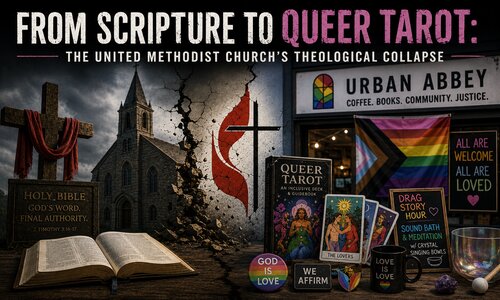
Urban Abbey is not a traditional church building. It operates as a United Methodist congregation inside a bookstore and coffee shop, describing itself as an intentionally progressive Christian community. Its founding pastor, Rev. Debra McKnight, is openly identified by the church as an advocate for "social justice, women's rights, and the LGBTQ+ community" who seeks to "heal the wounds created by conservative Christianity."
The question Christians should be asking is: heal people from what?
If "conservative Christianity" means believing that Scripture actually establishes boundaries regarding sexuality, worship and the nature of God, then what McKnight appears to be offering is not healing from Christianity's abuses. It is liberation from Christianity's doctrines.
Consider what Urban Abbey itself promotes.
The congregation proudly hosts Drag Story Hour, describing it as an event where drag performers read to children so they can encounter people who "defy rigid gender restrictions." The church says it provides an "affirming environment" for what it calls "gender creative children and adults."
Urban Abbey's spiritual experimentation extends considerably further. Its own spiritual-formation page advertises "sound baths and singing bowls," Mandala meditation and other practices presented as ways of expanding one's spiritual journey. A past event specifically promoted a meditative "Sound Bath" using crystal singing bowls, chimes and other instruments to facilitate what organizers called healing and spiritual renewal.
Recent reports have also highlighted merchandise reportedly promoted through Urban Abbey's bookstore, including Pride items, LGBTQ-inclusive literature and Queer Tarot: An Inclusive Deck & Guidebook.
For Christians, tarot is not simply an edgy lifestyle product. Scripture consistently warns God's people against divination, sorcery and attempts to seek spiritual knowledge through occult practices. Deuteronomy 18:10-12 could hardly be more direct.
Yet perhaps even more revealing is McKnight's approach to Scripture itself.
A widely circulated 2024 sermon drew attention because McKnight attempted to reconsider the biblical portrayal of Jezebel and the religious environment surrounding the worship of Baal and Asherah. Conservative critics who documented the sermon noted that she presented Jezebel far more sympathetically than the biblical narrative traditionally has and challenged conventional Christian interpretations surrounding Asherah worship.
That is an extraordinary theological road to travel.
Throughout the Old Testament, Israel's accommodation of Baal and Asherah was not presented as beautiful religious diversity. It was apostasy.
Judges repeatedly describes Israel provoking God by serving the Baals and Asherahs. Elijah's confrontation on Mount Carmel was not an interfaith dialogue between equally valid spiritual traditions. It was a confrontation between the living God and false worship. Jezebel's campaign against the prophets of God is hardly incidental to her biblical reputation.
The danger here is larger than one controversial sermon.
Once biblical villains must be rehabilitated, pagan worship reconsidered, sexual boundaries overturned and practices historically associated with occult spirituality incorporated into church life, Christians eventually must ask what remains that the church is actually willing to call false.
That question now hangs over the United Methodist denomination itself.
More than 7,600 American United Methodist congregations left the denomination during its recent disaffiliation process--roughly 26 percent of its U.S. churches and approximately 24 percent of its members.
Then, at the 2024 General Conference, the UMC formally removed its prohibition against ordaining practicing gay clergy, eliminated restrictions surrounding same-sex weddings and removed longstanding language declaring homosexual practice "incompatible with Christian teaching." Those changes are now fully in effect.
Urban Abbey therefore should not simply be dismissed as an isolated progressive congregation that wandered off on its own.
It represents the logical danger facing any denomination that gradually replaces the question "What does Scripture say?" with "How can Scripture be reinterpreted to affirm what contemporary culture already believes?"
There is an enormous difference between welcoming sinners and affirming sin. Jesus welcomed people considered moral outcasts, but He did not redefine holiness so they could remain unchanged. Christianity offers grace precisely because it recognizes that every one of us needs repentance, forgiveness and transformation.
That distinction is disappearing across much of progressive Christianity.
For Methodists who still believe in biblical authority, however, the collapse of one denomination does not mean the collapse of Methodism.
The Global Methodist Church officially launched in 2022 with an explicit commitment to the authority of Scripture, historic Christian doctrine, Wesleyan holiness and the transforming power of the Gospel. It continues to define marriage as the covenantal union of one man and one woman while welcoming everyone to experience Christ's redemptive grace.
That offers Bible-believing Methodists an increasingly important alternative.
John Wesley did not launch the Methodist movement because Christianity needed fewer doctrines, fewer calls to holiness or greater accommodation with the spirit of the age. Methodism grew because Wesley preached repentance, conversion, sanctification and "scriptural holiness."
The tragedy of today's United Methodist crisis is therefore deeper than disagreements over sexuality.
A church can survive changing music, changing buildings and changing cultural circumstances.
What it cannot survive spiritually is changing the authority that determines what Christianity is.