
The September Perfect Storm: Too Many Warning Lights Are Flashing At Once
 By PNW Staff September 02, 2026
Share this article:
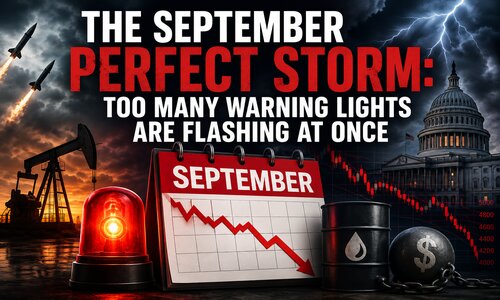
September has barely begun, and already the warning lights are flashing. War is escalating in the Middle East, oil prices are surging, diesel costs are soaring, and government bond yields are reaching levels not seen in decades. At the same time, America is carrying approximately $40 trillion in federal debt, the war in Ukraine continues to strain Europe, and investors are increasingly questioning whether the artificial intelligence boom has created another enormous financial bubble.
Any one of these developments would deserve attention, but the real concern is that they are happening at the same time. September already has an infamous reputation on Wall Street, historically ranking as the weakest month of the year for the S&P 500. That certainly doesn't mean September 2026 will produce a crash; history doesn't operate according to a calendar. But this September is arriving with an unusually combustible collection of risks already in place.
War Meets Wall Street
The most immediate danger is the rapidly escalating confrontation between the United States and Iran. On September 1, U.S. forces launched renewed strikes against Iranian targets following attacks against commercial shipping and American forces in the region, and Iran responded with missiles and drones directed toward U.S. positions.
The Strait of Hormuz remains at the center of the confrontation, making this much more than another regional military exchange. A substantial portion of the world's petroleum supply normally moves through this narrow waterway, so any prolonged disruption immediately raises questions about global energy supplies.
Markets are already reacting. Oil futures jumped sharply Tuesday as the conflict intensified, while diesel prices have risen dramatically. But the consequences don't stop at the gas pump. Diesel powers trucks, tractors, construction equipment and much of the machinery responsible for moving goods throughout the economy. Higher transportation costs eventually find their way into groceries, manufactured goods and countless other products, meaning another energy shock could push inflation higher just as central banks hoped they were finally bringing it under control.
The Bond Market Is Sending A Warning
Perhaps the most important development, however, isn't occurring in the stock market. It is happening in bonds, where government borrowing costs are rising rapidly across much of the developed world.
Japan's benchmark 10-year government bond yield has reached 3 percent for the first time since 1996. Britain's 10-year government bond yield has climbed above 5.2 percent, reaching levels last seen around the time of the 2008 global financial crisis, while Germany's benchmark yield has reached a 15-year high. Meanwhile, U.S. Treasury yields have also pushed toward levels that would have seemed extraordinary during the era of near-zero interest rates.
These numbers may sound abstract, but they eventually affect almost everyone because government bond yields influence mortgage rates, corporate borrowing, business expansion, auto loans and countless other forms of credit. The stock market gets most of the headlines, but the bond market may ultimately matter far more.
America's $40 Trillion Problem
That becomes particularly concerning when combined with another historic development: the United States is now carrying approximately $40 trillion in federal debt.
Enormous government debt is much easier to manage when interest rates are extremely low. It becomes considerably more difficult when borrowing costs remain elevated because, as older government debt matures, Washington must continually refinance portions of it at prevailing rates.
That potentially creates a dangerous cycle. More debt requires more Treasury issuance, investors may demand higher yields to absorb that debt, and those higher yields increase government interest expenses. Higher interest expenses then increase deficits, requiring still more borrowing.
For years, politicians from both parties have been able to postpone dealing seriously with America's fiscal trajectory. The bond market may eventually make postponement much more expensive.
AI Is Adding Another Layer Of Risk
Then there is artificial intelligence. AI may ultimately transform the global economy in extraordinary ways, but revolutionary technologies can still produce enormous financial bubbles. Railroads transformed America, yet railroad speculation repeatedly produced financial crises. The Internet transformed civilization, yet investors still lost trillions of dollars when the dot-com bubble collapsed.
Now questions are growing about whether AI investment is following a similar pattern. Companies are spending staggering sums on data centers, advanced chips, electrical generation and other infrastructure based on expectations that demand for AI will continue expanding at extraordinary rates.
There is another element that makes today's boom particularly important: AI is increasingly becoming a debt story. Enormous amounts of capital are flowing into data centers and supporting infrastructure through corporate bonds, private credit and other forms of financing.
That raises an uncomfortable question. What happens if AI valuations fall after enormous amounts of debt have already been committed to infrastructure based upon expectations of explosive future growth?
The dot-com crash was primarily an equity-market disaster, while the 2008 crisis was fundamentally a leverage and debt disaster. The danger today is that elements of both could eventually begin appearing together.
The Dominoes Are Getting Closer
This is why searching for a single trigger for the next financial crisis may be the wrong approach. Today's risks are increasingly interconnected, meaning a shock in one area can quickly create problems somewhere else.
Iranian escalation threatens the Strait of Hormuz. Disrupted energy supplies push oil and diesel higher, which raises transportation costs and inflation. Higher inflation makes it more difficult for central banks to lower interest rates, while elevated rates push borrowing costs higher for governments, corporations and consumers.
Meanwhile, Russia's continuing war against Ukraine places additional pressure on European energy supplies, government budgets and defense spending. America must finance approximately $40 trillion of existing federal debt while continuing to run enormous deficits, technology companies are spending unprecedented sums on the AI infrastructure boom, and consumers remain burdened by expensive mortgages, credit cards, auto loans and elevated living costs.
None of these developments guarantees a financial crisis. Together, however, they leave considerably less room for something else to go wrong.
September's Uncomfortable History
Then there is the calendar. September has witnessed some extraordinary moments in financial history, even though the month itself obviously does not cause financial crises.
The stock market was already deteriorating in September 1929 before the infamous October crash. The September 11 attacks in 2001 struck an economy and market struggling after the dot-com collapse, and on September 15, 2008, Lehman Brothers filed for bankruptcy, transforming an escalating credit crisis into a global financial panic.
History doesn't repeat according to the calendar, but September has an uncomfortable habit of exposing problems that were already developing beneath the surface. That is what makes September 2026 worth watching carefully.
For Christians, financial uncertainty should also serve as a reminder about where our confidence ultimately rests. Scripture repeatedly warns about the temporary nature of earthly wealth. Proverbs 23 warns that riches can suddenly "make themselves wings" and disappear, while James cautions those who confidently assume tomorrow will unfold exactly according to their plans.
That doesn't mean Christians should panic, abandon investments or attempt to predict every market movement. It means recognizing how quickly circumstances can change and refusing to place ultimate confidence in financial systems that can appear permanent right up until the moment they aren't.
For years, governments, corporations and consumers became accustomed to abundant credit, rising asset values and the assumption that policymakers could rescue the financial system whenever serious trouble emerged. Those assumptions may eventually be tested again.
The question isn't whether September is somehow destined to produce another financial crisis. It isn't. The real question is whether September 2026 has arrived at precisely the moment when too many economic dominoes are standing too close together.