
The Body Wasn't The Problem: Changing Children Physically Won't Heal Them
 By PNW Staff August 29, 2026
Share this article:
For years, one of the most powerful arguments for medically transitioning children has been that these treatments are necessary for their mental health. Puberty blockers and hormones, Americans were told, could relieve the intense psychological suffering experienced by young people struggling with their gender. Critics who urged caution were frequently confronted with an emotionally devastating question: Would you rather have a transgender child or a dead child?
But a newly released report from a major taxpayer-funded study is raising an uncomfortable question: What if changing the child's body doesn't actually solve what is happening inside the child's mind?
The National Institutes of Health funded a long-running research project titled "The Impact of Early Medical Treatment in Transgender Youth." According to NIH records, researchers recruited 95 young people beginning puberty suppression and hundreds more beginning cross-sex hormone treatment.
The recently obtained final report on the blocker cohort found that after two years, mental-health measures remained relatively unchanged and were described as being within a "clinically non-significant range." This hardly supports the simplistic claim that puberty blockers are a proven mental-health rescue.
That matters because these were deeply troubled young people before medical intervention began. According to the report, roughly half had clinically concerning depression and anxiety scores at baseline, about two-thirds had experienced suicidal thoughts, and approximately one-quarter reported having attempted suicide.
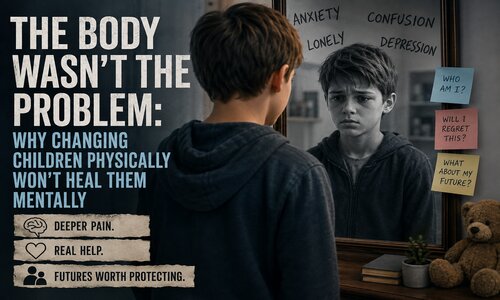
Those numbers should provoke compassion, but they should also provoke a different question: Why are these children suffering so profoundly in the first place? Instead of beginning with the assumption that the body needs to change, perhaps medicine should begin by exhaustively investigating what is happening within the child.
That is increasingly the direction other countries are taking. Britain's landmark Cass Review concluded that the evidence supporting medical interventions for gender-distressed children was remarkably weak. NHS England subsequently ended the routine use of puberty blockers for gender dysphoria in minors, emphasizing holistic assessment, including mental-health and neurodevelopmental evaluation.
That approach recognizes something our culture seems increasingly reluctant to acknowledge: psychological distress can be real without every conclusion a distressed person reaches about himself or herself necessarily being correct. We understand this principle elsewhere in medicine. A person suffering from anorexia may sincerely believe his or her body is overweight, yet compassion requires taking that suffering seriously without requiring a doctor to agree with the patient's perception of the body.
With gender distress, however, medicine has increasingly been asked to adopt a radically different principle: alter the body to accommodate the psychological perception. That should at least make us stop and ask whether we have reversed the proper direction of treatment.
The contradiction becomes even more striking when children are involved. We don't allow a 12-year-old to buy cigarettes, a 14-year-old to drink alcohol, or minors to enter most legal contracts, gamble in casinos, or make countless other consequential decisions reserved for adults.
Why? Not because children are unintelligent, but because they aren't adults. We recognize that adolescence is a period of extraordinary psychological, neurological, sexual and emotional development, and that what seems absolutely certain at 13 may look profoundly different at 23.
Yet we are asking some children to participate in medical decisions whose implications may reach decades into their futures. Will that 13-year-old someday want biological children? How important will sexual function become? How will he or she feel about these decisions at 25, 35 or 45? Those aren't questions a seventh-grader can meaningfully answer.
Puberty blockers also should not be reduced to the reassuring phrase "pause button." A major 2024 systematic review published in Archives of Disease in Childhood concluded that high-quality evidence concerning puberty suppression remains lacking. Researchers found limited or inconsistent evidence regarding psychological health, gender dysphoria, cognitive development and fertility, while multiple studies demonstrated reductions in bone-density measures during treatment.
More recent research continues to examine whether bone development fully catches up after subsequent hormone treatment, with the long-term picture still carrying uncertainty. That doesn't mean every effect of puberty blockers is irreversible, and critics should be precise about this. Some physical effects may recover after treatment ends or subsequent hormones are introduced, while other long-term consequences remain uncertain.
But uncertainty is itself important when the patient is a child. Normally, uncertainty surrounding a medical intervention involving children produces caution. Here, for years, it too often produced confidence.
Perhaps the most revealing development is what Britain is doing now: conducting more rigorous research precisely because fundamental questions about effectiveness and long-term outcomes remain unanswered. Children have already been receiving these interventions for years, yet researchers are still trying to establish answers to some of the most basic questions about benefits and risks.
Meanwhile, the mental-health crisis among young people continues. Depression, anxiety, loneliness, autism and other neurodevelopmental conditions, family instability, bullying, social-media pressure, sexual confusion, body-image problems and trauma can all complicate adolescent development.
When a child presents with multiple psychological difficulties, those problems deserve serious investigation rather than being automatically interpreted through a single lens.
The child needs help, and that should never be controversial. The real question is what genuine help looks like.
Sometimes compassion means challenging conclusions when necessary and allowing time for development before making decisions with potentially lifelong consequences. Our society understands that principle everywhere else because children deserve protection precisely because they cannot see their entire lives from where they stand.
An 11-year-old cannot imagine being 35 and desperately wanting children. A 13-year-old cannot fully understand adult sexuality. A 15-year-old struggling with depression cannot know whether today's identity will remain unchanged through adulthood. That is why adults are supposed to supply something children don't yet possess: perspective.
Perhaps pediatric gender medicine needs to recover an older medical instinct—first understand the patient, then treat the underlying problem, and avoid permanently altering a healthy body.
Because if a child's deepest wounds are psychological, emotional or developmental, changing the body may never heal them. The body may not have been the problem in the first place.