
Hidden Beneath The Waves: The New Nuclear Threat From Russia And China
 By PNW Staff September 02, 2026
Share this article:
While much of the world is watching drones transform the battlefields of Ukraine and the Middle East, another military revolution is taking place largely out of sight.
It is happening beneath the oceans.
Russia and China are rapidly developing underwater nuclear capabilities designed around one of the most important principles of nuclear warfare: survival. Missiles sitting in fixed silos can be targeted. Air bases can be monitored by satellites. But a nuclear submarine that disappears beneath millions of square miles of ocean presents a completely different problem.
And both Moscow and Beijing are investing heavily in making that problem much more difficult for the United States.
Russia's newest contribution is particularly ominous.
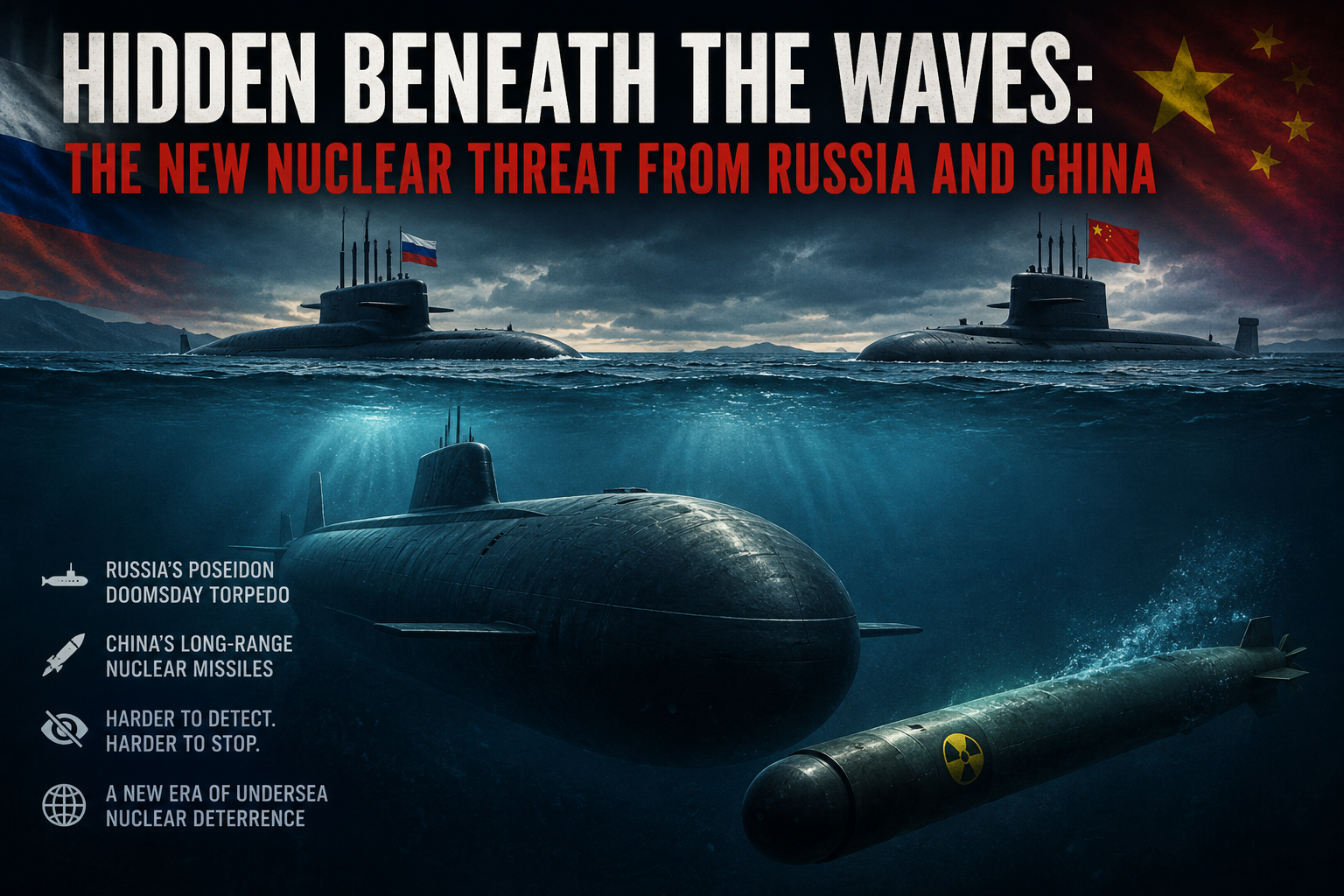
The nuclear-powered submarine Khabarovsk reportedly began sea trials in Russia's White Sea in August. Launched in November 2025, the vessel is the first of a new class specifically designed to carry Russia's Poseidon nuclear-powered underwater weapon. Reports indicate that Khabarovsk could eventually carry as many as six Poseidons.
Poseidon is unlike the ballistic missiles that dominated Cold War nuclear planning. It is essentially an enormous autonomous underwater vehicle powered by its own nuclear reactor and capable of carrying a nuclear warhead.
Russian claims surrounding the weapon have often been dramatic and should be treated cautiously, but the concept itself is serious. Instead of sending a warhead through space on a predictable ballistic trajectory, Poseidon is designed to travel enormous distances underwater before approaching its target.
That makes it primarily a weapon of retaliation.
If Russia's land-based missiles, bombers and military installations were devastated during a nuclear exchange, Moscow wants an enemy to know that weapons hidden beneath the ocean could still be coming.
That is why Poseidon has earned the disturbing nickname "doomsday weapon."
China, meanwhile, is pursuing a somewhat more conventional but potentially even more consequential expansion of its underwater nuclear forces.
On July 6, Beijing conducted a rare test of a strategic missile launched from a nuclear-powered submarine toward the Pacific. China said the missile carried a dummy warhead and described the launch as routine training, but the test demonstrated something Washington and its Pacific allies cannot ignore: China's sea-based nuclear deterrent is becoming increasingly capable.
The missile was widely believed to be China's JL-3, although Beijing did not publicly identify it. The JL-3 has an estimated range of roughly 10,000 kilometers, giving Chinese ballistic-missile submarines the ability to threaten portions of the continental United States without traveling nearly as far into the Pacific as earlier Chinese systems required.
China currently operates six Jin-class Type 094 ballistic-missile submarines and has been upgrading them with longer-range JL-3 missiles. Even more important is what comes next: Beijing is developing the quieter Type 096 ballistic-missile submarine while rapidly expanding its broader nuclear-powered submarine fleet.
U.S. naval intelligence warned Congress earlier this year that China's undersea forces could eventually challenge American regional maritime dominance. China's submarine fleet already exceeds 60 vessels, while its shift toward increased production of nuclear-powered submarines represents a significant change from its historical dependence on diesel-electric boats.
Put Russia and China together and the strategic picture becomes considerably more troubling.
For most of the Cold War, American nuclear planning was overwhelmingly focused on one principal nuclear adversary: the Soviet Union. China possessed nuclear weapons, but its arsenal was comparatively small.
That world is disappearing.
China's nuclear stockpile is now estimated at roughly 620 warheads, while Beijing is simultaneously expanding its land-based missiles, submarine-launched weapons and bomber capabilities. Russia already possesses one of the world's two largest nuclear arsenals and is adding unconventional systems such as Poseidon.
The United States therefore faces the increasingly difficult challenge of deterring two major nuclear powers at the same time.
Submarines make that equation especially dangerous because deterrence depends heavily upon knowing what an opponent can do—and where his weapons are located.
A missile silo can be photographed. A bomber base can be watched. Satellite constellations can monitor missile fields and military installations almost continuously.
But somewhere beneath the Pacific, Arctic or Atlantic, a submarine carrying nuclear weapons can simply disappear.
That uncertainty is precisely what makes these vessels so valuable. Even after absorbing a devastating surprise attack, a nation with surviving ballistic-missile submarines retains the ability to retaliate. The enemy can never be certain it has eliminated the threat.
Russia's Poseidon takes that logic another step by attempting to create an entirely different underwater retaliatory system.
Meanwhile, China's expanding submarine fleet forces the United States to devote greater resources to tracking increasingly capable vessels across the vast Pacific at the same time Washington must continue monitoring Russian submarines in the Arctic and Atlantic.
None of this means nuclear war is imminent. In one sense, survivable retaliatory weapons can strengthen deterrence because they make a successful first strike virtually impossible.
But they also reveal where the world's major powers believe the future may be heading.
While headlines concentrate on inexpensive drones, artificial intelligence and hypersonic missiles, Russia and China are spending enormous resources preparing for a far darker possibility.
The most frightening weapons of the next great-power conflict may not be the ones everyone can see crossing the sky.
They may already be silently moving beneath the waves.