
When Churches Become Mosques: The Changing Face Of An American City
 By PNW Staff September 22, 2026
Share this article:
Drive through parts of Warren, Michigan, and you can see America's religious transformation written into the buildings themselves.
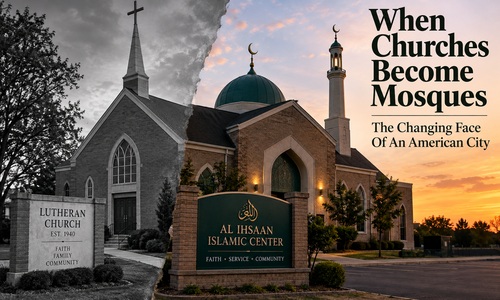
A Lutheran church that stood for more than 80 years is now the Al Ihsaan Islamic Center. The cross that once topped its steeple is gone. A former Baptist church has become another Islamic center. An old industrial machinery business has become a mosque.
And another large mosque is being built.
Within seven miles of one Warren neighborhood highlighted in a new Fox News investigation, residents identified five new mosques. Longtime residents say the transformation has happened with stunning speed -- largely within the past decade.
This isn't simply another story about immigration.
It is a picture of two religious trajectories moving in opposite directions.
Islam is building.
Christianity is selling.
And the buildings tell the story.
A Neighborhood Transformed In Less Than A Decade
Warren was once the picture of blue-collar, postwar America. Auto workers, veterans, modest homes, neighborhood churches and families formed the backbone of the community. Today it remains Michigan's third-largest city, but some longtime residents barely recognize portions of the place they grew up in.
Justin Tye returned to Warren 13 years ago and bought his childhood home. He told Fox News that the neighborhood hadn't changed dramatically when he first returned.
Then it did.
"This whole neighborhood has been flipped in a decade -- less than a decade -- to Muslim," he said.
The transformation isn't merely anecdotal.
Warren's own government records document the expanding Islamic infrastructure.
At an April 2025 Planning Commission meeting, one Muslim resident appealed for approval of a new Islamic center on behalf of what he explicitly described as Warren's "growing Muslim Community." Another explained that Muslims currently traveled longer distances to worship and needed a local mosque because they pray five times each day.
Months later, the city was considering expansion of another Islamic prayer facility because of the "current and growing needs" of its community. Another project involved adding minarets to an existing mosque. Yet another city proceeding involved plans for an Islamic worship center on Thirteen Mile Road.
This is what demographic and religious transformation looks like on the ground.
It doesn't require armies.
It requires families, institutions, buildings, businesses, religious conviction and another generation willing to carry that conviction forward.
When The Church Becomes The Mosque
And that should make Christians uncomfortable.
Because while Islam is expanding its religious footprint in communities like Warren, Christianity has spent decades surrendering much of its own.
When an 80-year-old Lutheran church becomes a mosque, the most important question isn't simply why Muslims wanted the building.
Why didn't Christians need it anymore?
That question extends far beyond Michigan.
Across America, churches have closed, denominations have hemorrhaged members and generations have grown increasingly disconnected from Christianity. Buildings constructed through the sacrifices of Christians decades ago eventually become too expensive, too empty or simply unnecessary.
Someone eventually buys them.
In Warren, sometimes that buyer is a Muslim congregation.
The symbolism could hardly be clearer.
The cross comes down.
The mosque opens.
And life moves on.
Growing Pains -- And Growing Frustration
Meanwhile, some longtime Warren residents say the transformation has brought practical conflicts as well.
Residents interviewed by Fox described Friday traffic problems, vehicles blocking driveways and lawns, amplified religious services and a feeling that their concerns aren't being taken seriously.
Those disputes have surfaced in official city proceedings too. At a September Planning Commission meeting concerning additions to an existing mosque, residents complained that parking during special events was "out of control," creating traffic problems and obstructing sidewalks.
And Warren is hardly occurring in isolation from the enormous Muslim presence already established in nearby Dearborn and other parts of metropolitan Detroit.
Islam Is Building. Is Christianity Retreating?
The lesson Christians should draw from Warren isn't that Muslims practice their religion too seriously.
Perhaps it is that Christians increasingly don't.
Muslims organize communities around their faith. They establish mosques. They teach their children. They build institutions. They create businesses serving their communities. They arrange their schedules around religious observance.
Christian America increasingly treats faith as something squeezed into Sunday morning -- assuming there isn't soccer practice.
Cultures rarely remain spiritually empty.
When one worldview retreats, another eventually occupies the space.
That is why the converted churches of Warren matter far beyond Michigan.
Those buildings are monuments to a transition already underway.
A Lutheran congregation once worshipped beneath that steeple. Children once played outside. Families gathered there. Hymns were sung. Sermons were preached. Generations passed through its doors.
Today Muslims gather there for Islamic prayer.
No invading army seized it.
No government confiscated it.
Christians relinquished it, and Muslims had enough religious commitment and community cohesion to take its place.
That may be the most sobering part of Warren's story.
One Church At A Time
Christians can complain about Islam's growing influence in America. They can debate immigration policy, assimilation, mosque construction and cultural change.
But eventually Christianity must confront a much more uncomfortable reality.
A civilization cannot preserve a Christian inheritance after abandoning the Christianity that created it.
If Christians stop filling churches, someone else may eventually fill the buildings.
Warren is showing America what that future can look like.
One church at a time.