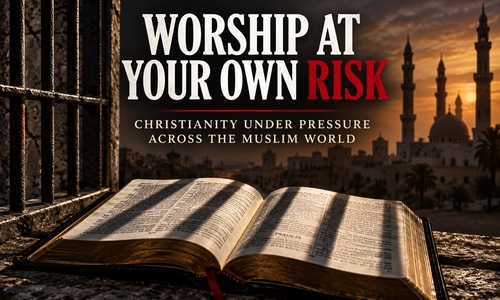
Worship At Your Own Risk: Christianity Under Pressure Across The Muslim World
 By PNW Staff September 30, 2026
Share this article:
For millions of Christians, Sunday worship begins with a question most Americans have never had to ask: What could happen to me if someone discovers I am here?
Will the police come? Will the church be closed? Will my Bible be confiscated? Could I lose my job, be rejected by my family, be accused of blasphemy, or find myself sitting in a prison cell because I chose to follow Jesus Christ?
Across parts of the Muslim world, these are not hypothetical questions.
Christianity continues to survive — and in some places grow — under governments and societies where abandoning Islam, evangelizing Muslims, operating an unapproved church or publicly expressing Christian beliefs can bring consequences ranging from harassment and surveillance to arrest, imprisonment and violence.
The methods differ from country to country. Some governments use licensing laws and bureaucratic restrictions to squeeze churches out of existence. Others target converts and underground congregations as threats to the state. Elsewhere, blasphemy laws create an environment in which an accusation involving Islam can place a Christian's freedom — and potentially life — in jeopardy.
Three recent cases illustrate the different faces of this pressure.
In Algeria, police raided a Christian worship gathering and seized Bibles and Christian literature.
In Iran, an intensified crackdown has swept Christians associated with underground churches into arrests and imprisonment, while one Christian ministry reports that dozens of its ministers have been killed.
And in Pakistan, Christians continue to face blasphemy prosecutions under laws carrying the possibility of a death sentence.
Three countries. Three different systems. One recurring reality: openly following Christ can come with a price.
And sometimes all it takes to discover that price is gathering together to worship.
Algeria: When A Worship Service Becomes A Police Matter
Twelve Christians gathered quietly for worship in an apartment connected to a humanitarian shelter in Algeria on September 4.
Then the special forces arrived.
Police raided the gathering at the House of Refuge in L’Ayaida, about 22 miles east of Oran. All 12 Christians present were detained. Christian literature was seized along with mobile phones and identity cards. The women were eventually released, while some of the men reportedly remained in custody until around 3 a.m.
Their alleged offense was not violence, extremism or plotting against the government.
They had gathered for Christian worship.
Christians fear the group could be prosecuted under Algeria's Ordinance 06-03, the 2006 law governing non-Muslim worship. Among other provisions, the law restricts collective non-Muslim worship to approved locations and criminalizes certain attempts to persuade Muslims to embrace another religion.
Penalties for some violations can include years in prison.
The September raid also didn't occur in isolation.
Open Doors reports that nearly all 47 churches associated with the Protestant Church of Algeria have received closure orders or have been sealed. More than 50 Christians have reportedly faced prosecution connected to their faith in recent years.
That creates an extraordinary dilemma: Christians are told they must worship within approved structures while churches themselves have been systematically closed.
The result is exactly what happened in L’Ayaida.
A small gathering of believers inside an apartment became a matter for police surveillance, detention and confiscated Christian literature.
Iran: Christianity Goes Underground
Several thousand miles east, the stakes become even higher.
Iran recognizes some historic Christian minorities, but converts from Islam and Christians associated with evangelical house churches operate in a dramatically different environment.
Texas-based Iran Alive Ministries recently reported that at least 33 Christian ministers associated with its network had been killed amid Iran's recent unrest and crackdown. The ministry also reported that 131 Christians connected to its work had been arrested, with some detainees potentially facing extremely serious charges.
Those specific numbers come from Iran Alive's network and have not all been independently verified. But Iran's broader persecution of converts and underground Christian congregations has been extensively documented by religious-freedom organizations.
The pressure extends beyond church meetings.
Christian broadcasting has also come under intensified restriction, creating additional danger for Iranians seeking Christian teaching outside government-approved religious structures.
Yet something remarkable continues beneath the surface.
Christianity refuses to disappear.
Iran Alive says thousands of Iranians have responded to the Christian message this year despite the danger. Underground believers continue gathering. Converts continue sharing their faith. According to the ministry, some Christians who have been imprisoned have even viewed prison as another place to share the Gospel.
That exposes one of the great limitations of religious persecution.
A government can confiscate a Bible.
It can close a church.
It can arrest a pastor.
But stopping people from believing what is written inside that Bible is considerably harder.
Pakistan: When An Accusation Can Destroy A Life
Pakistan presents another form of pressure — one built around some of the world's most severe blasphemy laws.
Christian laborer Amir Masih was arrested in August following allegations involving religious remarks and material reportedly circulated on social media. Police registered charges that included Section 295-C of Pakistan's Penal Code, which deals with derogatory remarks concerning Islam's prophet and carries the death penalty.
The allegations against Masih have not been proven in court, and Christian and human-rights organizations have called for an independent investigation into the evidence.
His case isn't unique.
Twenty-six-year-old Christian Samuel Arif was arrested in Lahore later that month in another blasphemy case. His family disputes the allegations. He too reportedly faces charges under Section 295-C.
Pakistan has not carried out a state execution for blasphemy, but defendants have received death sentences and can spend years imprisoned while their cases move through the courts.
A July 2026 British government assessment cited USCIRF information showing at least nine Pakistani Christians serving death or life sentences for blasphemy and another nine detained on blasphemy allegations as of May.
But prison isn't the only danger.
Blasphemy accusations in Pakistan have repeatedly triggered mob violence and threats against religious minorities. That means an accusation itself can have devastating consequences long before a court reaches a verdict.
Families flee.
Communities turn against the accused.
Christian neighborhoods can become targets.
Churches can require protection.
A few words attributed to the wrong person — whether accurately or falsely — can transform an ordinary life overnight.
Three Countries, Three Methods
Algeria, Iran and Pakistan are very different nations. Their governments, laws and Muslim populations should not be treated as interchangeable.
But the experiences of Christians within them reveal a disturbing pattern.
In Algeria, government regulation determines where Christians may legally worship and churches have been systematically closed.
In Iran, converts and underground evangelical congregations face intense scrutiny and the possibility that Christian activity will be treated as a threat to the Islamic state.
In Pakistan, blasphemy allegations can expose Christians to prosecution, imprisonment, death sentences and mob violence.
Control the worship.
Suppress the conversion.
Criminalize the alleged blasphemy.
Different mechanisms. Similar vulnerability.
And underneath each situation lies a question Christians in the West rarely have to contemplate:
What happens when following Christ becomes dangerous?
For Christians living under these pressures, Christianity isn't merely an identity selected on a census form. Attending a worship gathering, possessing Christian literature, sharing the Gospel or publicly identifying with Jesus Christ can carry consequences most Western believers have never experienced.
Remember Those In Chains
It is easy for persecuted Christians to become statistics.
Twelve arrested.
Dozens reportedly killed or detained.
Christians sitting in Pakistani prisons under blasphemy convictions or accusations.
But behind every number is a person who has made the same decision believers have been making for nearly two thousand years: Christ is worth following even when following Him has a price.
Hebrews gives the Church an instruction that remains painfully relevant:
“Remember them that are in bonds, as bound with them.”
The persecuted Church isn't a historical chapter belonging to Roman emperors and ancient martyrs.
It exists right now.
It meets in apartments when churches are closed.
It worships behind doors that may suddenly be opened by police.
It hides Christian literature.
It gathers in underground house churches.
It enters courtrooms accused of blasphemy.
And sometimes believers must decide whether worshipping Jesus Christ is worth the possibility that authorities — or an angry crowd — will discover what they are doing.
For much of the Western Church, worship remains something Christians schedule.
For millions of believers elsewhere, it remains something they risk.