Israel's Most Unexpected Weapon Isn't A Missile - It's A Netflix Show
 By PNW Staff September 28, 2026
Share this article:
Israel has spent nearly three years trying to explain October 7 to the world.
It released videos. It brought journalists to view footage of the massacre. Survivors told their stories. Families described hiding for hours while terrorists moved from house to house. Hostages returned with accounts of captivity. Israeli officials stood before cameras and international bodies pleading with the world not to forget what started the war.
And yet, much of the world moved on.
Now something unexpected is happening.
A television show may be reaching people Israel's diplomats never could.
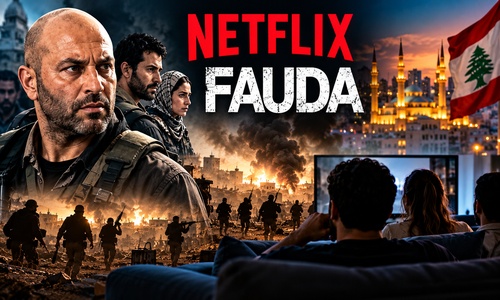
The fifth season of the Israeli series Fauda was released globally on Netflix on September 8, and its reception has been extraordinary. The show entered Netflix's Top 10 in dozens of countries and drew 2.1 million global views during its first week. Most remarkably, it became the No. 1 Netflix television show in Lebanon. It also reached the Top 10 in Jordan, Qatar, Bahrain, the United Arab Emirates, Oman and Kuwait.
Think about that for a moment.
An Israeli television series, created by Israelis, centered this season on the trauma of October 7, became the most watched Netflix show in Lebanon.
No Israeli government information campaign could have dreamed of that kind of penetration.
And Fauda may be accomplishing something even more important.
It is making people feel what happened.
The Day The Story Changed
Fauda was already an international success long before October 7. The series follows Israeli operatives working undercover among Palestinians, and much of its appeal comes from its refusal to portray the conflict as a simple video game of heroes shooting villains.
Palestinian characters have families, motivations and fears. Israeli characters make mistakes, suffer psychologically and sometimes cross lines themselves.
That complexity matters because audiences don't feel as though they're watching a government commercial.
But October 7 changed the show just as it changed Israel.
Writers had already begun working on Season 5 when Hamas attacked southern Israel. Co-creator Avi Issacharoff said the series could not simply continue as though the largest event Israel had experienced in generations hadn't happened.
Two episodes of the new season return directly to October 7.
Co-creator and star Lior Raz explained that they weren't trying simply to recreate the massacre. They wanted to place characters viewers had known for years inside situations based upon what actually happened.
Accuracy, Raz said, was important.
The result has produced extraordinary reactions.
Viewers around the world have described the October 7 episodes as devastating, frightening and difficult to watch. Some said they had to stop afterward simply to process what they had seen. Social media reactions have appeared from viewers in the United States, Europe, Brazil and elsewhere describing a much deeper emotional understanding of the massacre after watching the episodes.
Which raises an uncomfortable question.
Why did it take a television drama?
When October 7 Disappeared
Part of the answer is what happened to the world's attention after October 7.
The attack initially dominated global coverage. But as Israel entered Gaza, the camera moved.
For nearly three years, audiences have been saturated with images of Gaza: destroyed buildings, wounded civilians, grieving families, hungry children and enormous casualty figures.
October 7 gradually became the prologue rather than the story.
For younger viewers encountering the conflict primarily through social media, the chronology could become almost inverted. Israel's military response was constantly visible. The event that triggered it increasingly wasn't.
Then Fauda put viewers back inside October 7.
Not as diplomats.
Not as military analysts.
Not as competing casualty statistics.
As people.
Families hiding. Israelis trying to survive. Terrorists crossing into communities. Confusion. Helplessness. Fear.
That is the extraordinary power of storytelling. Statistics inform the brain. Stories can reach somewhere else entirely.
The Information War Israel Was Losing
There is another reason this moment deserves attention.
Recent comments by prominent Gazan photojournalist Motaz Azaiza have raised serious questions about what Western audiences were shown from Gaza.
Azaiza acknowledged in a September interview that Gaza journalists sometimes lowered their cameras when Palestinians criticized Hamas. He also said he filmed Palestinians beating Israeli captives on October 7 but withheld that footage because he did not want Israel to use it to identify those involved.
This demonstrates something critical about information coming from territory ruled by an armed terrorist organization: what the world sees can depend enormously upon where the camera is pointed--and when it is turned off.
And now comes the irony.
A fictional television show may be exposing audiences to realities they rarely encountered through the news.
The Cameras Cross Borders
Perhaps the most fascinating part of Fauda's success isn't happening in New York, London or Paris.
It's happening in the Arab world.
People in Lebanon, Jordan, Qatar, Bahrain and other countries are voluntarily watching an Israeli production about Israeli counterterrorism operatives and Israeli trauma.
Fauda hasn't suddenly created peace in the Middle East. Watching a television series doesn't tell us what individual viewers believe about Israel, Hamas or the war.
But curiosity itself is significant.
Millions of people now have access to Israeli characters speaking Arabic, interacting with Palestinian society and experiencing the conflict from inside Israel rather than through someone else's description of Israel.
That is something diplomacy has struggled to achieve.
The Battle Beyond The Battlefield
Israel possesses one of the world's most technologically advanced militaries. It has missile defenses, intelligence capabilities, fighter aircraft and precision weapons.
Yet one of the country's greatest vulnerabilities has always existed somewhere those weapons cannot reach: public perception.
Wars today are fought twice.
Once on the battlefield.
And again on the screen.
Israel can destroy a missile launcher. It cannot destroy an idea held by hundreds of millions of people. It can intercept a rocket. It cannot intercept a narrative.
That requires something different.
And perhaps that explains why Fauda is accomplishing what another press conference at the United Nations never could.
For a few hours, people aren't being asked to choose between competing political arguments.
They're being invited into the experience.
They see fear. They see families. They see trauma. They see Israelis not as geopolitical abstractions but as human beings living inside a conflict most viewers have experienced only through headlines.
Nearly three years after October 7, the world is watching those events again.
This time it isn't because an Israeli spokesman asked them to.
They clicked "Play" themselves.
And somewhere in Lebanon, Jordan, Qatar, Europe and America, viewers who thought they understood October 7 are discovering that perhaps they never really did.