
The Debt Bomb Meets The Socialist Generation
 By PNW Staff September 25, 2026
Share this article:
Something strange is happening in America.
The federal government is running deficits normally associated with wars or severe recessions. Interest on the national debt has crossed the trillion-dollar mark. Washington continues borrowing enormous sums simply to maintain existing commitments. And according to the Congressional Budget Office, federal debt held by the public is already roughly equal to the entire annual output of the U.S. economy.
Yet at precisely the moment government is demonstrating how difficult it is to pay for the promises already made, a growing number of Americans want government to make even more promises.
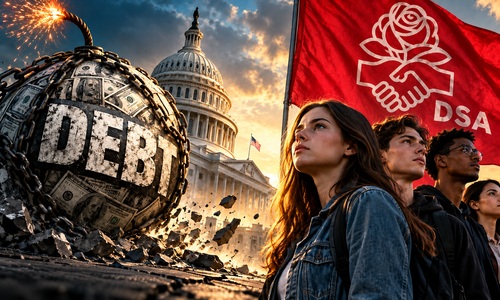
That is the collision now taking shape: America’s debt crisis is meeting America’s socialist generation.
And neither trend should be dismissed.
The Debt Problem Is No Longer Somewhere In The Future
The numbers are becoming difficult to comprehend.
The Institute of International Finance reported this week that global debt surpassed $365 trillion during the first half of 2026. Governments around the world are increasingly confronting higher borrowing costs and growing interest expenses.
America is hardly watching from the sidelines.
The Congressional Budget Office projects the federal government will run a $1.9 trillion deficit in fiscal 2026. By 2036, that annual deficit is projected to reach $3.1 trillion.
Debt held by the public is projected to rise from 101% of GDP today to 120% by 2036, surpassing the previous record reached following World War II.
But perhaps the most sobering number is interest.
Net federal interest costs are projected to exceed $1 trillion this year and more than double to $2.1 trillion annually by 2036. At that point, interest would nearly equal all federal discretionary spending combined.
That money doesn't build a bridge.
It doesn't hire a teacher.
It doesn't strengthen the military.
It doesn't provide healthcare.
It simply pays for yesterday.
And Washington continues adding tomorrow's obligations to yesterday's bill.
Enter The Socialist Generation
Against that backdrop came another remarkable statistic this week.
Gallup reports that 43% of Americans now view socialism positively—the highest level recorded since Gallup began tracking the question in 2010.
Among Americans ages 18 to 34, the numbers are even more striking.
Socialism: 57%.
Capitalism: 43%.
Among Americans 55 and older, the picture is almost reversed: 65% view capitalism positively compared with 34% who view socialism positively.
It would be easy to conclude that young Americans simply haven't learned enough history.
There is certainly an historical lesson worth remembering. Centrally planned socialist economies repeatedly struggled with shortages, distorted incentives, political control and economic stagnation, while the most extreme communist experiments produced repression on a staggering scale.
But stopping there misses something important about what is happening in America.
Young Americans aren't comparing today's economy with a textbook.
They're comparing it with their lives.
They Know Something Is Broken
Imagine being 27 years old.
Housing prices have climbed beyond what your parents faced at the same age. Rent consumes an enormous portion of your paycheck. Healthcare can be extraordinarily expensive. College may have left you with debt before your career even began.
Meanwhile, you watch enormous corporations receive subsidies and government assistance while Washington runs trillion-dollar deficits year after year.
Then someone tells you this is capitalism.
Why wouldn't some young Americans conclude capitalism has failed them?
That doesn't mean socialism is the answer. But defenders of free enterprise make a serious mistake when they dismiss the question.
Because Gallup's numbers reveal something fascinating.
While 43% of Americans view socialism positively, an extraordinary 95% have a positive view of small business. Free enterprise also remains considerably more popular than socialism.
Americans apparently haven't stopped believing in enterprise.
They have stopped believing that the system they see around them always represents it.
There is a difference.
Government Will Rescue Us From Government Debt?
Here is where the contradiction becomes impossible to ignore.
Many of the solutions increasingly offered to struggling Americans require Washington to assume even greater financial responsibilities: expanded healthcare commitments, housing subsidies, student-debt relief, income guarantees, larger social programs and other benefits.
Every proposal can be debated on its own merits.
But collectively they encounter an unavoidable question:
Who pays?
America isn't beginning this experiment with an empty credit card.
CBO projects cumulative federal deficits totaling $23.1 trillion between 2026 and 2035 under its current baseline.
Washington is already borrowing heavily to finance the government we currently have.
This is the great political temptation of debt.
Borrowing allows government to give voters benefits today while sending much of the bill into the future. Politicians can promise programs without immediately imposing taxes sufficient to cover their full cost.
For a while, everyone can pretend the mathematics don't matter.
Eventually they do.
History Has Seen This Temptation Before
Socialism has always possessed a powerful political attraction because it begins with real problems.
Economic inequality is real.
Corporate abuse is real.
Poverty is real.
Crony capitalism is real.
People genuinely get left behind.
The question is not whether those problems exist. The question is whether transferring ever more economic power and responsibility to government ultimately solves them.
History gives plenty of reasons for caution.
Governments do not escape scarcity. They redistribute it. They cannot permanently promise more resources than an economy produces simply because those promises are popular.
Sooner or later somebody pays—through taxes, reduced benefits, inflation, diminished purchasing power, slower growth, or burdens transferred to another generation.
America has been postponing that reckoning through borrowing.
But borrowing does not eliminate the bill.
It changes the due date.
The Coming Battle Isn't Really Capitalism Versus Socialism
Perhaps America's deeper choice isn't between the economic system we have today and socialism.
It is whether America can rediscover the principles that made free enterprise work in the first place.
Competition.
Entrepreneurship.
Fiscal discipline.
Private property.
Sound money.
Opportunity to build something and keep the rewards of doing so.
A government that lives within reasonable limits.
A marketplace where failure isn't rescued simply because a corporation is politically connected.
That may explain why small business remains overwhelmingly popular even as confidence in capitalism has weakened. Americans still admire the person who opens a restaurant, starts a construction company, builds a technology business or turns an idea into something productive.
What many increasingly distrust is a system in which government and enormous corporations appear intertwined while ordinary families struggle to get ahead.
If defenders of free enterprise refuse to confront that frustration, socialism will continue filling the vacuum.
When The Bill Finally Arrives
America may therefore be approaching two reckonings simultaneously.
The first is financial.
A nation cannot indefinitely increase debt faster than its economy while devoting ever-larger portions of federal revenue to servicing yesterday's borrowing. Exactly when that trajectory forces major political changes is impossible to know, but the direction is increasingly difficult to ignore.
The second reckoning is ideological.
A generation coming of age amid expensive housing, enormous government debt and declining confidence in institutions is searching for something different.
Socialism increasingly sounds to some of them less like Soviet breadlines and more like affordable housing, healthcare and economic security.
That is precisely why the argument over America's economic future matters.
The greatest danger may not be that Americans suddenly wake up one morning and decide they want socialism.
It may be that decades of debt, government intervention, corporate favoritism and fiscal irresponsibility convince them that the free-enterprise system has already failed.
And then, desperate to escape a broken system, they hand even greater responsibility to the institution sitting at the center of the debt crisis itself.
The debt bomb and the socialist generation are approaching one another.
When they finally meet, America may discover that its fiscal crisis was never only about money.
It was about what Americans would believe when the money began running out.