
When Every Desire Becomes An Identity - And Every Identity Demands Protection
 By PNW Staff September 24, 2026
Share this article:
Another boundary in America's sexual revolution quietly moved this week.
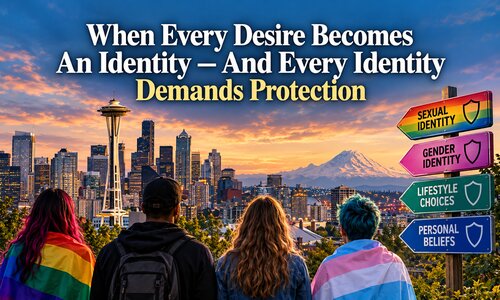
Seattle's City Council unanimously passed legislation expanding the city's civil-rights protections to encompass additional sexual orientations, gender identities and people involved in consensual relationships with multiple partners.
The legislation explicitly adds pansexuality and asexuality to its definition of sexual orientation and says protected "attitudes, preferences, beliefs, and practices" include "consensual relationships involving multiple partners such as non-monogamous relationships."
The legislation also deliberately removes the words "male or female" from portions of Seattle's definition of sexual orientation, while the bill's stated purpose includes recognizing "gender identities outside the gender binary."
This isn't merely Seattle saying adults are free to live however they choose. They already were.
Something more significant is happening.
The government is taking additional sexual identities and relationship arrangements and placing them within the framework of protected civil rights.
From Tolerance To Protection
For decades, Americans have repeatedly been told that changes involving sexuality are primarily about leaving people alone.
But there is an enormous difference between saying, "You are free to live this way," and saying, "Your decision to live this way constitutes a legally protected characteristic."
Seattle has crossed that line with multi-partner relationships.
The ordinance reaches into employment, housing, public accommodations, business licensing, policing, parks and other areas governed by Seattle's anti-discrimination laws. The city's legislation specifically speaks of "multi-partner/multi-parent families," consensually non-monogamous relationships and other relationship structures that historically were not explicitly recognized.
Supporters view this as straightforward civil-rights protection. People shouldn't lose an apartment or job simply because their private relationships differ from conventional ones.
But there is another question society needs to confront:
What happens when virtually every new form of sexual identity or relationship structure moves from personal choice to protected identity?
Because the movement rarely stops at tolerance.
The Expanding Definition Of Identity
America once possessed relatively straightforward categories for marriage, family and sex. Those categories have been steadily dismantled and reconstructed.
Sex became detached from marriage. Marriage became detached from male and female. Gender became detached from biological sex. Gender itself multiplied into a growing spectrum of identities.
Now exclusivity is becoming detached from intimate relationships.
Seattle's legislation doesn't legalize plural marriage, and it is important not to claim that it does. But it does give legal recognition and protection to people in multi-partner relationships in significant areas of public life.
And Seattle isn't alone.
The Guardian reports that Seattle is now the tenth American city to adopt protections for consensual non-monogamy, following communities including Cambridge and Somerville in Massachusetts and Berkeley and Oakland in California. Advocates are pursuing similar measures elsewhere.
What was once considered far outside mainstream American family life is gradually acquiring a legal vocabulary, advocacy organizations and civil-rights protections.
We've seen that pattern before.
If Three, Why Not Four?
The uncomfortable question is where the limiting principle comes from.
If two consenting adults may define their relationship however they choose, advocates ask why three consenting adults should be treated differently.
But follow that reasoning one step further.
Why three?
Why not four?
Why not five?
If relationship structure itself becomes a protected characteristic, on what non-arbitrary basis does society eventually deny recognition to increasingly complicated arrangements among consenting adults?
That question becomes particularly difficult once demands move beyond discrimination protections.
Imagine three adults who consider themselves one family. If marriage law eventually changes, could all three marry? Could all three be legal parents of the same child? Would all three receive spousal benefits? What happens with inheritance, Social Security, taxes, medical decision-making or divorce?
What happens when a four-person relationship becomes a three-person relationship and assets must be divided?
These aren't arguments that Seattle's ordinance answers those questions. It doesn't.
They are questions about where the philosophy behind these changes ultimately leads.
Marriage Has Already Been Redefined Once
That brings us inevitably to marriage.
The Supreme Court's 2015 Obergefell decision established a constitutional right to same-sex marriage. It did not establish a right to plural marriage, and nothing Seattle passed this week changes that.
But the cultural argument is becoming increasingly familiar.
If consenting adults should determine the structure of their intimate relationships, why should government insist that marriage contain exactly two people?
Polyamory advocates increasingly have the language needed to make that case: equality, identity, discrimination, dignity and recognition.
Today's argument is that someone shouldn't lose an apartment because he has two romantic partners.
Tomorrow's argument could be: Why should those three people be prohibited from marrying one another?
That doesn't mean courts will accept the argument. It means the question that once sounded absurd is becoming considerably less theoretical.
When Does Society Say No?
There is a deeper philosophical problem underneath all of this.
Every civilization establishes boundaries.
Freedom has never meant that every desire must be affirmed, every behavior celebrated or every lifestyle transformed into a protected identity.
Traditional Christianity certainly doesn't operate that way.
Biblical sexual morality imposes limits: male and female, husband and wife, marriage, fidelity and sexual exclusivity. Those limits aren't based upon the premise that human beings possess no desires outside those boundaries. Christianity teaches precisely the opposite—that human desires themselves require moral restraint.
The modern sexual revolution increasingly begins with a radically different premise.
Identity is discovered through internal feelings and desires. Authenticity requires expressing them. Society is expected to affirm them. Eventually institutions are expected to accommodate them.
And when accommodation isn't enough, legal protection follows.
That progression matters far beyond Seattle.
A society can survive disagreement. It can survive people making radically different personal choices.
But something changes when society becomes increasingly unable to say that any consensual sexual desire or relationship structure can ever be objectively disordered, unhealthy or morally wrong.
Because once desire becomes identity, disagreement becomes discrimination.
Once identity becomes protected status, affirmation increasingly becomes an institutional obligation.
And once every boundary is treated as oppression, there is always another boundary waiting to fall.
Seattle hasn't legalized polygamy.
But it has given Americans another glimpse of a question our culture increasingly seems unable to answer:
If consenting adults should be free to define sex, gender, marriage and relationships entirely for themselves, what principle remains for saying there is anywhere the sexual revolution must finally stop?