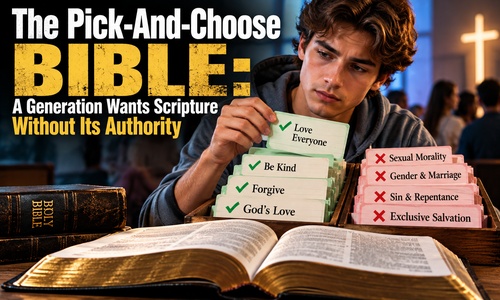
The Pick-And-Choose Bible: A Generation Wants Scripture Without Its Authority
 By PNW Staff September 30, 2026
Share this article:
Something strange is happening among America's younger Christians.
They haven't necessarily abandoned the Bible. Many are still attending church. Some are reading Scripture with renewed interest. They may quote it, discuss it, post verses from it and describe it as important to their faith.
But increasingly, they appear unwilling to let it have the final word.
That is the troubling picture emerging from new Lifeway Research findings showing a widening generational divide over biblical authority. Among Protestant churchgoers ages 18 to 29, 54% agreed that "as culture changes, some biblical truths become obsolete."
Think about what that means.
These aren't statistics drawn exclusively from atheists, agnostics or people who walked away from Christianity years ago. Lifeway surveyed Protestant Americans who attend church at least monthly.
Yet more than half of the youngest adult churchgoers surveyed believe cultural change can apparently place an expiration date on biblical truth.
And that may tell us more about the future of American Christianity than declining attendance ever could.
The Bible As Adviser Instead Of Authority
There is an enormous difference between struggling with something the Bible teaches and believing you possess the authority to discard it.
Christians have wrestled with difficult passages for two thousand years. They have debated interpretation, doctrine and application. Serious Christians can disagree about what particular passages mean.
But historically orthodox Christianity begins with a fundamentally different assumption: Scripture judges us. We don't judge Scripture.
Increasingly, that relationship appears to be reversing.
Lifeway found that 34% of Protestant churchgoers say they accept some truths from the Bible while others "do not fit what they believe," up from 30% in 2019.
Among churchgoers ages 18 to 29, that figure reaches 56%.
That wording is revealing.
The question is no longer simply, "What does the Bible teach?"
It becomes, "Does what the Bible teaches fit what I already believe?"
Once that happens, Scripture has ceased functioning as an authority. It has become an adviser. We consult it, appreciate the portions that affirm us and quietly dismiss those that don't.
It is Christianity with an edit button.
Culture Gets The Deciding Vote
This helps explain what has happened inside portions of American Christianity.
The Bible hasn't suddenly changed its teaching about marriage, sexuality, sin, repentance, judgment, salvation or the identity of Christ.
The surrounding culture has changed.
And wherever Scripture collides with the prevailing values of the age, Christians increasingly face a choice: allow Scripture to challenge the culture, or allow the culture to reinterpret Scripture.
The temptation to choose the latter is enormous.
It is much easier to announce that an uncomfortable biblical teaching belongs to another time than to tell friends, coworkers or children that Christianity places boundaries around human desires.
It is easier to redefine sin than call people to repentance.
It is easier to reinterpret Jesus than submit to Him.
And eventually Christianity can be reconstructed into something remarkably compatible with whatever society already believes.
The result may still have churches. It may still have worship music, clergy, crosses, Bible studies and Christian vocabulary.
But who actually has authority?
That is the question.
The Encouraging Part Of The Story
There is another development taking place that makes these findings even more fascinating.
Young Americans appear increasingly interested in the Bible.
Barna reported that weekly Bible reading among American adults climbed sharply in 2025, with particularly strong engagement among younger generations.
That should be encouraging.
After years of warnings about biblical illiteracy, a generation shaped by social media, political turmoil, loneliness and rapidly changing technology may be looking again for something deeper and more permanent.
But reading Scripture and submitting to Scripture are not necessarily the same thing.
A person can open the Bible searching for wisdom while still reserving the right to reject anything that conflicts with his worldview.
That may be the defining spiritual struggle of this generation.
Will young Christians approach Scripture asking, "What does God require of me?"
Or will they approach it asking, "How can this be reconciled with what I already believe?"
Those questions may sound similar.
They lead in opposite directions.
When Truth Becomes Personal
The Lifeway findings reveal another striking generational difference.
Among churchgoers ages 18 to 29, 87% agreed that the truth of God's Word can mean different things to different people.
There is a legitimate sense in which Scripture applies differently to people in different circumstances. But if the underlying truth itself becomes personalized, Christianity enters dangerous territory.
Because Christianity makes claims that aren't merely personal.
Christ rose from the dead or He didn't.
Sin separates humanity from God or it doesn't.
Christ is the way to the Father or He isn't.
God established moral boundaries or He didn't.
Those claims cannot simultaneously mean contradictory things simply because different people prefer different conclusions.
Jesus did not present truth as infinitely customizable.
He said, "I am the way, the truth, and the life."
The Coming AI Bible
And now this struggle is arriving at exactly the moment artificial intelligence is becoming a powerful interpreter of information.
That combination deserves much more attention.
Barna reported in 2026 that large majorities of practicing Christians and pastors are concerned about AI misinterpreting Scripture. At the same time, AI is rapidly becoming a normal place for people to ask deeply personal questions about relationships, morality, purpose and spirituality.
Imagine where this leads.
For most of Christian history, someone wrestling with a biblical teaching might consult a pastor, commentary, theologian or mature Christian.
Now he can ask an algorithm.
And if he doesn't like the first answer, he can rephrase the question.
Again.
And again.
Until he receives an interpretation comfortable enough to accept.
The danger isn't merely that AI could misunderstand the Bible. The greater danger may be that humans will use AI to construct exactly the Bible they want.
A Christianity customized to the individual.
No uncomfortable doctrines. No unwanted restrictions. No difficult demands.
Just affirmation on demand.
The Question Every Generation Must Answer
Every generation encounters biblical teachings it would rather avoid.
Ours isn't unique in that regard.
What is different is the growing assumption that cultural change itself can make biblical truth obsolete.
If that principle is accepted, there is ultimately no fixed point left.
Culture changes constantly. What society celebrates today may embarrass it fifty years from now. Moral fashions rise and fall. Political movements appear and disappear. Entire philosophies that once seemed unquestionably modern eventually end up in history books.
Christianity makes a radically different claim.
"Jesus Christ is the same yesterday and today and forever."
The church therefore cannot measure Scripture against the culture and keep whichever one seems more modern.
It must decide which one possesses authority.
Because once Christians reserve the right to decide which biblical truths remain acceptable, the Bible may still sit on the nightstand.
It may still be carried into church.
It may still be quoted on Sunday morning.
But it is no longer really in charge.
And a generation that wants Scripture without its authority may eventually discover that it has kept the Bible while creating an entirely different religion.