The Interfaith Gospel: When Religious Unity Comes At The Expense Of Truth
 By PNW Staff September 30, 2026
Share this article:
Something remarkable happened inside a Catholic Mass in Belgium this month.
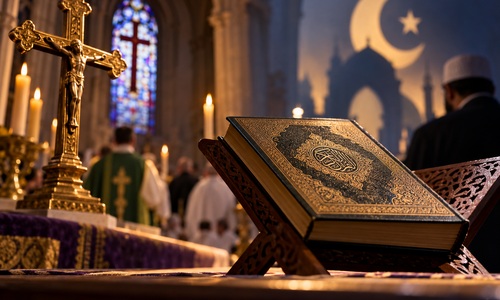
During the September 16 opening Mass for the academic year at KU Leuven, a Catholic university, verses from the Qur'an were chanted in Arabic inside St. Peter's Church. Archbishop Luc Terlinden, president of the Belgian bishops' conference, was reportedly present.
Even more significantly, the university later confirmed that the interreligious elements were not spontaneous. They had been deliberately planned in consultation with university officials and Flemish bishops.
The justification was predictable: dialogue, reconciliation, peace.
But Christians need to ask a question that increasingly seems forbidden.
Is there a point at which interfaith dialogue stops being dialogue and becomes religious compromise?
Because Christianity is not merely one spiritual tradition among many. At the center of the Christian faith stands an extraordinarily exclusive claim: Jesus Christ is Lord.
Not one lord among many.
Not one path among many.
Jesus Himself declared, "I am the way, the truth, and the life: no man cometh unto the Father, but by me."
That claim makes genuine friendship with people of other religions entirely possible. But it makes theological fusion impossible.
And increasingly, some churches seem unable--or unwilling--to understand the difference.
Hospitality Is Not The Problem
Christians should love Muslims.
Christians should love Jews, Hindus, Buddhists, atheists and everyone else.
We should share meals. We should build friendships. We should defend people's right to worship freely. We should help neighbors in need regardless of their religion. We should be able to sit across a table from someone who profoundly disagrees with us and treat that person with dignity and respect.
None of that requires pretending our religions teach the same thing.
There is an enormous difference between inviting a Muslim neighbor to dinner and inviting Islamic worship into a Christian service.
There is a difference between discussing the Qur'an and proclaiming it from a Christian sanctuary.
There is a difference between respecting another person's beliefs and presenting contradictory religious claims as though they are complementary paths toward the same God.
That boundary is disappearing.
In February, St. Paul United Methodist Church in Fremont, California hosted its third interfaith Iftar. Organizers describe how participants eventually entered the church sanctuary, where the program included a Qur'an recitation and a presentation on the spiritual significance of Ramadan.
In March, Holy Redeemer Catholic Church in Washington hosted Jews, Muslims and Christians for what it called a "Celebration at the Table of Abraham." The gathering included readings from Genesis and the Qur'an, and an imam recited from the Qur'an. Muslim participants later held night prayer. The pastor described the event as celebrating "our oneness in faith, going back to Abraham."
In Australia, St John's Camberwell Church hosted an Iftar in March that included a Qur'an recitation alongside a Gospel reading, followed by the Islamic call to prayer marking the breaking of the fast. Organizers celebrated the event as an expression of interfaith understanding and shared values.
And earlier this month, St John's Church in Hyde Park, London, became the venue for Modest Fashion Week London, with reporting describing models appearing in hijabs and niqabs. The symbolism of Christian buildings increasingly becoming religiously interchangeable spaces is difficult to ignore.
A Church Cannot Be Religiously Neutral
This is where the modern interfaith movement encounters a problem it cannot easily solve.
Christianity makes truth claims.
So does Islam.
And those claims contradict each other at the most fundamental point imaginable: the identity of Jesus Christ.
Christianity proclaims Jesus as the eternal Son of God, God incarnate, crucified for humanity's sins and resurrected from the dead.
Islam accepts Jesus as a prophet but rejects the Christian confession of His divine sonship and rejects the Trinity.
Those aren't minor denominational disagreements.
They concern the identity of Christ Himself.
So what exactly is communicated when a Christian church places the Gospel and Qur'an side by side as parallel sacred voices?
The people involved may intend to communicate friendship.
But the sanctuary communicates something much bigger.
It can suggest that Christianity is merely one contribution to a larger religious conversation--that Jesus Christ may be proclaimed on Sunday, while contradictory claims about Him can be given sacred space in the name of unity.
That isn't tolerance.
It is theological confusion.
The Gospel Is Unavoidably Exclusive
The modern Western church often seems embarrassed by Christian exclusivity.
Yet remove that exclusivity and Christianity becomes something fundamentally different.
The apostles did not preach that Jesus was one useful path toward God.
Peter proclaimed that salvation is found in Christ and that "there is none other name under heaven given among men, whereby we must be saved."
Paul wrote that "there is one God, and one mediator between God and men, the man Christ Jesus."
Christianity can coexist peacefully with other religions precisely because Christians do not need to force anyone to believe those claims.
But peaceful coexistence does not require theological coexistence inside Christian worship.
A mosque should be free to be Muslim.
A synagogue should be free to be Jewish.
And a church should have the courage to be unmistakably Christian.
The irony is that Western Christianity sometimes appears to demand less respect for its own sacred spaces than it would instinctively grant to others.
Few Christians would enter a mosque and demand that the pastor be allowed to preach the Trinity during Friday prayers in the name of dialogue.
We would understand immediately that doing so would violate the purpose of the gathering.
Why, then, is maintaining similar boundaries inside Christian worship increasingly treated as intolerance?
The Interfaith Gospel
The danger isn't that Christians will suddenly convert to Islam because they heard several Qur'anic verses.
The danger is subtler.
It is the slow formation of a generation of Christians who come to believe that religious truth matters less than religious harmony.
That all religions are different languages describing essentially the same spiritual reality.
That insisting Christ is the only way to the Father is unnecessarily divisive.
And eventually, that evangelism itself is disrespectful because attempting to convert someone implies his present religion is not sufficient.
At that point, Christianity may retain its churches, bishops, liturgies and religious vocabulary.
But something essential has disappeared.
The Gospel has been replaced by an interfaith gospel whose highest virtue is not truth but unity.
Christians don't need to fear their Muslim neighbors. They should befriend them.
They don't need to silence other religions. They should defend their freedom.
They don't need to avoid dialogue. They should welcome serious conversations about God, Christ and salvation.
But dialogue requires differences. Otherwise there is nothing to discuss.
A Christian can sit beside a Muslim and say, "I respect you, I care about you".
But Christianity also requires the courage to add:
"I cannot say that what we believe is the same."
There is room at the Christian table for friendship.
There is room for conversation.
There is room for hospitality.
But the Christian altar belongs to Christ.
And once the Church becomes embarrassed to say that, interfaith dialogue has stopped building bridges and started erasing the very faith those bridges were supposed to connect.