
Think You're Anonymous? 5 Ways AI Can Find You Without GPS
 By PNW Staff September 29, 2026
Share this article:
For years, privacy advice has been relatively straightforward: turn off location services, strip location metadata from photographs, keep your face out of pictures, and be careful about what personal information you post online.
Artificial intelligence is beginning to complicate that advice.
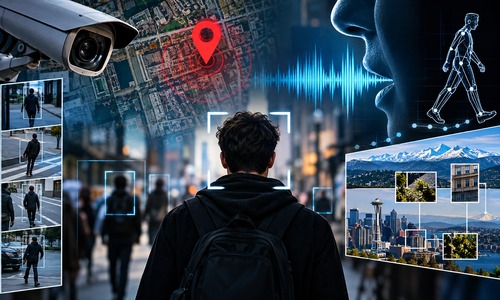
A new generation of AI systems doesn't necessarily need you to explicitly reveal where you are or even who you are. Instead, machines are becoming increasingly capable of extracting clues buried inside photographs, videos, voices and surveillance footage -- clues most people would never notice.
Some of these technologies have obvious benefits. They could help locate hostages, identify criminals, combat human trafficking and find threats on battlefields.
But they also raise an uncomfortable question.
What happens to privacy when hiding the obvious information is no longer enough?
Here are five technologies showing how quickly that world is approaching.
1. AI Can Figure Out Where Your Video Was Recorded
One of the clearest examples comes directly from the U.S. intelligence community.
The Intelligence Advanced Research Projects Activity, or IARPA, launched a program called LocUS -- Location Using Sound -- designed to automatically geolocate multimedia even when accurate location metadata isn't available.
Instead of depending solely upon GPS coordinates, LocUS is intended to combine visual and audio information to determine where previously unseen video was recorded, both indoors and outdoors. Potential national-security applications include hostage recovery and human-trafficking interdiction.
Think about the implications for an ordinary video.
A building in the background. The sound of traffic. Local architecture. Vegetation. Terrain. A distant announcement. Street markings.
Individually, such details may mean very little. Combined and compared against enormous databases, they can become clues.
Removing the GPS tag doesn't remove the world visible -- and audible -- around you.
2. AI May Recognize You Without Seeing Your Face
Facial recognition gets most of the attention, but a face isn't the only biometric characteristic people reveal.
Researchers have been developing gait-recognition systems capable of analyzing the distinctive way people walk. Characteristics such as body proportions, stride, posture and movement can potentially contribute to identifying or matching individuals.
That creates an important distinction.
A person wearing a mask may have hidden his face without hiding his identity.
Gait recognition isn't infallible. Clothing, injuries, camera angles and other factors can affect results, and it shouldn't be treated as some magical identification system.
But AI doesn't necessarily need one perfect biometric if it can combine multiple imperfect ones.
3. Your Voice Can Become An Identifier
Then there is something millions of people voluntarily place online every day: their voice.
Speaker-recognition technology analyzes characteristics within speech to determine whether recordings may belong to the same person.
Even attempts to anonymize voices aren't necessarily foolproof.
In research published this month, the National Institute of Standards and Technology examined identity leakage in speaker de-identification systems, including the possibility of re-identification even after attempts have been made to conceal the speaker's identity.
Consider how many voice samples now exist.
YouTube videos. Podcasts. TikTok clips. Interviews. Livestreams. Recorded meetings. Security cameras with microphones.
A photograph may hide your face.
Your voice may tell another story.
4. AI Can Follow People From Camera To Camera
Perhaps even more significant is what happens when AI begins connecting surveillance systems.
IARPA's Video LINCS program is developing technology capable of autonomously re-identifying people, vehicles and eventually other objects across different video collections.
The objective isn't simply to recognize something in one camera.
It's to determine where that same object appears throughout multiple videos and map those observations into a common geographic reference system. The research is intended to work across different types of footage, potentially including aerial drones and ground-based CCTV.
That changes surveillance dramatically.
Camera one sees someone leave a building.
Camera two sees that person farther away.
Another camera captures a vehicle.
Another system sees the vehicle somewhere else.
Historically, connecting those dots could require enormous amounts of human labor. AI potentially makes searching massive collections of footage far faster.
And IARPA has noted that more than one billion CCTV cameras are operating globally.
The problem is no longer collecting video.
It's making sense of all of it.
5. The Real Breakthrough: AI Can Connect Everything
This may ultimately be the most consequential development.
Each individual technology has limitations.
A voice match can be uncertain. A gait can change. A photograph may contain few recognizable landmarks. A security camera may capture only several seconds of useful footage.
But AI doesn't have to examine those clues separately.
The National Geospatial-Intelligence Agency says its AI strategy includes improving identification and automated geolocation. Its Maven program uses computer vision and AI to automatically detect, identify, characterize and extract information about objects and features appearing in imagery and video.
That points toward a fundamentally different surveillance environment.
Imagine a system combining your approximate location, vehicle, voice, gait, travel direction, surrounding architecture and appearances across several cameras.
None of those clues has to identify you perfectly.
Together, they may tell a much clearer story.
The End Of Anonymous?
There are legitimate reasons governments want these capabilities. Few people would object to using sophisticated geolocation technology to locate a kidnapped child or rescue a hostage.
The concern is what happens as the technology becomes cheaper, more powerful and more widely available.
The smartphone era taught us to worry about the information our devices transmit.
The AI era may require us to think about something much bigger: information we reveal without realizing we are revealing anything at all.
Turning off GPS doesn't remove the mountains behind you. Removing metadata doesn't remove the architecture. Covering your face doesn't necessarily conceal your gait. Staying out of photographs doesn't erase your voice. Moving between different cameras doesn't necessarily mean those appearances cannot be connected.
Privacy has traditionally depended partly upon obscurity -- the practical difficulty of gathering thousands of tiny pieces of information and connecting them to one person.
AI is attacking that barrier.
The surveillance system of the future may not need you to tell it where you are.
It may simply look at the world around you -- and figure it out.