
The Apartheid Smear Meets The Israeli Ballot Box
 By PNW Staff October 29, 2026
Share this article:

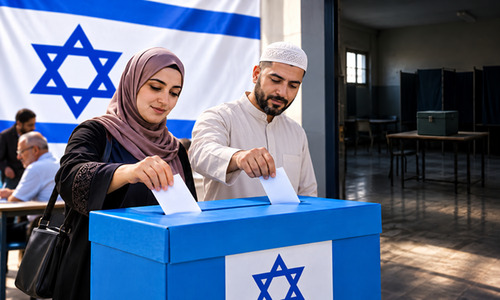
Israelis went to the polls this week, and Arab citizens—Muslim, Christian, Druze, and Bedouin—turned out in force. In Arab-majority towns across the country, turnout surged past the final 2022 figures, with some communities recording double-digit increases. Overall national turnout reached historic levels. Arab votes were not symbolic. They helped shape the results and could prove decisive in the coalition negotiations now beginning. Arab parties are projected to gain significant seats and may emerge as pivotal players.
That simple reality cuts through one of the most persistent accusations leveled against Israel: that its Arab citizens are voiceless, excluded, and denied political rights. Israel’s Arab citizens are not spectators in someone else’s democracy. They participated in a national election whose outcome may depend on them.
The same cannot be said of the Palestinian Authority.
Israel’s Ballot Box Was Open
Arab citizens voted alongside Jewish citizens. They chose Arab-led parties, joined other lists, elected representatives, and used their ballots to shift the balance of power. Israeli politicians knew it. The intense focus on Arab turnout itself proved that these votes mattered.
Arab Israelis have voted in every Knesset election since 1949. Their parties have held seats for decades. An Arab party, Ra’am, sat in a governing coalition as recently as 2021–2022. Arab members of Knesset influence budgets, legislation, and policy. This is not tokenism. It is political agency exercised inside a functioning democracy—even under wartime pressure and security threats.
Many of these citizens and some of their elected representatives openly reject the legitimacy of the Jewish state and support its destruction. Israel still grants them equal voting rights and full access to the political system. That fact alone exposes the emptiness of the apartheid charge. A state that faces existential rejection from a portion of its own citizens yet continues to protect their equal franchise is not practicing apartheid. It is practicing democracy under conditions few other nations would tolerate.
A democracy is not measured by whether every citizen agrees with the government or even accepts the state’s right to exist. It is measured by whether citizens can vote, organize, elect representatives, and influence who governs. Israel’s Arab citizens did exactly that. The apartheid smear erases the very people it claims to defend.
The PA’s Election Excuses
The Palestinian Authority has not held a presidential election since 2005 or a legislative election since 2006. Mahmoud Abbas’s presidential term expired years ago. Elections scheduled for this year were postponed until September 11, 2027.
The PA points to Israeli restrictions and security conditions. Those claims do not explain away two decades without a national vote. Nor do they change the basic fact that Palestinian leaders have chosen to remain in power without asking voters to renew their mandate. Reports indicate Fatah and Hamas leaders agreed to the latest delay.
The polling helps explain why a real contest threatens the ruling establishment. A recent Palestinian survey put Abbas at just 6 percent in a multi-candidate leadership test. Official Fatah lists have trailed competing lists, including one linked to Marwan Barghouti, who is serving multiple life sentences after convictions for murder. Hamas has ruled Gaza since seizing control in 2007. Palestinians still have not had a national election to choose who governs them.
This is not a temporary setback. It is a pattern of elite self-preservation.
Statehood Without Consent
European and other Western governments continue to present Palestinian statehood as the answer to Palestinian problems. But recognition cannot manufacture democratic legitimacy. It cannot make Abbas accountable, reconcile Fatah and Hamas, or give Palestinians a choice their leaders have withheld.
A state is not a solution simply because foreign governments announce it. If its leaders fear an election, if rival authorities rule separate territories, and if citizens cannot remove those leaders at the ballot box, statehood risks strengthening the political class that has failed them.
Western governments should stop demanding that Israel prove its democratic character while treating the PA’s election failures as a footnote. This week, Israelis—including Arab citizens—voted to shape their country’s government. Palestinians are being told to wait until 2027, after waiting nearly two decades already.
That is the contrast. Israel’s democracy is imperfect, contested, and alive. The PA’s national democratic process is stalled, its leaders entrenched, and its people still waiting for a vote. A Palestinian state may be a diplomatic goal. It is not an answer to Palestinian problems unless Palestinians are allowed to choose who rules them.