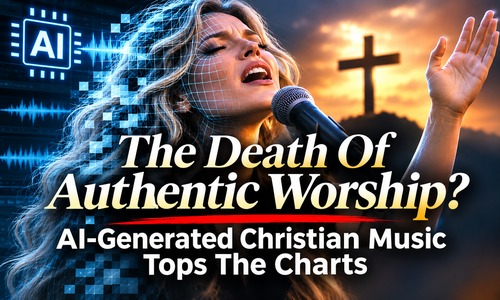
The Death Of Authentic Worship? AI-Generated Christian Music Tops The Charts
 By PNW Staff November 04, 2026
Share this article:

A Christian song about heaven, grief, and the loss of a loved one has accomplished something remarkable. It climbed to number one on the U.S. iTunes music chart, competing against some of the biggest names in the industry.
There is just one problem. The singer delivering those emotional lyrics may not be a real person at all.
The song, "Tell Me, How Is Heaven?" was released by an act called May the Lord Studio. Its YouTube video has attracted millions of views, while the project has built an enormous social media following.
But behind the moving vocals and carefully crafted imagery is a music operation that acknowledges using artificial intelligence. Reports identify the popular AI music platform Suno as the technology behind the recording.
Yet listeners purchasing the song on iTunes may never realize the voice moving them to tears was artificially generated.
Welcome to a new era of Christian music, where the person singing about heaven may never have experienced grief, never attended church, never prayed, and may not even exist.
When Artificial Faith Tops The Charts
The controversy isn't simply that artificial intelligence helped create a popular song. Technology has transformed music production for decades.
What makes this development troubling is the possibility that listeners are forming emotional connections with what they believe is a genuine Christian performer, without realizing how much of that performance may be manufactured.
May the Lord Studio acknowledges AI involvement in its music, and some streaming platforms have identified that involvement. But how many grieving listeners investigate an artist's website before downloading a song?
Most people assume that when they hear a powerful voice singing about heaven, there is an actual person behind the microphone.
They assume the performer has some connection to the emotions being expressed.
Those assumptions can no longer be taken for granted.
Should AI-generated performers compete on the same charts as human artists without unmistakable labeling?
The Difference Between Creativity And Deception
There is nothing inherently wrong with Christians exploring artificial intelligence as a creative tool.
Someone who writes heartfelt lyrics but lacks musical ability can now experiment with melodies, instruments, and arrangements. Small churches and independent Christian creators can produce music previously requiring expensive studios.
These possibilities are exciting.
The problem begins when technology stops assisting human creativity and starts replacing the human identity behind it.
Consider the difference between a songwriter using AI to arrange a song and a computer-generated singer presented through images, social media accounts, and music releases resembling an actual performer's career.
One is a tool. The other risks becoming an artificial personality marketed as a human experience.
And in Christian music, that distinction matters.
A song about losing a loved one can speak directly to someone who has buried a spouse, parent, or child. Listeners may believe the performer understands their pain because they hear what sounds like genuine sorrow.
But a synthetic voice has never stood beside a grave. It has never wrestled with God through a sleepless night or experienced the comfort of Scripture during personal tragedy.
The human creators may have experienced those things. But listeners deserve to know whose testimony, if anyone's, they are hearing.
Can A Machine Really Lead Someone In Worship?
Here is where the issue becomes especially important for Christians.
David wrote psalms flowing from repentance, suffering, and praise. Paul and Silas sang hymns while imprisoned. The early Church sang spiritual songs as expressions of genuine faith.
Biblical worship is not simply the production of beautiful sounds. It is an expression of the human heart directed toward God.
Jesus declared in John 4:24 that those who worship God must worship Him in spirit and truth.
A computer can reproduce the sound of worship. It can generate emotional lyrics and a voice that seems overwhelmed by God's presence.
But it cannot worship God.
It cannot repent, believe, love Christ, or surrender its life to Him.
Certainly, God can use a song produced with AI to encourage a believer. The listener's response can still be genuine worship.
But Christians must distinguish between an artificial performance of spiritual emotion and authentic spiritual experience.
When Christian Music Becomes A Factory
Imagine a music company generating dozens of Christian songs every week, testing which themes produce the strongest emotional responses, and releasing endless variations without hiring singers or musicians.
Songs about heaven, grief, healing, marriage, and personal struggles could be manufactured at extraordinary speed.
Artificial performers could receive names, faces, biographies, and social media personalities designed to appeal to particular Christian audiences.
Unlike human performers, these digital personalities would never grow tired, demand compensation, or need time away from recording.
The temptation would be obvious: manufacture whatever sells.
Christian music already operates within a commercial industry where popularity and streaming numbers influence what gets promoted. AI could accelerate those pressures dramatically.
A song about heaven could become another product optimized for grieving customers.
That does not establish that May the Lord Studio intended to exploit anyone. But it demonstrates why transparency matters.
The Church Must Demand Something Better
Apple and other music platforms don't necessarily need to ban AI-generated songs. But they should require clear disclosure when artificial voices or performers are used.
Christian radio stations, worship playlists, and publishers should establish similar standards.
Churches should also resist replacing human-led worship with synthetic performances simply because they sound polished and cost less.
There is a difference between using technology to support ministry and allowing technology to manufacture the appearance of ministry.
And that distinction is becoming increasingly important.
When Everything Sounds Spiritual, What Is Real?
Artificial intelligence is rapidly learning to imitate the outward expressions of human faith. It can simulate compassion, produce persuasive sermons, generate convincing testimonies, and sing songs that sound deeply spiritual.
Soon, Christians may encounter virtual worship leaders who never existed, inspirational testimonies from fictional believers, and entire online ministries built around artificial personalities.
The question is no longer whether AI can sound Christian.
It already can.
Scripture repeatedly warns believers against confusing outward appearances with spiritual reality. First John 4:1 instructs Christians to test the spirits rather than blindly accepting every spiritual claim.
That principle of discernment becomes especially relevant when technology can manufacture convincing religious experiences.
A beautiful voice is not proof of a faithful heart. Emotional lyrics are not evidence of genuine testimony. And millions of views do not establish spiritual authenticity.
An AI-generated Christian song reaching number one on iTunes may seem like a small development today.
But it raises a question the Church cannot afford to ignore:
When machines can perfectly imitate the sound of worship, will we still care whether there is a worshiper behind the voice?