
Death On Demand? Canada's Dangerous Path Toward Suicide Without Limits
 By PNW Staff November 14, 2026
Share this article:
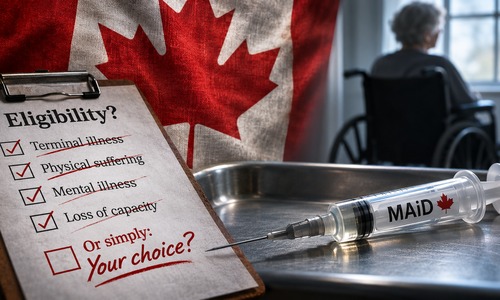
What if the only requirement for ending your life with government assistance was that you wanted to die?
No terminal illness. No unbearable physical suffering. No medical condition whatsoever. Simply the belief that your life was no longer worth living — and a healthcare system prepared to help you end it.
That is not Canada's law today. But it is the disturbing destination that an unrestricted philosophy of personal autonomy could eventually lead to. And a revealing exchange in Canada's Parliament has raised serious questions about just how far some politicians are prepared to take the country's assisted-suicide experiment.
What began as an exceptional measure for people facing grave suffering has expanded into a system responsible for thousands of deaths annually. Now, even as Canada retreats from allowing assisted suicide for mental illness alone, lawmakers are considering another controversial expansion involving advance requests.
The question is no longer simply how Canada got here. It is where the country is heading next.
During debate over Bill C-41, Conservative MP Andrew Lawton confronted Liberal MP Kristina Derksen over the ambitions of Dying with Dignity Canada, an organization she had co-hosted an event with.
Lawton quoted the organization's vision of a world where everyone wishing to consider medically assisted dying could do so. He then asked whether Derksen agreed, pointing out that the statement contained no reference to illness, suffering, or medical necessity.
Derksen spoke of bodily autonomy and the right of Canadians to determine how they wished to leave this life.
When directly challenged about a vision of assisted dying without stated medical limitations, she did not defend those limitations. Instead, she appealed to bodily autonomy and the freedom to choose how to leave this life.
That raises a question advocates of ever-expanding assisted suicide must eventually answer: If choosing death is fundamentally a matter of personal autonomy, why should the government have any authority to tell a competent adult that their suffering is insufficient to qualify?
Once personal choice becomes the overriding principle, medical restrictions risk becoming temporary political obstacles rather than permanent moral boundaries.
When Death Becomes Easier Than Getting Help
Consider the case of Alan Nichols, a 61-year-old Canadian with a history of depression who was hospitalized in amid concerns that he might be suicidal.
Within weeks, he received medically assisted death.
According to an Associated Press investigation, the only medical condition listed on his application was hearing loss. His family strongly objected, arguing that he lacked the capacity to make such a decision and did not meet the requirements for unbearable suffering.
His family had sought help for a troubled man. Instead, they were left grieving his medically assisted death.
Then there was the heartbreaking case of a Canadian woman publicly identified as Sophia, who suffered from severe chemical sensitivities.
She desperately needed affordable housing that would accommodate her medical condition. Unable to secure suitable living arrangements, she ultimately received medically assisted death as well.
Think about the implications. A woman struggling to find housing that would allow her to live with dignity ended up receiving government-sanctioned assistance to die.
Canada has also faced scandal over Veterans Affairs employees raising assisted suicide with veterans seeking help. An investigation confirmed that one employee had inappropriately discussed the option with four veterans.
These veterans were seeking assistance, not requesting death.
These cases raise a deeply unsettling question: What happens when the institutions responsible for protecting vulnerable people begin treating death as an acceptable answer to their suffering?
The numbers reveal just how thoroughly assisted dying has become embedded in Canadian society.
In 2019, Canada recorded 5,461 medically assisted deaths. By 2024, that figure had climbed to 16,499 — approximately one out of every twenty deaths in the country.
What began in 2016 as a restricted practice has become a significant part of Canadian healthcare. In 2021, lawmakers removed the requirement that a person's natural death be reasonably foreseeable.
The boundaries have already moved. Now the battle is over where they move next.
Mental Illness Was A Bridge Too Far — For Now
Canada was preparing to allow medically assisted death for people whose sole underlying condition was mental illness.
Imagine the contradiction.
On one hand, society spends enormous resources on suicide prevention, telling people struggling with depression that their lives have value, their circumstances can improve, and hope remains possible.
On the other, the same healthcare system was preparing to authorize doctors to help certain psychiatric patients end their lives.
How can a physician confidently determine that someone's psychological suffering will never improve? How many people who once desperately wanted to die have subsequently recovered, found treatment, rebuilt relationships, and become grateful they survived?
Death eliminates every possibility of recovery.
The controversy became so intense that the Canadian government repeatedly delayed the expansion. Now Bill C-41, introduced by Prime Minister Mark Carney's government, would prevent the scheduled extension of eligibility to those suffering solely from mental illness.
That is a welcome boundary. But the same legislation would open another disturbing door.
Under its proposed advance-request framework, Canadians diagnosed with certain illnesses, including Alzheimer's disease, could authorize medically assisted death before losing the mental capacity to consent.
Someone could receive a lethal intervention at a time when they are no longer capable of personally consenting to it.
Consider an elderly woman who signs an advance request after receiving a devastating dementia diagnosis. Years later, she may no longer recognize her family, but she smiles when her grandchildren visit, enjoys familiar music, and appears content in her daily routine.
Should a document signed years earlier determine that her life must end?
Who gets to decide what constitutes suffering when the person can no longer explain what they feel?
These are not minor administrative questions. They concern the most irreversible decision imaginable.
From The Right To Die To The Duty To Disappear?
The greater danger is the philosophy emerging beneath these legislative battles.
If personal autonomy becomes the ultimate justification for assisted suicide, why should eligibility remain limited to people with serious medical conditions?
What about someone devastated by divorce? Someone crushed by debt? Someone experiencing unbearable loneliness? Someone who simply believes life no longer offers anything worth living for?
These circumstances do not independently qualify someone for MAID under current Canadian law. But a philosophy built around an unrestricted right to choose death would struggle to explain why such requests should be rejected.
And once death becomes an ordinary medical service, another danger emerges: economics.
Providing long-term care, disability assistance, specialized housing, mental health treatment, and compassionate end-of-life support can be enormously expensive.
Providing a lethal injection is comparatively inexpensive.
That does not mean governments are deliberately pursuing assisted suicide to save money. The more troubling danger is that a system under financial pressure could gradually become better at facilitating death than providing the resources necessary to sustain difficult lives.
Imagine an elderly parent watching their children struggle with the financial and emotional burden of caregiving. Imagine a disabled person repeatedly denied adequate assistance. Imagine someone suffering chronic illness who begins to believe their continued existence is an inconvenience to everyone around them.
At what point does the supposed right to die become a perceived responsibility to stop being a burden?
A society does not need to force people to die if it can convince vulnerable people that choosing death is the compassionate, dignified, or responsible thing to do.
Canada's assisted-suicide experiment should serve as a warning to every nation watching.
What began as an exceptional response to extreme suffering has evolved into an expanding system in which the boundaries of who qualifies continue to be debated and challenged.
Today, the controversy concerns mental illness and advance requests for people who may eventually lose the ability to consent. Tomorrow, it could concern whether serious medical suffering should remain a requirement at all.
That is the danger of building an entire philosophy around personal autonomy without recognizing the inherent sanctity of human life. Every safeguard becomes a restriction waiting to be challenged. Every eligibility requirement becomes another barrier to individual choice.
And eventually, the question becomes frighteningly simple: If death is a fundamental right, why should anyone have to justify wanting it?
For Christians, the answer begins with a truth that no government can overturn: Human life is sacred because it is created in the image of God. Its value is not determined by suffering, disability, productivity, or personal despair.
A truly compassionate society does not measure its progress by how many people it can help die, but by how faithfully it stands beside those who are struggling to live.