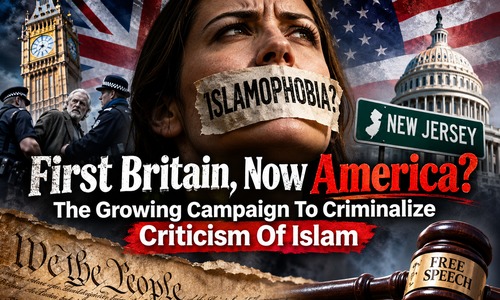
First Britain, Now America? Growing Campaign To Criminalize Criticism Of Islam
 By PNW Staff November 14, 2026
Share this article:
Imagine living in a country where questioning a religion could put you under government scrutiny. Where criticizing religious teachings, challenging political movements, or raising concerns about ideological influence could become evidence of hatred in the eyes of authorities.
For Americans who believe the First Amendment protects the right to speak uncomfortable truths, that possibility should be alarming.
Yet in New Jersey, lawmakers have introduced legislation raising precisely these concerns.
Assembly Bill A1146 would establish an official definition of "Islamophobia" for use in civil and criminal discrimination investigations.
The legislation would require officials to consider its definition when determining whether alleged violations of existing laws were motivated by anti-Muslim bias.
There is great danger in allowing government authorities to examine religious and political opinions as potential evidence of unlawful intent.
And Americans need only look across the Atlantic to understand why.
When Criticism Becomes Evidence Of Hate
The most troubling aspect of New Jersey's proposal is not its opposition to violence or unlawful discrimination. Existing laws already address those offenses.
It is the language used to define Islamophobia.
Among the examples listed are "hostility and fear of Islam," certain allegations concerning Muslim political influence, and claims of a demographic threat involving Muslims.
Where does legitimate criticism of a religion or political ideology end, and government-defined prejudice begin?
Consider the questions Americans should be free to debate.
Should Islamic religious principles influence American legislation? What about Sharia-based restrictions on religious conversion, blasphemy, or women's rights in countries where such rules are enforced? Should Islamist organizations advocating religious governance face public scrutiny?
These are legitimate subjects of public debate, not questions government should discourage.
Yet when an official definition includes hostility toward Islam and allegations concerning Muslim political influence, critics have reason to question how authorities might interpret such discussions.
Republican Assemblyman Paul Kanitra has warned that the legislation could allow officials to treat criticism of Islamic texts, history, and demographic developments as evidence of discriminatory motivation.
The bill contains language preserving First Amendment protections. But constitutional guarantees do not automatically eliminate concerns about vague definitions, selective enforcement, or investigations that discourage lawful speech.
Consider the chilling effect.
A journalist hesitates before investigating a controversial religious organization. A teacher avoids discussing Islamic law. An employee remains silent about political Islam. A pastor wonders whether an outspoken sermon could generate an official complaint.
None of these outcomes is inevitable. But they illustrate the danger when government definitions of prejudice become entangled with criticism of ideas.
Freedom of speech means little if citizens become afraid to exercise it.
Britain's Warning: When Speech Becomes A Police Matter
New Jersey's proposal did not emerge in isolation.
Its legislative statement acknowledges that the definition was modeled partly on work by a British parliamentary group examining Islamophobia.
That connection matters because Britain has already experienced years of controversy surrounding hate-speech enforcement, online communications laws, and police investigations of controversial statements.
British authorities have investigated and sometimes prosecuted individuals over social media communications under laws addressing threatening, grossly offensive, or otherwise unlawful messages.
Who decides whether a statement is legitimate criticism, offensive commentary, or evidence of prejudice?
How freely will ordinary citizens speak when those boundaries become uncertain?
America's First Amendment provides stronger constitutional protections than Britain's legal framework. But that protection should never become an excuse for complacency.
The question remains: How far should government go in defining unacceptable attitudes toward a religion?
Religious Freedom Must Include The Freedom To Disagree
For Christians, this debate reaches far beyond politics.
Christianity and Islam make fundamentally different theological claims.
Christians believe Jesus Christ is the divine Son of God, crucified and risen from the dead, and that salvation comes through Him alone. Islam rejects central elements of those beliefs.
When Jesus declared in John 14:6 that He is the way, the truth, and the life, He made an exclusive claim that conflicts with other religious teachings.
Christians must remain free to proclaim that conviction.
They must also remain free to examine Islamic doctrine, criticize religious practices, discuss persecution of Christians in Muslim-majority countries, and challenge political movements seeking to incorporate religious law into government.
Those same freedoms belong to Muslims criticizing Christianity, former Muslims challenging Islam, and atheists rejecting religion altogether.
A free society cannot guarantee comfortable religious disagreements. It must guarantee the freedom to have them.
When protecting religious believers begins to blur into protecting religious beliefs from scrutiny, freedom of expression becomes vulnerable.
And once government authorities are empowered to evaluate which religious criticisms constitute hostility, the potential for abuse becomes impossible to ignore.
The Precedent America Must Examine
New Jersey's A1146 remains in committee for now...
But the proposed use of a broad religious-bias definition in civil and criminal investigations raises questions extending far beyond one state.
If officials are instructed to consider religious or political viewpoints when assessing discriminatory intent, what prevents legitimate disagreement from being mistaken for unlawful prejudice?
What happens when definitions introduced for one purpose become embedded in workplace investigations, educational policies, and future legislation?
And if criticism of Islam can become evidence of hostility, could similar standards eventually be applied to criticism of other religions or political movements?
Americans do not need government permission to criticize Christianity, Islam, Judaism, secularism, or any other system of belief. Nor should they need to demonstrate that their opinions are polite or acceptable to those who disagree.
The freedom to challenge powerful ideas is not a privilege granted by government. It is a constitutional right government is obligated to respect.
Britain offers a warning about what can happen when speech restrictions and government enforcement become entangled in disputes over religious hostility.
New Jersey offers an opportunity to examine those dangers before new legislation is enacted.
The question is whether government can protect individuals from genuine discrimination without allowing accusations of prejudice to become a tool for scrutinizing religious and political dissent.
Because once criticism of an idea becomes grounds for official suspicion, the debate is no longer simply about religion. It is about who gets to decide what Americans are free to say.