How Turkey Is Spreading Its Radical Islamist Agenda To Europe
 By Alon Ben-Meir/Algemeiner.com October 24, 2018
Share this article:

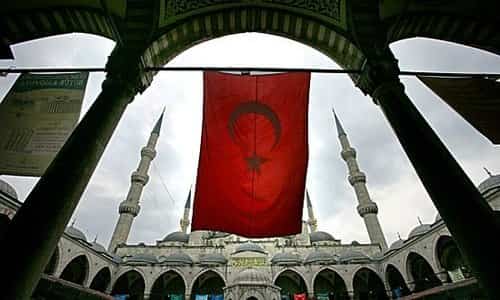
With less than two million people, Kosovo, which declared its independence from Serbia in 2008, is the home of over 800 mosques. Now the Islamic Community of Kosovo is building the "Central Mosque" at an estimated cost of $35 to $40 million. Turkey's Directorate of Religious Affairs (the Diyanet) is financing the project.
The Diyanet also financed the building of a similar mosque on a 10,000-square-meter parcel of land in Tirana, Albania -- the largest mosque in the Balkans -- along with dozens of other mosques across neighboring countries.
Diyanet is the official Turkish state institution whose role is "to execute the works concerning the beliefs, worship, and ethics of Islam, enlighten the public about their religion, and administer the sacred worshiping places." Diyanet is also responsible for the religious affairs of the Turkish diaspora. In Germany alone, it administers 970 mosques, run by imams trained by the organization.
Austria was the first country to realize that the mosques built with Turkish President Recep Tayyip Erdogan's money are used for political purposes to promote his Islamic agenda. In June 2018, Austrian Chancellor Sebastian Kurz ordered the closing of seven mosques built by Diyanet, and deported 60 imams and their families with ties to Turkey as part of the "fight against political Islam."
In February 2016, German law enforcement agencies revealed that clerics from the organization were involved in espionage against followers of Erdogan's arch-rival Fethullah Gülen's followers. Two years ago, Cumhuriyet, an independent Turkish newspaper, reported that Diyanet was very active in collecting intelligence, specifically on the activities of Gülen sympathizers in 38 countries across Europe, including Germany and the Balkans. Accusations of espionage by the organization have existed since the 1990s, but these revelations pointed to far more extensive operations than were previously thought.
Meanwhile, Diyanet has extended its religious program to countries whose connection to Ottoman history is tenuous. The president of Diyanet, Ali Erbaş, said that it has extremely strong relations with Balkan countries, and stressed that this cooperation will continue in the future, especially in relation to religious education, services, and publications. He emphasized the importance and affinity of Turkey to the Balkans and added, "The Balkans have a special place for us. Our historical ties will continue as they have done in the past."
Ironically, while most of the Balkan countries suffer from unemployment, lack of foreign investments, and rampant poverty, Erdogan's investments are focused on mosques and religious educational institutions at a time when Kosovo's unemployment rate is 30%.
Lulzim Peci, the former Ambassador of Kosovo to Sweden and Executive Director of the Kosovo Institute for Policy Research and Development (KIPRED), is one of the most critical voices in Kosovo against Erdogan's Islamist scheme. He agrees that the mosques built in Kosovo are political establishments meant to promulgate Erdogan's vision. "In the case of Kosovo and Albania, the tens of millions of dollars invested in building mosques has to do with the symbol of Turkish supremacy and influence, not only religious but also political," says Peci.
Erdogan's enormous investments in Ottoman symbolism are designed to influence the mindset of the population in Kosovo and increase the pro-Turkish-Islamist sentiments among the present and future generations. The Islamic ideology that Diyanet promotes caused wide-spread indignation even in Turkey. Diyanet stated that girls can become pregnant and therefore get married at the age of nine years old and boys at the age of 12. Thus, the concerns over Diyanet activities are not limited to building mosques, but its cultural and societal influence based on radical Islam.
"Unfortunately, Albanian mosques thus are confirming the thesis of Swiss Islamist Saida Keller-Messahli in her book Islamic Centrifuge in Switzerland, where Albanian mosques in fact are radical centers serving this kind of Islamic agenda for the radicalization of Albanian Muslims in favor of Erdogan's politics," says Xhemal Ahmeti, a historian and expert on Southeast European issues.
Visar Duriqi, a Kosovo journalist specializing in religious affairs, said that the project for the construction of the mosque with Turkish funds sends a clear political message by Erdogan to the effect that he has control over this region.
Mosques are increasingly being used to spread Islamist ideologies to a point where only limited room is left for actual prayers. In the countries with majority Christian populations in the Balkans, such as Serbia, Macedonia, and Croatia, Turkey is investing in major development projects, while in Albania the investments are geared mainly toward building Islamic religious institutes. "It has been shown that the most powerful and sustainable influence in this region, especially among Albanians, is made precisely through the instrumentalization of the religion," says Neziri.
To be sure, anyone who follows Erdogan's ambitions in the Balkans cannot escape the conclusion that the Turkish leader had a specific, well-articulated Islamic agenda that he is determined to entrench in the psyche of the Balkan people by building mosques and appointing imams that follow his doctrine. It is part and parcel of Erdogan's vision to restore elements of the Ottoman Empire under his leadership.
Erdogan himself and many other Turkish officials have openly spoken about their dream that by 2023 -- the centenary of modern Turkey -- the country will enjoy as much sway and influence that was once enjoyed by the Ottomans. Erdogan uses Diyanet as one of his main vehicles to that end. For the Balkan states, this will certainly turn out to be nightmarish unless they prevent Erdogan from exploiting them in the name of Allah, while debasing Islam to serve his long-term, menacing plot.
Originally published at Algemeiner.com - reposted with permission.