
Will Coronavirus Tempt Iran To Target Israel?
 By Israel Kasnett/JNS.org March 25, 2020
Share this article:
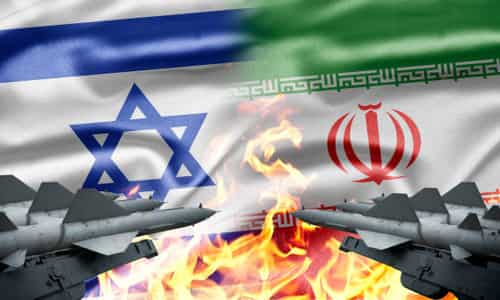
With the chaos of the coronavirus (COVID-19), will Iran take advantage of Israel's perceived weakened state to attack through proxies?
Iran may perceive Israel's military as being unable to call up masses of reserves or send large groups of civilians into close quarters in rocket shelters due to coronavirus restrictions. Will Iran attack?
This was one of the questions posed in a conference call hosted by the Jewish Institute of National Security for America (JINSA) on the security implications of the coronavirus for Iran and the Middle East. The call featured JINSA Fellow Yaakov Amdiror, Israel's former Israeli National Security Adviser, and also JINSA Fellow Itai Shapira, former deputy head of the Research and Analysis Division (RAD) in the Israel Defense Forces.
According to Amidror, the extent of the disease in Iran is not really known. "It is clear the Iranians are not telling the truth and are hiding the real situation," he said. "We know that the numbers are growing and are much greater than those announced by the authorities. As far as can be judged from the outside, without having the real information, everything is out of control."
He said Iran made a huge mistake in the beginning, allowing flights between Iran, China and Lebanon. "Iran is the center of spreading the virus around the Middle East because people are flying between Beirut and Tehran," he said.
On Tuesday, the spokesperson for the Iranian Health Ministry announced a total of 988 deaths as a result of COVID-19, with nearly 15,000 infected, according to reports. As of Friday, the number of infected had risen to 19,644.
In terms of stopping activities in the Middle East, Amidror said this is not going to happen. "Iran will try to continue with the pressure [against the United States], especially in Iraq, where it has Shi'ite militias."
"Iran will not stop," he stressed. "There are more questions than answers with regard to Iran. It is very complicated."
'A regional phenomena'
Shapira said we should think of the effect of the coronavirus as "a regional phenomena" and predicted the possibility of another wave of instability that could sweep the Middle East, not unlike the "Arab Spring" protests that began in 2010.
Regarding Iran specifically, he said, "this is now one of the biggest challenges Iran has faced since the 1979 Islamic Revolution. This could not have come at a worse time for Iran, after the maximum pressure policy placed on it by the U.S., after the sanctions, after the protests a few months ago, after the downing of a Ukrainian airliner, and now the low oil prices. This is a unique challenge for the regime."
Shapira said that the so-called "moderate" camp, including President Hassan Rouhani, in Iran is growing weaker as a result of the virus. "We see it in the streets. This is a president who is considered a failure. He is not succeeding in providing economic relief, not succeeding with the JCPOA, not lowering gas prices, and now failing with the coronavirus crisis," he said.
"The IRGC and military are becoming stronger and more dominant," he warned.
However, Shapira said he does believe that the absence of former IRGC commander Qassem Soleimani, assassinated in a U.S. drone strike in January, "dramatically reduces the capability of the IRGC and the Quds force."
"With the absence of Soleimani and his less charismatic and less connected successor [Esmail Ghaani], I wonder if this Iranian 'alliance' with the Shi'ite militias in Iraq and the militias in Syria, Hezbollah in Lebanon and Houthis in Yemen, is still as centralized and controlled by Iran as it was in the days of Soleimani," he posed.
Shapira said that with or without the virus, "the issue of a Western presence in the Middle East, specifically in Iraq, is something that bothers [Iranian Supreme Leader Ayatollah Ali] Khamenei, and the Iranian military and the IRGC, no less than the virus disturbs them at the moment."
Whether or not Iran will indeed make any moves against Western forces in the region, he said, "I am not sure they will now be less hesitant or more capable or more willing to act externally, but since they are at such a dramatic strategic crisis, they might consider some actions in the Gulf. They understand the U.S. administration is a red line. They might consider some actions such as cyber warfare or directing proxies, if they are under extreme distress."
With regard to Iran's proxies and the possibility of them opening a front against Israel, Amidror said, "for sure, Hezbollah will be very, very cautious. They know the situation in Lebanon," which is $90 billion in debt and just defaulted on a $1.2 billion bond.
"The crisis in Lebanon is only the beginning," said Amidror. "Everyone in Lebanon sees Hezbollah as responsible since they decide who is in the government and who has influence in the government. Hezbollah leader Nasrallah will be very cautious."
Amidror thinks that Iran will not "push themselves into another corner" when it has such huge internal problems. "The last thing Iran wants to see right now," he said, "is 400 Israeli airplanes above Tehran."
Originally published at JNS.org - reposted with permission.