Religious 'Nones' Are the Product of a 'Post-Christian, Religiously Confused Age
 By Sarah Holliday/Washington Stand March 05 ,2024
Share this article:
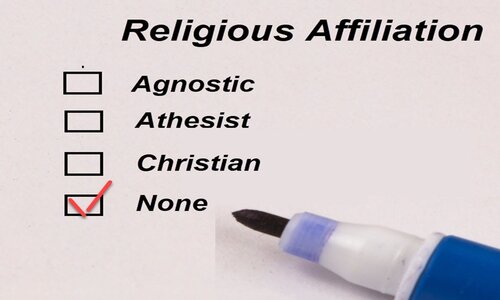
The Pew Research Center recently released data about the religious "nones" in America. The poll tried to uncover more about this enigmatic group and what it is they believe. According to the results, 28% of U.S. adults fall into the religious "none" or "religiously unaffiliated" category, with 17% calling themselves atheist, 20% agnostic, and 63% "nothing in particular."
When diving into the semantics of the people in this category, the poll showed that the majority of atheists and agnostics were more educated and civically engaged than those "who describe their religion as 'nothing in particular' and who tend to have lower levels of educational attainment than religiously affiliated U.S. adults."
Many of the participants claimed "they question a lot of religious teachings or don't believe in God." Additionally, 47% expressed criticism of organized religious institutions, including 30% who cited "bad experiences ... with religious people."
Neha Sahgal, vice president of the Pew Research Center, shared more about the results recently on "Washington Watch" with Family Research Council Senior Vice President and guest host Jody Hice. "Over the course of the last 15 years," she said, "We at the Pew Research Center have seen a dramatic rise in the share of Americans who describe themselves as either atheist, agnostic, or having no particular religion."
She explained that the most recent poll revealed a dip in those who don't identify with any religion, but that those statistics alone do not clarify whether this group is truly declining or stabilizing. "We're going to need data for future years to say that definitively," she added, but to consider the largest group who are religiously "nothing in particular" as not religious at all would be inaccurate.
"I think it would be incorrect, as per the data, to call the religious nones and non-believers as people who are against religion," Sahgal said. "We actually find that the majority of this group does say that they believe in God. Now, they may not necessarily believe in God as described in the Bible," but most say "they believe in some form of higher power."
So the question remains: What do the religious "nones" believe? And where are they getting their beliefs? David Closson, director of FRC's Center for Biblical Worldview, provided some answers on "Washington Watch."
As Closson emphasized, "Rejecting organized religion does not necessarily equate with a rejection of God." Ultimately, he continued, "I think this survey ... reinforced ... that we really live in a post-Christian, religiously confused age."
He further explained that of the 28% who do not affiliate with religion, only 3% attend church. "And yet," he noted, "56% of them said that they believe in a higher power. And even 13% of these people said that they believe in God as described in the Bible. And about half of them actually say that spirituality is important to them." Only 29% would prove to be opposed to a higher power or spiritual power. But as Closson emphasized, it appears several of those who are hesitant to religion "haven't given up belief in God entirely."
Hice added that, as believers, "We've got a spiritually fertile soil ... with these people, because they do have a spiritual foundation. They just don't know what to do with it." And the more secular the age becomes, the more controversial "basic doctrine" becomes, as well, Closson stated.
"There's a lot of people who have become disenchanted with organized religion [and] ... with the church," he pointed out. What it looks like to be religious only changes with each year, especially as the church is "infected with theological liberalism" that denies the resurrection, the Bible's authority, miracles, and the virgin birth. Instead, progressive ideology is adopted that then redefines doctrine. Ultimately, Closson said, "Hundreds of thousands, if not millions of Christians have gotten disillusioned with churches and religious leaders who are clearly abandoning the Bible."
But even these findings aren't hopeless, as Closson deemed them "a tremendous opportunity for the church to do what the mission of the church is: to spread the gospel" and "teach all that Jesus has commanded." He added, "People are dying ... for authenticity. They're dying for something distinct.
They're craving ... authentic community." Referring to Ephesians 4:15, he emphasized the need for believers to "speak the truth in love." Hice agreed and said it's "a ripe opportunity for the body of Christ to no longer be fearful, but to step out with the gospel and with love and grace and reach" those who need it.
Closson concluded, "We don't need to dress the gospel up. We don't need the light show, the rock bands. I think there's something unique about the Christian gospel. And if churches and Christians really push into their communities, I think they would find a lot of people that would be ready to hear the gospel and to respond to it."
Originally published at The Washington Stand