A Courtroom Battle That Could Redefine Religious Freedom in America
 By PNW Staff March 18, 2026
Share this article:
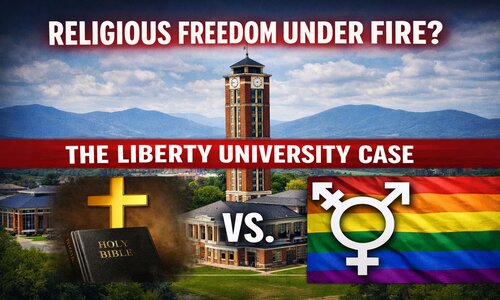
The outcome of a single case now unfolding in the U.S. Court of Appeals for the Fourth Circuit could reshape the legal and cultural landscape for Christian institutions across the nation. At the center stands Liberty University--one of the largest Christian universities in the world--facing a lawsuit that, while framed as an employment dispute, carries implications far beyond one campus or one employee.
This is not merely a disagreement over workplace policy; it is a defining test of whether religious organizations can still operate according to their deeply held beliefs in an increasingly hostile legal environment.
The case involves former Liberty employee Jonathan Zinski, who, after being hired for a technical role and signing a doctrinal statement affirming the university's biblical beliefs, later identified as transgender and was subsequently dismissed. Advocacy groups, including the American Civil Liberties Union, argue that his role did not fall under the "ministerial exception," a legal doctrine rooted in the First Amendment that allows religious institutions to make employment decisions based on faith commitments.
Liberty, supported by Liberty Counsel and its founder Mat Staver, contends that even non-pastoral roles contribute to the university's religious mission and therefore deserve constitutional protection.
At stake is the scope of the ministerial exception itself--a doctrine affirmed by the U.S. Supreme Court in cases like Hosanna-Tabor v. EEOC and Our Lady of Guadalupe School v. Morrissey-Berru. In those rulings, the Court recognized that religious institutions must retain autonomy in selecting individuals who embody and advance their faith mission. The question now before the Fourth Circuit is whether that protection extends beyond overtly religious roles into operational and support positions within faith-based institutions.
If the court sides against Liberty University, the consequences could be immediate and far-reaching. Christian colleges, churches, and ministries may find themselves legally compelled to employ individuals whose beliefs or conduct directly contradict their doctrines. The distinction between "ministerial" and "non-ministerial" roles could become so narrow that only clergy are protected, effectively stripping religious organizations of the ability to maintain a cohesive faith identity across their staff.
The financial ramifications alone could be devastating. A ruling against Liberty could open the floodgates to lawsuits targeting Christian institutions nationwide. Damages, legal fees, and compliance costs could force smaller ministries and schools into closure, while larger organizations might be pressured to abandon doctrinal hiring standards simply to survive. What begins as one case could quickly become a legal blueprint used to challenge faith-based employment policies across the country.
But beyond the courtroom and balance sheets lies a deeper cultural shift. This case reflects a growing tension between expanding interpretations of anti-discrimination law and the constitutional guarantee of religious liberty. While civil rights protections are essential in a pluralistic society, the question remains: can those protections coexist with the right of religious communities to define and preserve their beliefs?
Supporters of Liberty argue that this case is not about denying anyone dignity or opportunity, but about preserving the integrity of religious conviction. They point out that Zinski voluntarily agreed to the university's doctrinal standards upon hiring--standards that clearly articulate beliefs about gender and identity rooted in Scripture. To later reject those standards while demanding continued employment raises serious questions about contractual honesty and institutional rights.
Critics, however, frame the issue as one of fairness and equality in the workplace. They argue that allowing religious exemptions in non-religious roles creates a dangerous precedent where employees can be excluded based on identity rather than job performance. This tension--between equality and liberty--is precisely why the case carries such weight.
Yet, as Mat Staver and others have emphasized, religious freedom is not a secondary right to be balanced away when inconvenient. It is a foundational principle enshrined in the First Amendment, intended to protect minority beliefs from majority pressure. If religious institutions lose the ability to govern themselves according to their faith, the very concept of religious liberty becomes hollow.
The broader concern for the Christian community is clear: if Liberty University loses, no faith-based institution is truly safe. Today it may be a university; tomorrow it could be a church, a charity, or a small Christian school. The precedent set here could redefine what it means to operate as a religious organization in America--not as a community of shared belief, but as an entity subject to the shifting winds of cultural and legal trends.
This is why the case resonates so deeply. It is not simply about one employee or one policy, but about whether Christian institutions can remain distinctly Christian in both belief and practice. The decision will signal whether the courts still recognize the unique role of faith in public life--or whether that role must now be confined to private worship, stripped of its institutional expression.
As the judges deliberate, the stakes could not be higher. The future of religious liberty in America may well hinge on what happens next.