When the Cartoon Ends: Dilbert's Creator's Faces Death & Questions Of Eternity
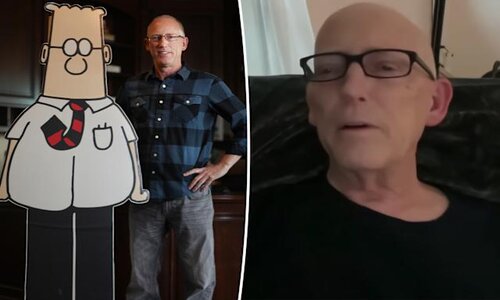 By PNW Staff January 06, 2026
Share this article:
When a man who built a career skewering corporate absurdity suddenly stares down mortality, the punchlines fall away. What remains are the questions that have haunted humanity since the beginning: What happens next? Did my life matter? And is there something -- or Someone -- beyond this?
Scott Adams, the creator of Dilbert, now paralyzed and battling terminal prostate cancer, has publicly said he plans to convert to Christianity. The announcement, shared candidly with millions, was not wrapped in church language or theological precision. Instead, it came in the voice of a rational skeptic facing the end of his life -- thoughtful, respectful, and deeply human.
Adams has long described himself as agnostic, skeptical of certainty itself. But in recent weeks, as his prognosis has turned grim, something has shifted. Conversations with Christian friends, reflections on death, and what he describes as a "risk-reward" calculation have nudged him toward faith. "You're never too late," he said, acknowledging both time running out and hope still lingering.
At the heart of Adams' reasoning is a modern echo of Pascal's Wager -- the idea that when certainty is impossible, belief is the most rational choice. If God exists, the reward is infinite. If He does not, little is lost. For a man whose mind has long wrestled with simulation theory and the nature of reality, Adams sees Christianity as the only worldview that definitively answers the question after death. "Any skepticism I have about reality would be instantly answered if I wake up in heaven," he said plainly.
For many watching, especially those living with chronic illness or facing their own mortality, Adams' honesty is striking. He is not posturing. He is not pretending certainty. He is standing at the edge of life and admitting what so many feel but rarely say out loud: I don't know -- but I hope.
And yet, as soon as Adams expressed that hope, the noise began.
Online reactions ranged from encouragement and prayer to theological correction and criticism. Christian thinkers were quick to point out what Adams still misunderstands -- namely, that Christianity is not about living a "good life" to earn heaven, nor is salvation a wager hedging cosmic bets. Frank Turek reminded readers that salvation is a gift of grace, not an achievement. Megan Basham gently but firmly emphasized that the Gospel is not about insurance against hell, but about surrender to Christ.
Their critiques are theologically sound. Adams does, indeed, have more to learn about grace. Christianity is not a transaction; it is a transformation. It is not "I win if I'm right," but "I am saved because I am not."
But here is the tension worth sitting with: Adams is at the beginning of a journey, not the end. And beginnings are often clumsy.
Scripture itself gives us room for this. The thief on the cross did not have time to master doctrine. He did not parse atonement theories. He simply turned, in desperation and trust, and said, "Remember me." Jesus did not correct his theology. He offered him paradise.
What nearly derailed Adams, by his own admission, was not doubt -- but debate. After the flood of well-meaning messages insisting there is "one right way" to convert, Adams confessed that the arguing almost talked him out of it altogether. That confession should sober the Church.
There is a danger -- especially online -- of overcomplicating salvation until it feels inaccessible, guarded by gatekeepers of correct language and perfect understanding. But conversion is not a group project. It is not crowdsourced. It is, at its core, a private reckoning between a soul and its Creator.
Adams understood this instinctively when he finally said, "What happens next is between me and Jesus."
That may be the most theologically accurate statement he has made yet.
For those watching this unfold while facing illness, aging, or the quiet fear of death, Adams' story carries a gentle invitation. You do not need to have every answer. You do not need the right words. You do not need to pass a test. Grace meets people where they are -- hospital beds, wheelchairs, doubt and all.
Faith is not about winning an argument before you die. It is about discovering, sometimes at the very end, that you were never meant to save yourself in the first place.
And in a world loud with opinions, that truth is still best heard in the quiet space between God and the individual -- where grace speaks softly, but unmistakably.