
This Is What Modern War Looks Like - When Men Surrender To Machines
 By PNW Staff January 29, 2026
Share this article:
War has always been a deeply human endeavor. Fear, courage, exhaustion, survival. For thousands of years, battles were decided by who could march farther, fight harder, and endure longer. But a chilling new moment from the war in Ukraine suggests that era may be ending.
In recently released footage, Russian soldiers are seen doing something unprecedented: they surrender not to enemy troops, but to a machine.
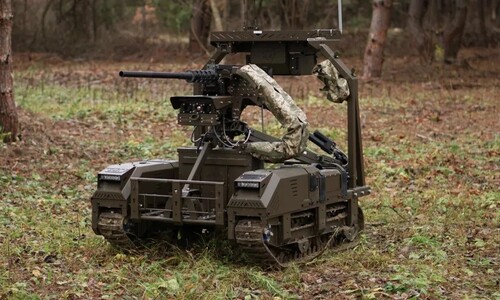
The scene unfolds quietly. A tracked ground combat robot rolls forward through the snow, its mounted machine gun aimed steadily ahead. No shouting. No visible Ukrainian soldiers. Just the mechanical advance of a weapon controlled from afar. One by one, Russian troops emerge from hiding, raise their hands, and drop to the ground. Above them, an aerial drone watches, documenting the surrender from the sky.
No Ukrainian lives are put at risk. No shots are fired. The battlefield decision is made by circuits, cameras, and remote commands.
This is not science fiction. This is modern war.
From Soldiers to Systems
The ground robot involved -- a Ukrainian-made reconnaissance and strike platform armed with a remotely operated machine gun -- represents a rapidly growing class of weapons systems that blur the line between human command and machine execution. While the robot itself is remotely controlled rather than fully autonomous, its presence alone was enough to compel surrender.
That distinction matters. These machines don't need to feel fear, fatigue, or hesitation. They don't panic under fire. They don't break ranks or lose morale. They advance relentlessly, following commands with mechanical precision -- and human beings on the other side know it.
In this encounter, psychological warfare did as much work as firepower. The soldiers weren't facing another human who might hesitate or negotiate. They were facing a machine that would simply keep moving forward.
The Drone-Dominated Battlefield
Ukraine has become the proving ground for a new style of warfare where drones and robotic systems dominate nearly every layer of combat.
Small aerial drones now scout enemy positions, direct artillery, drop explosives, and even guide surrendering troops. Larger drones conduct long-range strikes once reserved for missiles and aircraft. On the ground, unmanned vehicles clear trenches, deliver supplies, evacuate wounded soldiers, and increasingly, engage the enemy directly.
What makes this shift so profound isn't just the technology -- it's the scale. These systems are cheaper, faster to produce, and easier to deploy than traditional military hardware. Losses that would once have been devastating are now expected, absorbed, and replaced within days.
War has become iterative. Algorithms learn. Operators adapt. Machines return to the field with updated software, better sensors, and improved targeting.
Distance Without Detachment
One of the most unsettling aspects of this transformation is how it changes the relationship between killing and risk.
The operator of the ground robot that accepted the Russian surrender may have been miles away, sitting behind screens rather than crouched behind cover. The decision-making remains human, but the danger does not.
Supporters argue this saves lives -- and they're right. Fewer soldiers are exposed to direct fire. Fewer families receive knock-on-the-door visits. Machines take the risks humans once had to.
But critics warn that distance can dull restraint. When combat feels more like operating equipment than surviving a firefight, the moral weight of decisions can shift. The battlefield becomes cleaner for one side, infinitely more terrifying for the other.
The Ethics We're Racing Past
The surrender-to-robot moment forces an uncomfortable question: What happens when machines don't just fight, but decide?
Today, humans still authorize lethal action. But the trajectory is clear. Systems already track targets, predict movement, and prioritize threats faster than any human can. The temptation to give machines greater autonomy -- to speed decision-making, reduce latency, and outmatch the enemy -- is enormous.
Once that threshold is crossed, warfare changes in ways we may not fully control. Accountability becomes murky. Errors scale rapidly. And the idea of a human conscience acting as a final brake begins to erode.
A Glimpse of the Future
The image of soldiers surrendering to a robot will likely be studied for decades. Not because it was dramatic -- but because it was quiet.
No chaos. No gunfire. Just men recognizing that the old rules no longer applied.
Modern war is no longer only about who has the bigger army or the stronger will. It's about who controls the smarter machines, the better data, the faster feedback loops. Victory increasingly belongs to those who can remove humans from harm -- while placing machines directly in its path.
The battlefield hasn't become less human. It has become less forgiving.
And as robots roll forward and drones watch from above, one thing is now unmistakably clear:
War has entered an age where surrendering to a machine is not only possible -- it may soon be common.
Watch footage of the event here: