'Pick Your Baby': The Quiet Arrival Of Consumer Eugenics
 By PNW Staff January 29, 2026
Share this article:
"Pick your baby."
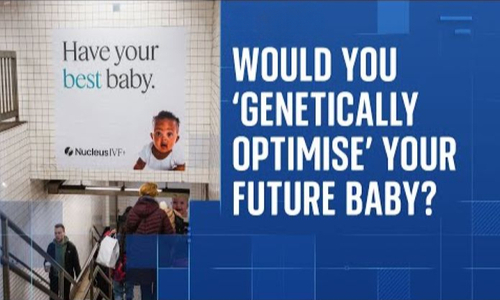
Until recently, those words belonged to toy aisles and video games. Now they appear on subway walls in New York City--one of the most influential cultural marketplaces in the world--inviting would-be parents to do something humanity has never formally normalized: shop for their child's genetic traits.
The company behind the campaign, Nucleus IVF+, presents itself as simply offering information. But the glossy marketing and cheerful language obscure a far more troubling reality. What is being sold is not knowledge--it is power over human life, exercised at its most fragile stage.
Through its IVF platform, Nucleus allows parents to compare up to 20 embryos using probability models that estimate future height, intelligence, disease risk, and physical traits like eye and hair color. The company emphasizes that these are probabilities, not guarantees. Yet the underlying logic is unmistakable: some embryos are preferable, others are not.
And in IVF, the "not chosen" are almost always destroyed.
This is not speculative. It is standard practice.
What distinguishes Nucleus from traditional IVF screening is not just the breadth of data but the shift in moral framing. This is no longer about avoiding fatal childhood diseases. It is about optimization--fine-tuning human beings the way one might configure a device. Two extra inches of height. A few points of IQ. Slightly lower risk of anxiety. A marginally better chance at elite universities.
That is not healthcare. That is consumer eugenics, repackaged for a data-driven age.
The company's founder, Kian Sadeghi, has defended the practice by appealing to parental love. Parents want their children to thrive, he argues. They already push kids toward better schools, better nutrition, better opportunities. Genetic selection, in this view, is simply the next step.
But there is a profound moral difference between nurturing a child and selecting one child to live while others are discarded based on predicted traits.
Historically, eugenics has never announced itself as cruelty. It has always arrived cloaked in compassion, progress, and improvement. In the early 20th century, it was framed as public health. In Nazi Germany, it was framed as national renewal. Today, it arrives through apps, probabilities, and lifestyle branding--"Have your best baby."
The New York subway campaign matters because it signals normalization. Subways are not niche markets. They are where ideas go to become ordinary. When commuters see slogans like "IQ is 50% genetic" or "Have a healthier baby," the implicit message is clear: not optimizing is irresponsible.
This is where the future becomes especially dangerous.
Once genetic selection moves from rare medical necessity to cultural expectation, parental choice quietly becomes parental obligation. Why didn't you screen? Why didn't you select? Why did you allow imperfection?
Experts in genetics have already raised alarms--not only about ethics, but about science itself. Complex traits like intelligence, behavior, and mental health are influenced by thousands of genes and environmental factors. Predicting them accurately from embryos is far more uncertain than marketing suggests. Even small errors could result in devastating consequences, including the destruction of embryos based on flawed assumptions.
Yet history shows that societies rarely wait for perfect science before enforcing social pressure.
If such technologies expand beyond IVF--if prenatal screening becomes more granular, more predictive--eugenic abortion could increase dramatically. We already see this with Down syndrome, where termination rates approach near-totality in some countries. What happens when risk markers for depression, addiction, obesity, or learning differences are added to the list?
What happens to children who are born "unoptimized"?
Aldous Huxley in his famous book, A Brave New World, warned of a world divided not by wealth alone, but by biological class--those designed for advantage and those left to chance. That future no longer belongs to fiction. When companies openly predict that "four out of ten parents" will use genetic optimization to improve college outcomes, the class divide is no longer hypothetical.
It becomes structural.
The deeper danger is cultural. Children risk becoming products, their worth subtly measured against genetic forecasts rather than intrinsic human dignity. Love becomes conditional, even if unconsciously so. Failure becomes a design flaw.
This is not empowerment. It is commodification.
A society that cannot tolerate imperfection will eventually turn on the imperfect. And a society that teaches parents to rank embryos will eventually teach citizens to rank people.
The posters in New York may look sleek and futuristic. But beneath the branding lies an old idea with a dark past: that some lives are more worth living than others.
Once that idea takes root, history shows it never stays contained.
A Brave New World is no longer approaching.
It's already being advertised--one subway stop at a time.