
Stockpiling For Showdown: Why China’s Oil Buying Spree Has Analysts Worried
 By PNW Staff February 19, 2026
Share this article:
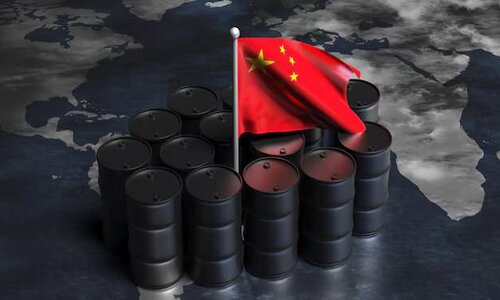
There are moments when numbers stop being statistics and start becoming warnings. The latest figures on oil accumulation by China may be one of those moments. On paper, Beijing's massive crude stockpiling spree looks like smart economics -- buying low while prices remain relatively soft. But in the language of geopolitics, stockpiles of fuel have always meant something more. They mean preparation. They mean insulation. And sometimes, they mean anticipation of conflict.
Over the past two years, China has quietly added hundreds of millions of barrels of crude to its reserves, building inventories equivalent to roughly three months of imports. Analysts told the U.S.-China Economic and Security Review Commission that large-scale energy stockpiling has historically functioned as a "strategic warning indicator." That phrase should not be brushed aside. Nations do not spend billions warehousing fuel simply because it is convenient. They do so because they believe they may someday need to operate without access to global markets.
To understand why this matters, consider China's vulnerability. The country imports more than 70% of its crude, much of it traveling along sea lanes effectively secured by the United States and its allies. In a hypothetical crisis over Taiwan, those routes could be restricted or blockaded. Oil, therefore, is not merely a commodity for Beijing -- it is a strategic lifeline. If that lifeline were cut, its military, manufacturing base, transportation grid, and chemical industries would all feel the shock simultaneously.
History shows this pattern clearly. Governments preparing for major conflict have always stockpiled critical resources. Before and during the early twentieth century, the United Kingdom treated oil reserves as a matter of national survival, especially once the Royal Navy shifted from coal to petroleum. Strategic fuel access became synonymous with military readiness. The same lesson was reinforced repeatedly throughout modern industrial warfare: armies march on logistics, not ideology.
China's defenders argue that what Beijing is doing is normal. Indeed, many advanced economies maintain emergency petroleum reserves coordinated through the International Energy Agency. Those stockpiles exist precisely to cushion supply shocks, natural disasters, or geopolitical disruptions. Even so, the scale, secrecy, and persistence of China's buildup set it apart. Most countries publish detailed reserve data. China treats its numbers as a state secret. That opacity is what transforms routine preparedness into a source of global suspicion.
The sheer size of recent accumulation raises eyebrows. Analysts estimate China added the equivalent of more than a million barrels per day to storage during 2025 alone, on top of similar increases the previous year. This was not passive growth tied to consumption needs. In fact, domestic fuel demand has been slowing due to electric vehicles and alternative fuels. Instead, imports continued to exceed refinery processing, leaving tens of millions of tonnes unaccounted for -- oil that appears to have gone straight into storage tanks.
That buying spree has already reshaped global markets. By absorbing surplus supply, China has helped prevent a deeper collapse in prices even as producers like Saudi Arabia and partners in OPEC increased output. In effect, Beijing has become an unofficial buffer for the world oil market. But this stabilizing role comes with a catch: if China ever stops buying -- or worse, starts releasing reserves strategically -- prices could swing violently in the opposite direction.
Supporters of Beijing's policy insist the explanation is simple risk management. From their perspective, a nation dependent on imported fuel would be irresponsible not to prepare for worst-case scenarios. They point out that three months of reserves is roughly consistent with historical benchmarks used by other import-dependent economies. In that sense, China may merely be catching up to standards long adopted elsewhere.
Yet context matters. Stockpiling alone is not proof of hostile intent. But stockpiling combined with military expansion, assertive regional policy, and increasingly confrontational rhetoric does send a signal. Strategic analysts do not evaluate indicators in isolation; they look for patterns. And the pattern emerging from Beijing is one of long-term resilience planning -- the kind a state undertakes when it expects to operate under sanctions, embargoes, or wartime disruption.
There is also a psychological dimension. Energy security can make leaders more cautious because they feel protected from external pressure. But it can also make them more confident in taking risks. If policymakers believe their economy can withstand isolation for months, they may be less deterred by threats of economic retaliation. In that sense, oil reserves can function not only as shields but as enablers.
The greatest concern is not that China is storing oil. It is that the world cannot clearly see how much it is storing, how fast it is adding to reserves, or under what conditions it would use them. Transparency builds trust; secrecy breeds suspicion. Right now, Beijing's energy policy is opaque enough that outside observers are left guessing. In geopolitics, guessing is dangerous. Misinterpretation has started wars before.
None of this means conflict is inevitable. Nations prepare for crises that never come all the time. But it does mean policymakers, investors, and citizens alike should pay attention. Oil has always been more than fuel. It is leverage, insurance, and sometimes a silent declaration of intent.
When a global power quietly amasses strategic energy stockpiles at record speed, the question is not whether it has a reason. The question is what reason it anticipates. And that is a question the world cannot afford to ignore.