
Trans Lawmaker Suggests Adult Sites Are Necessary For LGTB Education
 By PNW Staff February 23, 2026
Share this article:
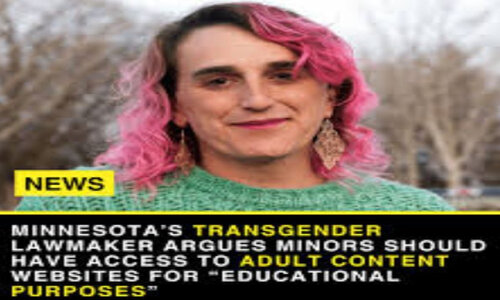
Something deeply unsettling is happening in America's moral conversation, and it surfaced starkly during a recent legislative debate in Minnesota. During a discussion of a bill that would require age verification for explicit websites, Minnesota State Rep. Leigh Finke, an outspoken transgender activist, opposed the restrictions, arguing that pornography could be "educational" for LGBTQ youth.
The proposal under consideration in Minnesota--HF 1434--was intended to restrict minors' access to adult content online. Yet instead of focusing solely on privacy concerns surrounding verification technology, the discussion shifted into something far more troubling: the suggestion that explicit material might serve as a learning tool for children.
Christians should pause here--not in outrage first, but in sober discernment. Because moments like this are not isolated controversies. They are signposts revealing where a culture's moral logic is drifting.
Legitimate Concerns Do Exist -- But They Don't Justify This
There are real debates worth having about age-verification laws. Civil liberties advocates worry about data breaches, surveillance overreach, and the risk of sensitive personal information being stored or hacked. Those concerns deserve thoughtful attention and careful safeguards. Protecting children should never come at the cost of recklessly exposing citizens' private identities.
But acknowledging those concerns is very different from arguing that minors should have access to pornography. Privacy risks may be a policy problem. Pornography for children is a moral and developmental crisis. Conflating the two is like opposing driver's licenses because you think teenagers should be allowed to drive without rules.
The Five Deep Harms Porn Inflicts on Young Minds
Modern neuroscience, psychology, and pastoral counseling all converge on one point: pornography is not harmless--especially for children.
1. Neurological Rewiring of the Developing Brain
Children's brains are still forming neural pathways that shape impulse control, emotional regulation, and reward processing. Porn floods the brain with dopamine surges far beyond normal stimuli. Over time, this can recondition a child's reward system so that artificial sexual imagery becomes the primary trigger for pleasure. The result is not curiosity satisfied--but neurological conditioning that can alter desire patterns for years.
2. Addiction Before Maturity Exists
Adults struggle to resist compulsive digital habits. Now imagine introducing an intensely stimulating, sexually charged feedback loop to a brain that has not yet developed self-control. Many counselors report that individuals exposed to pornography early often describe addiction patterns before they even understand what addiction is. Habit forms long before wisdom does.
3. Dehumanized View of Relationships
Pornography does not teach love. It teaches consumption. It frames intimacy as performance, bodies as products, and people as instruments of pleasure. For a child learning what relationships mean, this distorts the very concept of human dignity. Instead of seeing others as souls worthy of honor, they may learn to see them as objects for gratification.
4. Premature Emotional and Sexual Burden
Childhood is meant to be a season of formation--mentally, emotionally, and spiritually. Explicit material drags adult experiences into a stage of life where a child has no framework to process them. This can create confusion, anxiety, shame, or false expectations about identity and relationships before a child even understands themselves.
5. Behavioral and Psychological Fallout
Research increasingly links early exposure to explicit content with higher rates of risky behavior, relational instability, and emotional distress later in life. What begins as digital exposure often shapes real-world decisions. Seeds planted in secrecy can bear consequences in public.
The Spiritual Reality Beneath the Cultural Debate
For Christians, the concern goes deeper than sociology or neuroscience. Scripture teaches that what we consume inwardly shapes who we become outwardly. The eyes and mind are not passive windows; they are gateways to the heart.
Pornography is not merely explicit imagery--it is a counterfeit vision of intimacy that divorces desire from covenant, pleasure from responsibility, and bodies from souls. It teaches a theology of the human person that contradicts the biblical one. In Scripture, the body is a temple. In pornographic culture, the body is a tool.
The prophet Isaiah warned of a time when societies would blur moral categories--when darkness would be called light and light darkness. That warning was not poetic exaggeration. It was prophetic realism. Cultures rarely collapse overnight; they erode when their definitions of good slowly shift.
If children are told that explicit material is education, the danger is not only moral confusion. It is spiritual formation in the wrong direction. Because whatever disciples a child's imagination will eventually disciple their life.
A Warning About Those We Put In Authority
Elections are not just about policies--they are about worldviews. Sooner or later, what a leader truly believes about morality, truth, human nature, and the value of innocence will surface in the laws they defend and the causes they champion. Legislation is never neutral; it is the fruit of conviction. And when those convictions are misaligned with truth, the consequences rarely stay confined to politics--they shape culture, families, and the next generation.
That is why discernment matters long before ballots are cast. A society that stops paying attention to the beliefs of those it empowers will eventually be governed by those beliefs. If we care about the future of our children, we must care deeply about the character, judgment, and moral compass of the people we entrust with authority--because what they believe in private will one day be written into public life.





