The Sound Of Power: Islam's Rising Influence Echoes Across New York
 By PNW Staff February 24, 2026
Share this article:
A new sound is rising over New York City--and it is not just a sound. It is a signal.
When Eric Adams stood beside the NYPD in 2023 and announced that mosques could broadcast the Islamic call to prayer without permits during designated times, the decision was framed as a simple accommodation of religious freedom. Supporters compared it to church bells. Critics warned it was something different. Nearly three years later, that distinction is becoming harder to ignore, and what once sounded symbolic now feels structural.
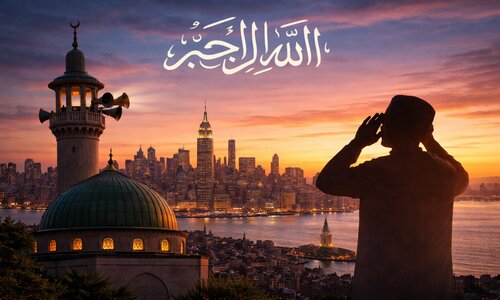
The adhan is not merely music or a neutral chime. It is a spoken theological declaration affirming that Allah is the one true god and that Muhammad is his messenger. In private, that proclamation is protected worship. But when amplified into public streets, shared neighborhoods, and dense apartment blocks, it becomes something more than devotion--it becomes presence. And in politics, presence is power.
Recent viral videos circulating online appear to show early-morning calls echoing through Brooklyn before sunrise. Officials have not confirmed whether those broadcasts violated existing limits, but the uncertainty itself is telling. Laws on paper matter less than enforcement in practice. When rules quietly stretch without clarification, it often signals a cultural shift underway before institutions formally acknowledge it.
That shift is not occurring in isolation. The election of Zohran Mamdani, celebrated by advocacy groups as a milestone for Muslim political visibility, reflects a broader transformation in the city's civic landscape. Mamdani's supporters see representation; critics see consolidation. Both may be right. Demographic growth, political organization, and public religious expression together form a powerful triad. History shows that when those forces align, they rarely remain symbolic for long.
Demographics help explain why this shift feels so rapid. Islam's visibility in the city is not emerging from symbolism alone--it is being reinforced by population trends. Immigration from Muslim-majority regions has steadily increased the Muslim population over the past two decades, and those communities tend to be younger on average and to have higher birth rates than the citywide norm.
Even naming data hints at the trajectory: variants of the name Muhammad have quietly climbed into the ranks of the most popular baby names in parts of the city in recent years. Names do not change a culture by themselves, but they do reveal what is growing beneath the surface. When population growth, family formation, and cultural continuity all move in the same direction, influence is no longer temporary--it becomes generational.
The visual transformation of public space may be even more striking than the audible one. In recent years, hundreds of worshippers have gathered in Times Square during Ramadan, kneeling in coordinated prayer beneath the neon skyline. Organizers distributed thousands of meals and Qurans as tourists filmed what looked less like a religious gathering and more like a demonstration of collective strength. Two reported conversions during one event were celebrated as victories. To participants, it was faith in action. To observers, it resembled a public display of influence.
None of this is illegal. None of it violates constitutional protections. That is precisely why it matters.
American history shows that cultural change rarely arrives through force; it arrives through normalization. Practices first introduced as limited accommodations gradually become expectations, and expectations eventually become standards. Cities such as Dearborn and Minneapolis have already wrestled with similar debates over public calls to prayer and noise ordinances. New York, as the nation's most visible metropolis, carries symbolic weight far beyond its borders. What becomes ordinary there often becomes acceptable elsewhere.
Supporters argue this is pluralism working exactly as intended. They insist that if America truly believes in religious liberty, it must welcome expressions that feel unfamiliar. That argument carries moral force. Yet pluralism also depends on balance. When any single tradition grows highly visible in shared civic space--audibly, visually, and politically--questions naturally arise about whether accommodation is quietly becoming preference.
Context matters. The rising public visibility of Islam in New York coincides with heightened tensions surrounding the Middle East and increased demonstrations over Israel. Some rallies have featured rhetoric sympathetic to groups such as Hamas, which the United States designates as a terrorist organization. When religious symbolism, street activism, and geopolitical passions overlap, the result is not just cultural expression. It is ideological signaling.
None of this means Muslim New Yorkers should be denied their rights. They are entitled to worship, organize, and participate in public life like any other citizens. But it does mean the broader public is justified in asking where the line lies between freedom of religion and transformation of the public square. A society confident in its values should be able to ask that question openly, without fear of being dismissed as intolerant.
Because what is happening in New York is not just about Islam. It is about momentum.
Cities change. Demographics shift. Sounds evolve. But when change accelerates simultaneously in politics, culture, and public space, wise societies pause to examine direction as well as speed. The call echoing through parts of the city is not merely summoning the faithful to prayer. It is announcing that influence is growing, confidence is rising, and a new chapter in the city's story is being written--one broadcast at a time.
The real issue is not whether that chapter should exist. It is whether anyone is still willing to ask how it ends.